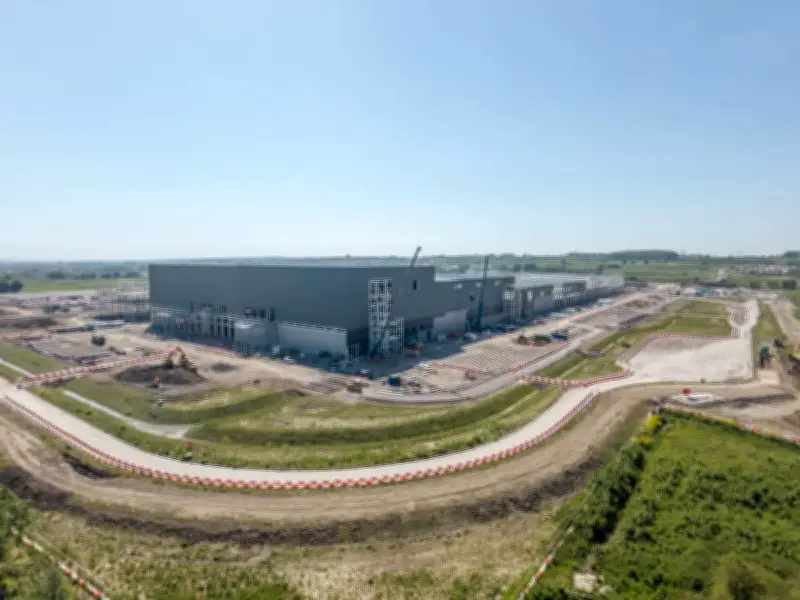
Battery manufacturer Agratas has publicly confirmed that the Huntspill River will not be used to cool its new £4bn 'gigafactory' under construction at the Gravity enterprise zone in Somerset, either during the building phase or once the facility becomes operational. The announcement comes amid concerns over local water resources following recent dry weather and a hosepipe ban introduced by Wessex Water.
Water supply arrangements for Building One
Work is well advanced on 'Building One' within the Gravity site, located between Puriton and Woolavington, with the new facility expected to be operational by the end of 2027. The Huntspill River, which runs north of the site, was originally built in 1940 to supply water to the Royal Ordnance Factory that previously occupied the area and now serves as one of the region's principal flood defences.
Agratas has secured a peak water supply rate of up to 14.5 litres per second from Wessex Water for both construction and operation of Building One. According to a company spokesperson, annual water consumption is expected to range between approximately 190,000 and 450,000 cubic metres, depending on production levels. The spokesperson stated: "We have secured a peak water supply rate of up to 14.5 litres per second [from Wessex Water] for the construction and operation of Building One – the first phase of our overall project."
River's role and environmental context
The Huntspill River is supplied by two sections of the River Brue catchment: the South Drain, flowing west of Glastonbury through the Avalon Marshes, and the Cripps River, which carries water south of the main river channel near East Huntspill. Water from both channels passes through the Gold Corner pumping station, travels north of the Gravity site, beneath the M5 north of junction 23, under the A38 near West Huntspill, before discharging into the River Parrett and ultimately joining the Bristol Channel.
The river has been earmarked for potential enhancements by the Somerset Rivers Authority (SRA), which indicated in June that water levels within it could be reduced ahead of forecast flood events, enabling greater volumes to drain off the Levels and Moors more rapidly.
Design changes to reduce water consumption
Agratas has made significant design amendments to Building One to minimise water demand and ensure no disruption to local residents and businesses. The spokesperson added: "We recognise our responsibility to the local community and have worked closely with utility providers and stakeholders to ensure the facility's water requirements can be met without adversely affecting local residents."
The facility has been designed to maximise water efficiency, incorporating water storage tanks, water recycling systems and closed-loop cooling technology. Design changes, including process improvements and the removal of steam boilers, have reduced expected water consumption by around 19 per cent compared with the original design. The spokesperson confirmed: "We have no plans to extract water from the Huntspill River, either during the construction or operation of Building One."
Wessex Water has confirmed it has sufficient capacity within its existing network to meet the forecast demand associated with the development. The company is currently in the early stages of planning for a second Cheddar reservoir, working alongside Bristol Water, Bournemouth Water and South West Water — collectively known as West Country Water and Environment (WCWE). Agratas stated it remains committed to responsible water stewardship and will continue to work with regulatory bodies throughout construction and operation.