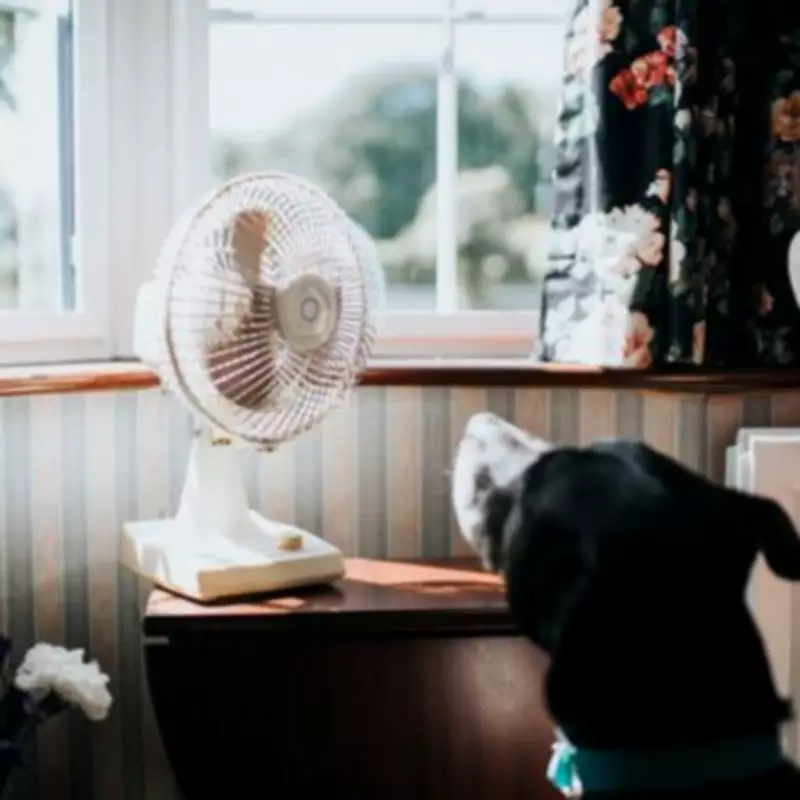
With the UK currently sweltering under a heatwave, we are all on the lookout for ways to keep cool. Now a power and cooling engineer has revealed the correct way to use a fan for faster and more efficient room cooling.
Given that most UK properties are designed to retain heat and lack air conditioning, a fan is frequently the preferred solution for many, particularly with the aim of getting some relief when trying to get a decent night's sleep in the uncomfortable warmth.
Social media has become the primary source for those seeking advice or clever strategies to beat the heat at home. A TikTok video from a woman sharing something her partner – who happens to be a power and cooling engineer – told her has generated considerable interest.

The six-second clip shows a fan positioned in front of an open window, with text overlaid which reads: "When he says if we point the fan out the open window, it will cool the room down quicker and he's right." Alongside the popular video, which has accumulated more than 166,000 likes, the woman added the light-hearted caption: "That's on living with a power and cooling engineer."
The post drew hundreds of comments from fellow TikTok users. One person explained: "Bernoulli's principle - fast moving air sucks in even more surrounding air. So pointing it out the window (at a distance) will draw a lot of the air in the room out the window with it." Another user quipped: "Why am I learning more on TikTok than I learned in school?" Another user recounted their own experience: "We only have AC in the living room, that's what we do to redirect the cold into the bedrooms. I thought my boyfriend was crazy too when he said it but it works."
Les Roberts, an energy expert at Bionic, provided further professional advice. "Opening opposite windows or doors allows air to flow through," he said. "For even better airflow, you can place a second fan facing inward at the opposite opening to pull cooler outside air into the room, creating a strong cross-breeze. Positioning the fan to face outward pushes the hot indoor air outside, which helps draw cooler air in from the other opening."
Roberts went on to say: "This method works best when it's cooler outside than inside - usually in the evening, overnight, or early morning - as the temperature difference creates a natural flow of air. The temperature gradient enhances the movement of air, allowing the fan to more effectively push hot air out and pull cooler air in, resulting in a more comfortable indoor environment."
"This approach is energy-efficient and can significantly cool your living space without air conditioning by exchanging hot indoor air for cooler outdoor air through natural ventilation enhanced by fans. It's a simple trick that could make a noticeable difference, especially at night, when outdoor temperatures drop."
Turning to the topic of air conditioning, Roberts continued: "On average, portable air-conditioning units cost around £8.40 to run per day, whereas a fan could cost you as little as 71 pence. By utilising a fan to its full advantage with this hack and forfeiting air con, households could save nearly £55 a week."