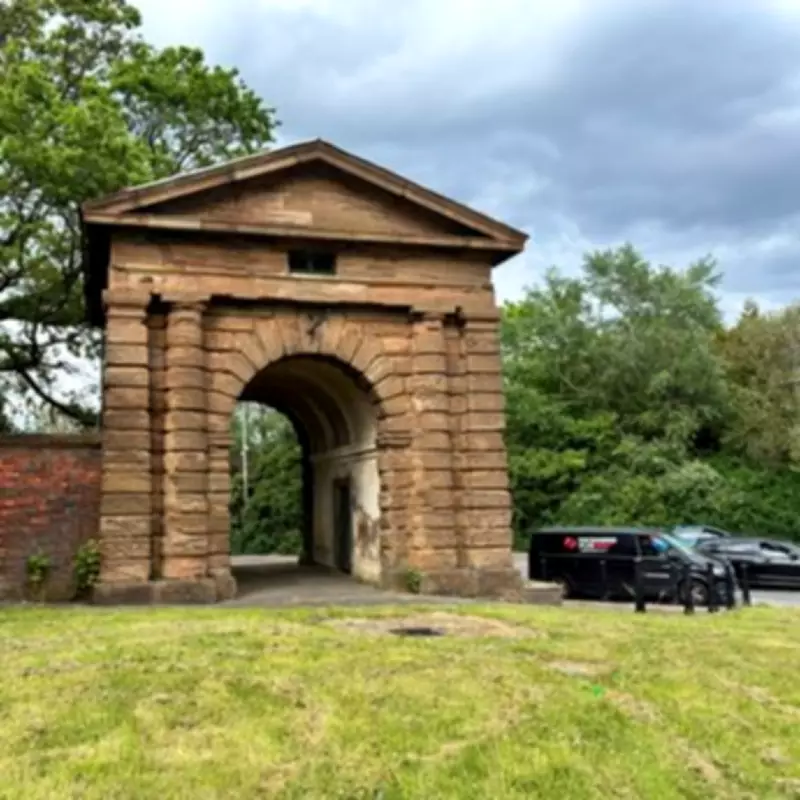
Tens of thousands of drivers pass Sandwell Hall Gatehouse every day, making it a true West Midlands landmark. Yet few have seen its interior, not least because reaching it is perilous. I managed to make my way there, as shown in the video above.
The Last Remnant of a Grand Estate
Located dramatically on the central island of the busy M5 motorway junction at West Bromwich, the gatehouse is all that remains of the once-grand Sandwell Hall estate. Surrounded by fast-moving traffic, the isolated structure creates a striking contrast between England's industrial modernity and its aristocratic past. It is one of the most intriguing historic landmarks in the Black Country.
The gatehouse originally formed part of Sandwell Hall, a large country house built in the eighteenth century for the Earls of Dartmouth. The estate occupied extensive grounds across what is now Sandwell Valley. Sandwell Hall itself was demolished in the 1920s after falling into decline, but the gatehouse survived due to its location and historical significance.
A Grade II Listed Structure
Sandwell Hall Gatehouse, often referred to as Sandwell Hall Lodge, is a Grade II listed structure and the only surviving remnant of the demolished 18th-century hall. When the M5 motorway was constructed during the 1960s, engineers designed the junction around the building rather than destroying it, leaving the structure stranded in the centre of a major traffic interchange.
Architecturally, the gatehouse reflects Georgian design, with elegant brickwork, arched openings, and decorative detailing that hint at the grandeur of the lost hall beyond. Although inaccessible to the public due to surrounding motorway lanes, it remains clearly visible to thousands of motorists every day. Many travellers are surprised to discover that the mysterious building in the middle of the roundabout is not a folly or modern ornament, but a genuine surviving fragment of local history.
An Unusual Regional Landmark
Today, Sandwell Hall Gatehouse has become an unusual regional landmark and a symbol of how historic buildings can survive alongside large-scale infrastructure projects. Its lonely presence amid roaring traffic serves as a reminder of the changing landscape of the West Midlands, where traces of rural estates and industrial expansion exist side by side.