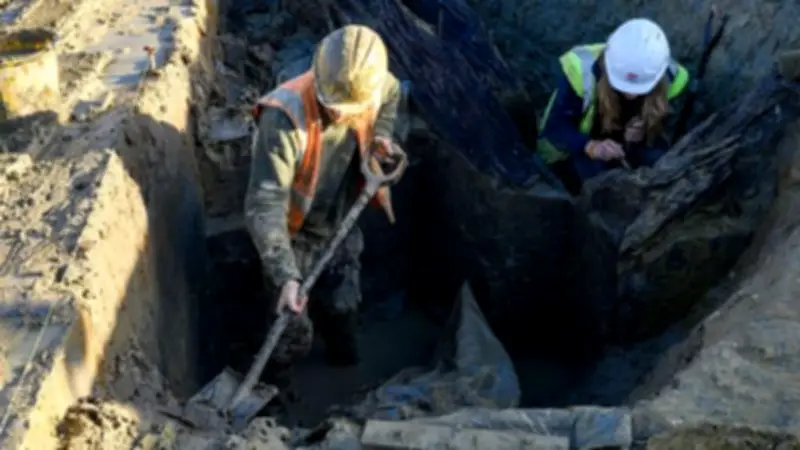
Archaeologists have discovered evidence that the site of a Taylor Wimpey housing development in West Cambourne was once home to an Iron Age settlement. Excavations carried out at Taylor Wimpey’s Burghley Green and Chivers Rise in West Cambourne uncovered signs that a 24-metre circular enclosure, likely used by Iron Age communities to manage livestock, once existed on the site.
Key Discoveries
According to the Cambridge Archaeological Unit, which conducted the dig on behalf of Taylor Wimpey earlier this year, the findings also revealed evidence of everyday activities, with pottery, animal bones, and burnt stones indicating the area was used for cooking. One of the most significant discoveries was a prehistoric 3-metre log ladder found at the bottom of a deep well shaft. The well was located inside a large watering hole measuring 25 metres long by 14 metres wide that preserved the wood through waterlogging. It is believed to be one of the longest log ladders discovered in the UK.
Other findings suggest the presence of early Roman activity, with a small section of the excavations uncovering more than 780 pieces of pottery from this time period.
Expert Insights
The team from the Cambridge Archaeological Unit investigated a five-hectare area at West Cambourne, uncovering more than 150 archaeological features dating back approximately 2,000 years to the Iron Age and early Roman communities. Dr Matthew Brudenell, director at the Cambridge Archaeological Unit, said: “Iron Age and Roman communities were the first to permanently settle the Cambourne landscape. The excavations are helping us to piece together the ways they used the land for agriculture and settlement. Watering holes would have been an important feature for sustaining livestock, and the well-preserved example we’ve uncovered has incredible potential to tell us more about how the land was managed. The Romans constructed an intricate network of fields for growing crops around the landscape, suggesting they were able to exploit the heavy but fertile clays of the Cambourne area in new and productive ways.”
Developer's Perspective
Tom Wheeler, land director for Taylor Wimpey East Anglia, said: “When constructing new homes, it’s really important to try to establish what was there before. Often, this can be easy to see, but sometimes we need to work with an expert team of archaeologists to dig a little deeper. It’s been fascinating to learn what the team has uncovered in West Cambourne. While the Iron Age and Roman communities had long since disappeared from sight, this discovery means it can be recorded in history as an early example of settlement in West Cambourne.”
For further information and to register your interest in the new homes at West Cambourne, please visit the website here.