A late Roman burial will go on display next week at the Roman Circus Visitor Centre in Colchester. The exhibition will centre on a high-status Roman woman, who will be displayed in the decorated lead coffin she was buried in. A group of grave goods buried with her will also be featured.
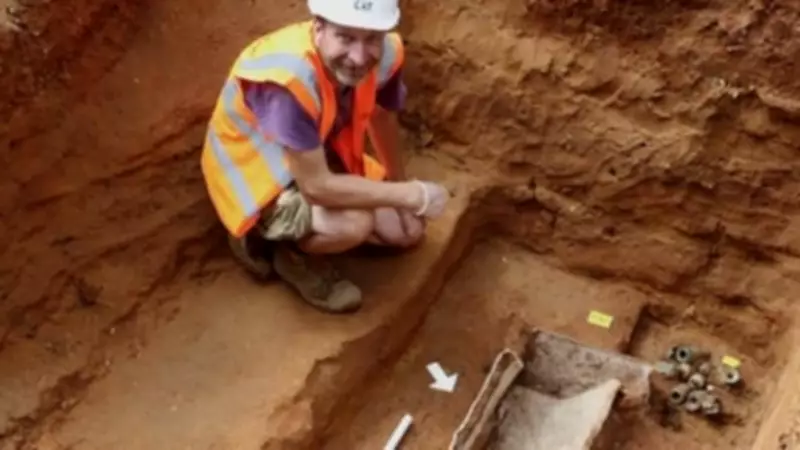
The burial was excavated by Colchester Archaeological Trust during archaeological work at the former Essex County Hospital site. The excavation formed part of the redevelopment of the area by Essex Housing, Essex County Council’s development team, which made the investigation and recovery possible.
Scientific Analysis Reveals Rare Substances
Scientific analysis following the excavation has revealed rare and valuable substances associated with her burial. The objects placed with her provide a vivid glimpse into life, death and funerary ritual in late Roman Colchester.
Grave Goods and Elite Fashion
The woman, believed to have been in her 20s or 30s, was buried with a collection of objects including jet hairpins, a group of rare glass flasks, and other grave goods that point to a carefully staged and richly furnished burial. Residue analysis has identified frankincense and gypsum in the coffin, as well as exotic resins in one of the glass vessels, suggesting the use of imported substances in the treatment of the body after death.
Preliminary scientific work also suggests that the woman may have grown up locally, offering a rare and personal connection to the people of Roman Colchester during the later Roman period.
Exhibition Details
The temporary exhibition opens at the Roman Circus Visitor Centre on Saturday, May 16, 2026 and will run for one year. Visitors will be able to see the coffin, the remains of the woman, and the associated finds, along with information about what archaeology and modern scientific analysis can reveal about her life and burial. The exhibition is supported by Fisher Jones Greenwood, exclusive corporate partner for the exhibition.
An Essex Housing spokesperson said: “We are delighted that this remarkable discovery, made during archaeological work at the former Essex County Hospital site, will now be shared with the public. It is wonderful to see an important part of Colchester’s past being preserved, studied and presented in this way.”
Adam Wightman, director of archaeology at Colchester Archaeological Trust, said: “This is one of the most fascinating Roman burials we have worked on in Colchester in recent years. The decorated coffin is a beautiful object in its own right, but it is the combination of the coffin, the grave goods and the scientific evidence that makes this burial so compelling. Together they allow us to glimpse not just a person, but the care, ritual and belief that surrounded her burial in late Roman Colchester.”
Robert Masefield, archaeology director at Tetra Tech Consulting Limited, said: “Over decades of working with Colchester Archaeological Trust on excavations of the Roman burial grounds around the Roman town, this is certainly the most spectacular I have seen, in terms of signifying the trappings of wealth and symbolism in death, of a fully Romanised citizen. The young woman, who probably lived and died in Colchester, was clearly cherished by her family and by her community. Essex Housing, in facilitating the excavation and CAT’s painstaking work to respectfully excavate, conserve, promote a full suite of scientific analyses and now to bring the find to public attention, is highly appropriate.”
The next chapter of the site’s history will see 120 homes built across the site in total. Over the next month, homes built as part of phase one will be available to purchase ahead of summer 2026. There will be 63 new one, two and three bed apartments available. For more information about the burial and exhibition, visit the exhibition page on the Colchester Archaeological Trust website.