
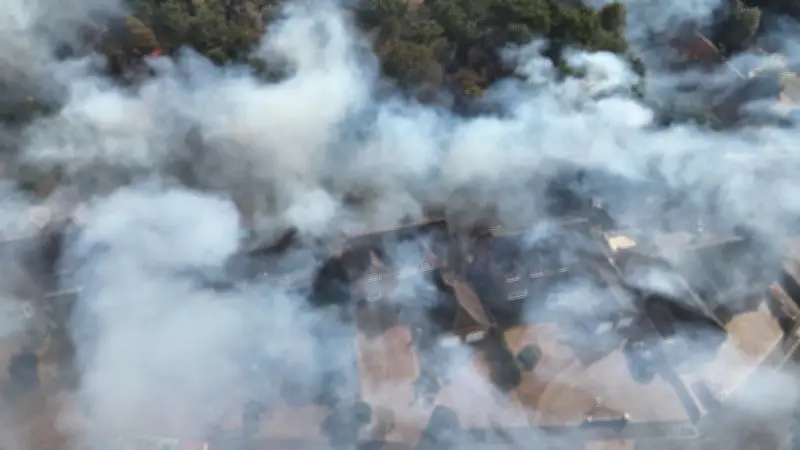
A wildfire that swept through Stourbridge this week has destroyed 19 homes and damaged more than a dozen others, drawing comparisons to "Armageddon" and an "apocalypse" from residents and officials. The fire, which started at Stourbridge Golf Course, prompted a large-scale emergency response and has ignited a national conversation about the role of climate change in increasing wildfire risk.
Fire Response and Immediate Impact
At 1.30pm on Thursday, 60 officers from the West Midlands Fire Service attended the large grass fire. Within two hours, six nearby properties and 40 acres of land were under threat. By 7.30pm, at least seven roads surrounding the golf course had been closed. Three firefighters and a child were hospitalised, while six more people were treated for smoke inhalation. Hundreds of residents were evacuated, with 19 homes completely destroyed. The Town Hall was converted into a rest centre for those displaced.
A resident told the Guardian it was among the "scariest days of my life." The scenes were described as worse than the 2022 Lickey Hills wildfire, which led to 15 evacuations. Similar blazes have broken out in South Birmingham, North Birmingham, Worcestershire, Staffordshire, and Warwickshire. On Wednesday, a fire in Castle Vale left a woman with serious injuries after a row of bungalows caught fire.
Climate Change and Wildfire Risk
The exact cause of the Stourbridge fire remains unconfirmed, but experts point to climate change as a key factor. Dr Theodore Keeping, who analyses extreme weather and wildfires at Imperial College London, said: "We know that heatwaves are getting more likely and more intense over the region." He likened the atmosphere to a sponge that grows in warm temperatures, drawing up moisture from the Earth's surface, leaving grass and vegetation extremely dry. "When those conditions occur, the fire risk spikes very strongly, and that is exactly why we are seeing a fire risk that we have historically very, very rarely seen in this region because we just weren't hitting those heat extremes," he added.
However, not everyone agrees. An unnamed Conservative councillor told a resident "we shouldn't bring politics into it" when they linked the fire to climate change, according to the Guardian. The Mail also reported that the 1,017 wildfires across the UK this year could be linked to "eco-dogma," quoting countryside groups like the Countryside Alliance and the Country Land and Business Association who argue that rewilding has caused a build-up of dry vegetation.
Local Reactions and Political Response
Residents in Stourbridge were caught off guard. Louise Farrington, a local, said she was "more worried about the animals" after watching videos of horses being rescued. Four good samaritans from the Sugarloaf Equestrian Centre led eight horses to safety. Kevan Roseby, another resident, said he first became aware of the fire when he smelt smoke, thinking "somebody was having a barbeque."
Local MP Cat Eccles said some evacuated residents didn't understand why they needed to leave, and "some needed to be dragged away by armed police." Prime Minister Andy Burnham visited Stourbridge on Friday, telling Sky News: "I've never seen anything like it. I mean, I've dealt with wildfires in Greater Manchester but nothing on this scale. I've never seen a scene like this in Britain where you just see a whole house gutted, smouldering." He promised support and urged the public not to use disposable barbecues or fireworks during heatwaves.
Adaptation and Future Preparedness
Dr Keeping emphasised the need for long-term adaptation, taking cues from southern Europe where vegetation is cut back from houses and fire bricks are used to prevent spread. He also highlighted the need for better resources to fight wildfires: "If what you have is a fire truck with some tools and a hose, you can't actually do very much against a large wildfire because the water will just evaporate in the air as you spray." He called for bulldozers and diggers to clear vegetation ahead of fires.
West Midlands Fire Service's skill and the efforts of local farmers and neighbours saved lives, but the scale of destruction is extraordinary. As the region faces hotter, longer summers, the question of how to prepare for future wildfires remains pressing.