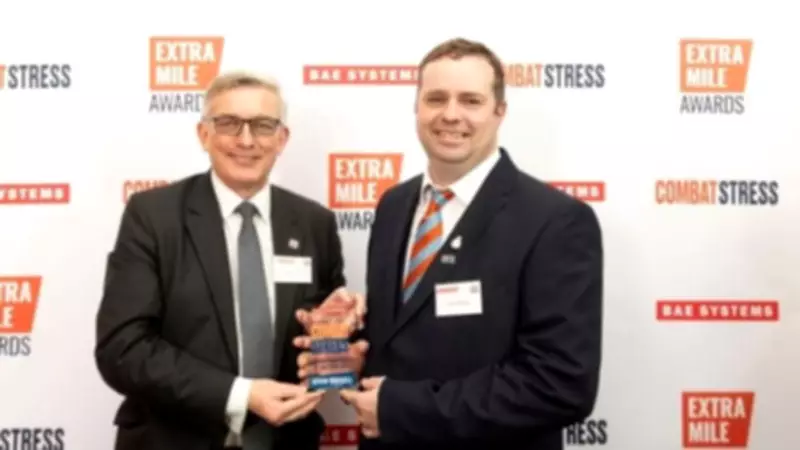
Former Army Medic Honoured for PTSD Awareness Campaign
A former Army medic has been recognised with a prestigious national award from the veterans' mental health charity Combat Stress for his unwavering commitment to raising awareness about post-traumatic stress disorder (PTSD). Kevin Russell, who currently serves as a mental health act manager for the Essex Partnership University NHS Foundation Trust (EPUT), sought assistance from the charity after years of personal struggle.
From Seeking Help to Helping Others
Combat Stress provides specialist treatment and support to former service personnel across the United Kingdom who are dealing with military-related trauma. After undergoing treatment himself, Kevin made the courageous decision to share his story publicly, aiming to encourage other veterans facing similar mental health challenges to reach out for help. His efforts were formally acknowledged last month at the annual Combat Stress Extra Mile awards ceremony, where he was presented with the Veteran Storyteller of the Year award by former First Sea Lord, Admiral Sir Philip Jones.
Kevin expressed profound gratitude, stating: "Combat Stress saved my life. I wouldn't be here without the charity, and the same can be said for countless others. How do you thank someone who saved your life? All I can do is put my efforts into raising as much awareness as possible in the hope of helping to reach others in need. I am honoured to win this award. It's a powerful reminder to me of how much I have helped to achieve since completing my own journey to recovery."
A Challenging Military Career
Kevin joined the Royal Army Medical Corps as a combat medic at the age of 21. His service included tours in Oman, Iraq, Bosnia, and Afghanistan. It was during his deployment in Afghanistan that he experienced particularly traumatic events, including responding to an incident involving two suicide bombers in Kabul. The attack resulted in multiple casualties, including children, and occurred during changeover time at a school near a busy junction.
He recalled: "Just the sheer volume of casualties, the number of civilians involved… the fact that we had dealt with one and then we had a second explosion. It was the worst day." Shortly after, he was called to another explosion scene. The cumulative devastation he witnessed over those few days led him to hand in his notice after completing the tour in 2006.
Professional Life and Personal Struggles
Since leaving the military, Kevin has worked for EPUT and its predecessor trusts. In his current role, he and his team support the Trust in meeting the statutory legal requirements of the Mental Health Act and provide advice to families of patients detained for treatment under the Act. While he finds great reward in seeing people recover, he kept his own mental health struggles hidden for years, despite his medical training and the concerns of family, friends, and colleagues.
For 17 years, Kevin suppressed the emotions and flashbacks from his military service. He described how ordinary situations, like a walk in a country park, could trigger his Army training, making him hypervigilant and mentally transporting him back to conflict zones. Living in Basildon, he explained: "I used to be a medic in the Army - I thought I could look after myself. I thought there were people worse off than me, as there were people who had had injuries and lost limbs. I never appreciated how bad it was until the day I broke down."
The Path to Recovery and Advocacy
In 2022, Kevin decided to seek help and contacted Combat Stress, specifically wanting to speak with someone who understood military life. His initial assessment revealed he was at high risk of suicide. He then joined a comprehensive treatment programme, where he learned about PTSD and worked with a psychologist to piece together his traumatic experiences, helping to manage his triggers.
Kevin likened the process to solving a complex puzzle: "My memories are very disjointed. It's like having a 5,000-piece jigsaw puzzle that's been thrown on the table, and you're trying to put it together. I could see more of what went on and what was triggering me. There were a lot more traumatic events I had bottled up."
Over two years, he worked with an occupational therapist to develop coping skills and participated in group therapy sessions and peer group meetings with other veterans with PTSD. This journey also motivated him to seek an official PTSD diagnosis from EPUT's mental health services, as he stated: "I wanted to get an official diagnosis because then I couldn't deny it."
Transforming Lives Through Storytelling
Kevin's life has transformed significantly since he first reached out to Combat Stress. As a married father of two, he has become a vocal advocate, emphasising: "The big thing for me is I want to make sure people know there is support available for them." His story was featured in a hard-hitting film about how PTSD affected his life, which has reached the finals of this year's Smiley Charity Film Awards.
Robert Marsh, director of fundraising at Combat Stress, praised Kevin's contributions: "We are so grateful to Kevin, whose bravery and honesty have no doubt inspired veterans to come forward for help, as well as shine a spotlight on the life-changing difference our specialist treatment makes. Kevin's support has been invaluable to the veteran community, and we are delighted to present him with our Veteran Storyteller of the Year award."