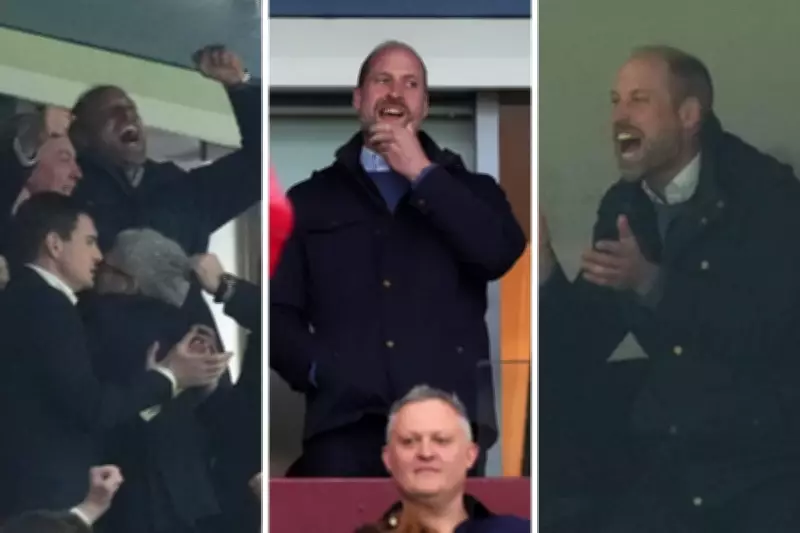
Why Prince William celebrating at Aston Villa brings the Royal Family closer to us. By Roshan Doug, Published 9th May 2026, 06:00 BST.
Prince William's joy at Villa's Europa semi-final win and King Charles' triumphant visit to the US are both examples of the Royal Family getting it right, says Roshan Doug.
It is not every day that a British monarch lands in the United States and sits down with a man who is both the former and current president. Yet when King Charles III met Mr Trump the moment felt at once improbable and entirely fitting. Whatever one's politics, the image was striking: centuries-old tradition stepping into the modern glare, carrying with it ceremony, symbolism, and no small degree of calculation.
Because the British monarchy has always understood something essential – not just the importance of power, but the importance of being seen. Abroad, that visibility often translates into fascination, even admiration. At home, it tends to provoke something closer to scepticism, or at least a raised eyebrow over the morning tea.
I write this not as a distant observer, but as someone who has brushed up against that world in an unexpected way. Some years ago, I was commissioned to write a poem for Queen Elizabeth II on her 75th birthday. It remains one of those experiences that feels faintly unreal. What struck me most, however, was not the honour itself, but the breadth of her reach. Messages of goodwill came not just from Britain, but from across the globe. That sense of connection was not abstract in my own life. My elderly mother, for instance, was a devoted monarchist during the reign of Queen Elizabeth II – her admiration reflecting a generation for whom the Crown symbolised continuity and reassurance.
Perhaps my own curiosity about the monarchy began much earlier. I have been interested in British kings and queens since primary school, when I first visited the Tower of London and saw the Crown Jewels. There was something captivating about the weight of history gathered in one place – objects that were not just ornamental, but symbolic of centuries of continuity and change.
That international affection has endured, even as the monarchy has navigated a far more complicated era. The shadow of the late Princess Diana still stretches across continents. Her life – and her death – reshaped how the institution is seen: less remote, more human, but also more exposed.
Since then, there have been other moments that might have done lasting damage to a less resilient institution. The controversies surrounding Prince Andrew have travelled well beyond Britain's borders. The ongoing saga of Harry and Meghan has played out as a kind of transatlantic drama – part royal narrative, part celebrity culture. And yet, these episodes have not erased the monarchy's appeal abroad. If anything, they have complicated it. The monarchy is no longer sustained by pageantry alone; it is sustained by story. And royal stories – especially those that blend history with human frailty – travel well.
I will admit, there are moments when the monarchy infuriates. It can seem out of step, overly insulated, or simply tone-deaf to the times. And then – just as one is ready to dismiss it – it does something disarming. Consider Prince William, an ardent supporter of Aston Villa. There is something unexpectedly grounding about a future king who suffers and celebrates like any other fan on a Saturday afternoon or a memorable European night that took Villa to a major final. It brings the institution a little closer to earth.
That duality is the monarchy's quiet strength. It exists in two realms at once. On the one hand, it offers spectacle: ceremony, continuity, the theatre of history unfolding in real time. On the other, it presents something recognisably human: a family navigating expectation, error, and change – often awkwardly, sometimes compellingly.
King Charles' visit to America fits neatly into that pattern. It is diplomacy, certainly. But it is also performance – soft power in its most refined form. A monarch shaking hands with global figures carries a symbolic weight few elected leaders can replicate. It signals continuity in an age defined by disruption.
At home, we see the untidy details: the cost, the controversy, the contradictions. Abroad, however, the picture often looks different. What people see is a living thread connecting past and present – a sense of identity that has endured, however imperfectly, through upheaval.
For my part, having once contributed a few lines to that long story – shaped by early fascination and by my mother's enduring admiration – I find it difficult to dismiss entirely. Not out of uncritical admiration, but out of recognition. The monarchy's relevance does not rest on perfection, nor even on consistency. It rests on something far less tidy and far more durable.
And as King Charles and Queen Camilla return to the UK, we are reminded that the monarchy endures not only because it adapts – just enough – but because, every so often, it still knows how to surprise.