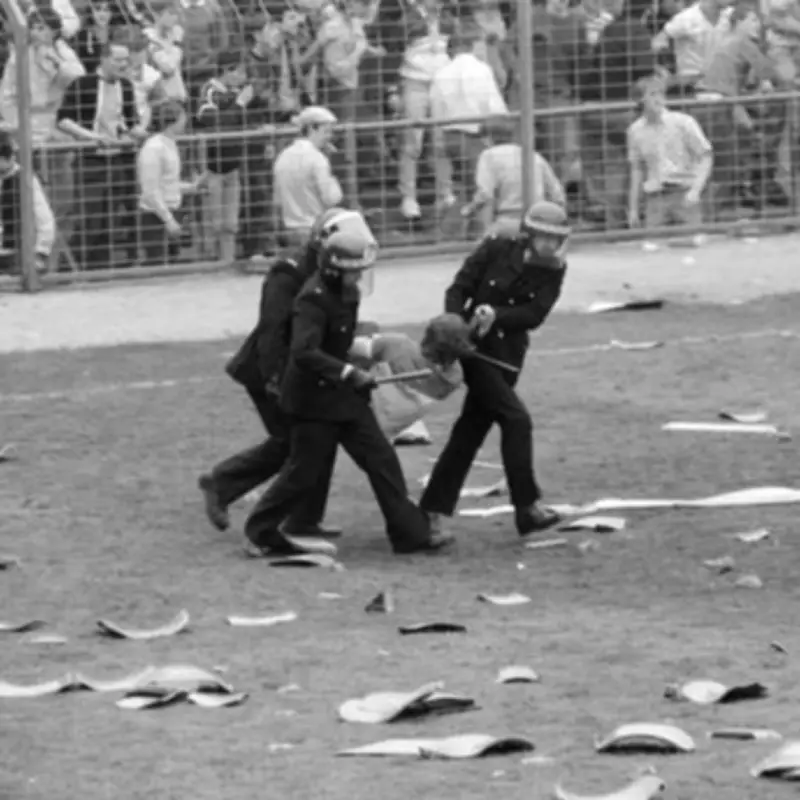
They are the dishonourable despatches from one all-conquering football firm to another. Once the dust had settled and blood dried, these are the tributes bestowed on Birmingham City’s notorious Zulu Warriors by Portsmouth’s 6.57 Crew.
For those who took part, memories of the many clashes that ignited before and after the April 13, 1985, fixture still linger sweetly. The game itself has long been forgotten – even the hat-trick by David Geddis that earned promotion-chasing Blues a 3-1 victory.
A Day of Unprecedented Violence
“Bit of a naughty day, one of the best mobs to have come to Pompey,” one Portsmouth terrace veteran posted on a hooliganism forum. It was extremely naughty. It was a tribal collision of very different villain values, a feud between the non-political right and left. The Zulus ranks were multi-cultural, while the 6.57 Crew – named after the time of the morning train from Portsmouth to Waterloo – growled extreme right wing things.

In 1987, the Derby Telegraph reported a Crew mob had fought with “local black youths” for four hours. Some gave Nazi salutes from stands “for a laugh”. On April 13, 1985, Portsmouth was a powder keg of violent disorder waiting for the inevitable spark that would plunge the South Coast city into mayhem. Zulus fought them at the station, on the streets, yet, despite the coastal setting, not on the beaches.
One Pompey diehard doffed his cap to those outnumbered Zulu invaders: “What a memorable day that was for everyone concerned! Brum came down in two different mobs, both of whom were rampant, and genuinely looking for it. They somehow managed to lose the Plod at the station and just started walking off the beaten track. There was action from 11am till 7pm in different parts of the city, nowhere near the ground. No-one except Millwall and Chelsea came to ours showing the same intent that Brum showed that day. They were pure class.”
The Peak of Zulu Power
This was 1985, domestic football’s blackest year – a turbulent time when too many “supporters” considered pints, pies and punch-ups pure class. This was the peak of the Zulus’ powers – a spring, autumn and winter studded with their most savage set-tos.
“Best mob to ever turn up in Pompey,” another veteran acknowledged. The glowing, misguided references go on and on: “Brilliant mob, one of the best, if not the best mob I've seen in Pompey to be honest.” “I remember a few of us in Commercial Road after the game, just sitting there! When a load of Zulus came walking past knowing they had got a result and, to be fair, didn’t take liberties with us. Respect to them.” “We took a good return mob to Birmingham, which from memory was a Tuesday night game, looking for it. Pompey got in Brum seats and made ourselves known.” “Respect. Probably the only firm that gave us a good go at Pompey back then, for sure.”
One former Zulu told me: “Blues were top four or five in the country, one of the top firms for a long time. They had some decent lads, some hangers-on as well, but a lot of game lads. A lot of good boxers were in with us.” He added: “I remember the match against Portsmouth at St Andrew’s – they were sitting in our seats and we sorted them.”
The Year of Chaos: 1985
1985. The year when Zulu howls prompted traders to pull down shutters, shoppers to scurry for safety. It was the year of flung bricks and blood running into drains, of shattered windows. Towns and cities were left scarred by the Zulus’ raids. It was their signature year of appalling warfare, a time when they committed Britain’s most brutal acts of hooliganism which, at its lowest point, cost the life of a schoolboy during the orgy of violence that was Blues’ game with Leeds.
Then Chief Constable Geoffrey Dear described scenes as “possibly the worst crowd disorders ever seen at a football ground in this country”. Mr Justice Popplewell, in a report on safety at sports grounds, described what unfolded as “more like the Battle of Agincourt than a football match.”

The fuse had already been lit long before that eruption. Blues’ first game of the season, a trip to Oldham, spelt trouble. A Lancashire paper reported: "Stones were thrown at police and rival supporters as around 300 Blues fans forced their way in to the ground through one of the main gates. Three policemen, one a chief inspector, were injured in the stone-throwing barrage which followed." A home fixture against Blackburn resulted in Rovers' supporters being attacked at New Street Station and two British Transport Police officers injured.
There had been running street battles with Tottenham’s Yid Army, even though the football teams, in separate divisions, never met during the season. Wolves’ Subway Army provided the opportunity for a derby day “bundle”. The Birmingham marauders rampaged at Manchester City.
The Leeds United Tragedy
Then came that horrific, well publicised, final match of the season against Leeds on May 11, 1985: it took place during the height of hooliganism, it eclipsed anything that had been seen before. In all, 545 people were treated for injuries – 145 of them police officers, 120 arrests were made before, during and after the match and trouble spilled into the city centre. Cars were smashed, seats inside the ground torn up and bottles hurled at police officers. Tragically, 15-year-old Ian Hambridge, from Nottingham, was crushed when a wall at St Andrew’s collapsed under the weight of warring mobs.
Back then, Blues’ firm, from its drinking den the Happy Trooper pub in Chelmsley Wood, ruled the roost. Fronted by gaffer Keith “Cuddles” Batchelor, the Zulu dawn broke in 1982 and just three years later members were casting a long shadow across Birmingham. Former West Midlands police chief Mike Layton, then a detective sergeant, later admitted: “The Zulu Warriors ruled the place. They ruled the football ground, they ruled New Street Station, and they ruled Birmingham city centre. Unofficially of course.”
Reflections from a Former Leader
In a rare interview, Keith Batchelor, now a reformed character, said the firm’s strength came from its multi-cultural camaraderie. “We were all proper Blues fans,” the 64-year-old stressed. “I think a lot of it was down to Birmingham at the time, in the football grounds there was racism. The new generation, the Windrush lads, we were coming of age. A lot of the white kids were growing up with the black kids and thinking, ‘maybe our dads were a bit racist’. I was 21 – 21 now is a real young age, but then you were a man. I was grown up and clued up. In 1982, I was one of the oldest of all of them, they looked up to me. It was the lads going out, going to the football. The other thing just come with it.”
The other thing came with it very frequently 41 years ago. It was the year of Live Aid, of the Miners Strike, of Margaret Thatcher at the peak of her powers. And 1985 will also be remembered as the Zulus at their very worst. The year Birmingham was gripped by a Zulu uprising.