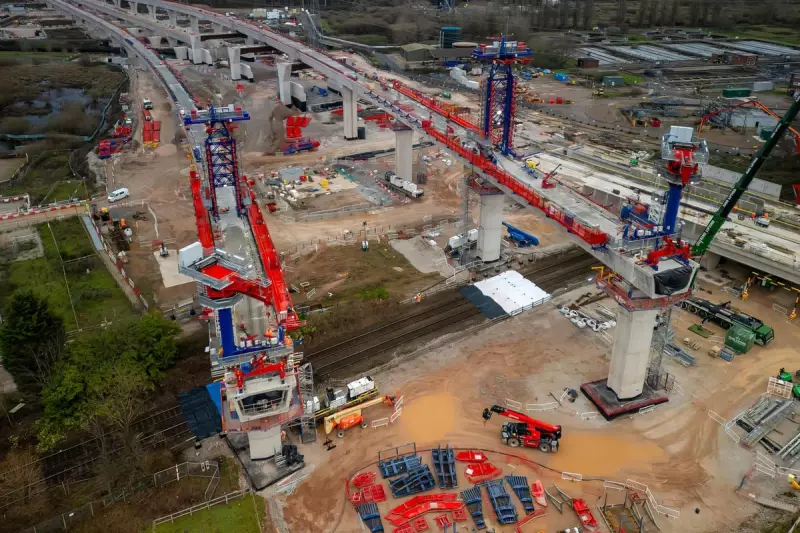
Engineers working on Britain's new high-speed railway have successfully navigated one of the project's most complex construction challenges, completing major work on a crucial Midlands viaduct during the Christmas break.
Precision Engineering During Holiday Shutdown
The significant operation took place near Water Orton in Warwickshire, where teams capitalised on a five-day closure of the existing railway network. This planned shutdown allowed engineers to safely lift and position two massive concrete viaduct spans directly over the live tracks. The work was carried out from late December into early January, with the milestone announced on 5th January 2026.
Coordinating heavy lifting equipment and precision surveying, crews worked around the clock to install the structures within the tight holiday window. This strategic timing was chosen specifically to minimise disruption on one of the region's busiest rail corridors, avoiding impact on passenger services.
A Critical Junction for the High-Speed Network
The newly installed spans form a vital part of the Water Orton viaducts, located at the northern end of HS2’s Delta junction. Once fully complete, these viaducts will serve a pivotal function in the new transport ecosystem.
Their primary role will be to enable southbound HS2 trains travelling on the mainline to diverge onto the spur that leads directly into Birmingham Curzon Street station. Additionally, the viaducts will provide essential access to the project's rolling stock maintenance depot at Washwood Heath.
Stepping Closer to Operational Reality
This successful installation represents a substantial step forward in delivering the core infrastructure required for high-speed services into Birmingham. A key principle of the HS2 project has been to maintain the safe and efficient operation of the existing railway network throughout the construction phase, a goal demonstrably met by this carefully orchestrated operation.
The completion of this complex stage brings the ambitious rail project closer to its goal of transforming connectivity across the Midlands and the North, while showcasing the intricate planning needed to integrate new infrastructure into a crowded landscape.