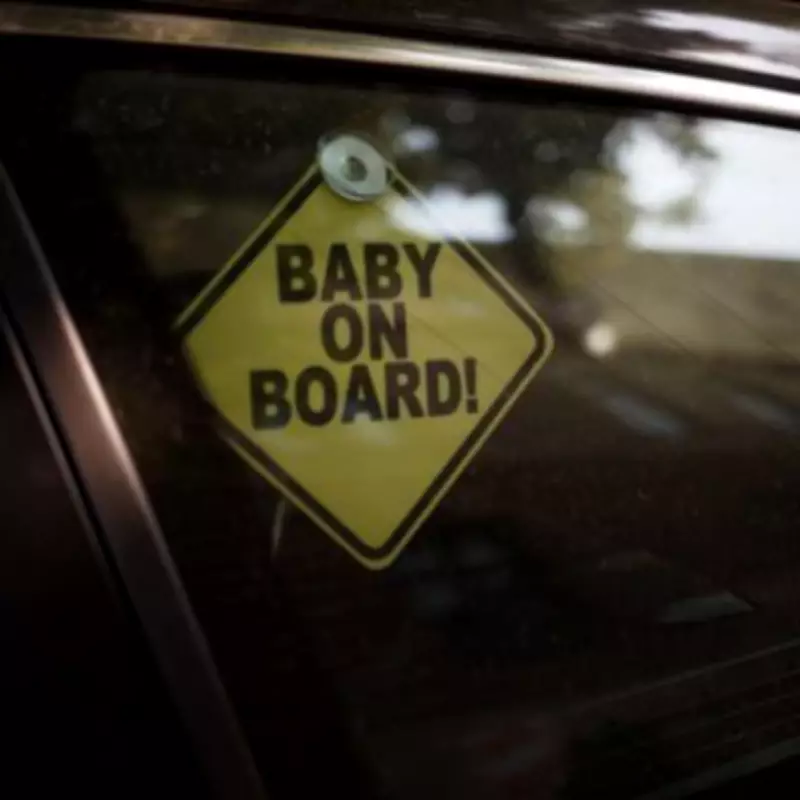
A heated social media discussion has revealed significant confusion among UK motorists regarding the true purpose of those familiar "Baby on Board" signs and stickers commonly displayed in car windows. The debate has exposed sharply divided opinions about whether these signs serve as warnings to other drivers or as crucial information for emergency services during accidents.
Conflicting Interpretations Emerge Online
The conversation gained momentum when user @BonkDaCarnivore shared a personal revelation on X, formerly known as Twitter. "I used to think these stickers were the dumbest things ever," they wrote. "Then my wife informed me 'no you idiot, it's so if you get into a wreck the fire department knows to look for a baby in the wreckage'...and I went ahead and decided maybe they weren't so bad."
This perspective was immediately challenged by other users, with one commenting: "I do drive more carefully when I see that sticker though. I assume whoever is driving would be also checking on the baby so they might be distracted." The debate has highlighted how different drivers interpret the same visual cue in completely different ways.
Emergency Services Weigh In
Perhaps most significantly, several emergency service professionals have entered the conversation with crucial insights. One firefighter commented: "As a firefighter I've never looked for a window sign or sticker. A car seat, stuffed animal, or toys at a crash scene is a triggering sign more than anything for us."
This viewpoint was echoed by a paramedic's spouse who shared: "My husband is a paramedic. I asked him if they look for these in an accident, he said 'no'." These professional perspectives challenge the common assumption that emergency responders actively search for these signs during rescue operations.
Safety Concerns Raised
Some users expressed genuine safety concerns about the potential drawbacks of these signs. One person explained: "That was the original purpose, and why they used to be on suction cups instead of stickers, so it could be removed when the baby wasn't on board. So many departments wasted time looking for babies that weren't there to the detriment of other passengers that they now ignore them."
Another added: "These stickers are pasted on the car. Even when the car owner goes out somewhere without the baby the sticker remains. Now if the car owner is severely injured in an accident, will emergency services spend precious minutes searching for a baby they can't find in the wreckage?"
Expert Clarification Offered
Road Safety GB has attempted to clarify the situation, stating: "The stickers are designed to alert the emergency services that a baby or small child is in the car in the event of a collision, and to encourage other drivers to be more careful around them."
However, paramedic Paul Maxwell offered a different perspective: "I've never heard that theory before. I surveyed my crew and everyone thinks it's to warn people to be extra cautious driving behind so as to not crash into them."
Professional Training Prevails
Former paramedic Nikki Jurcutz, co-founder of Australian first aid training programme Tiny Hearts Education, addressed the issue directly on Instagram. "Do paramedics look for 'Baby on Board' signs?" she asked. "This is a myth! During my time as a paramedic, I was trained to assess the whole situation."
She continued: "Paramedics aren't just relying on a baby on board sign, they are looking for clues that a child may have been in the vehicle, like car seats, and baby bags. Paramedics will thoroughly check all parts of the car and around the area too. The paramedics on the scene will be there assessing the full picture with or without the baby on board sign on the car."
Historical Context
The signs have an interesting history, having been originally invented in 1984 by Massachusetts resident Michael Lerner following a journey home with his 18-month-old nephew. "People were tailgating me and cutting me off," he recalled. "For the first time, I felt like a parent feels when they have a kid in the car."
The debate even found its way into popular culture decades ago, featuring in a classic 1993 episode of The Simpsons where Marge Simpson gifts Homer a baby on board sign, quipping: "Now people will stop intentionally ramming our car."
As the discussion continues to unfold across social media platforms, it's clear that these simple signs have sparked a complex conversation about road safety, emergency response protocols, and how visual cues are interpreted differently by various road users across the United Kingdom.