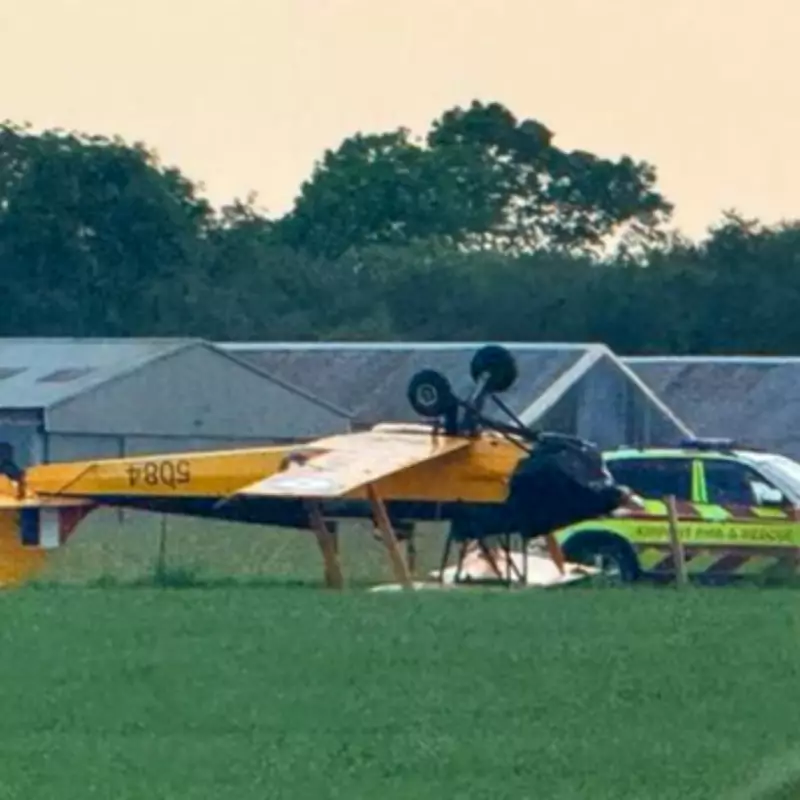
A vintage de Havilland Tiger Moth aircraft crash-landed upside down at Dunkeswell Aerodrome in Devon on the evening of May 28, with two people on board. The aircraft, widely used for pilot training during the Second World War, suffered a malfunction as it attempted to land.
Emergency Response
Emergency services were called to the scene shortly before 8pm after the crash landing. Local residents Ashleigh Vaughan and his wife Dawn spotted the fire service in the area and later saw the overturned plane. Ashleigh Vaughan said: "On research these biplanes are prone to flipping on landing if there's a strong rogue wind. It appears that the plane had been landing on the runway and then flipped into the field."
Fire Service Statement
Devon and Somerset Fire and Rescue Service reported: "At 7.49pm on May 28, we were called to attend an aircraft landing incident. A two-person Tiger Moth aircraft crashed whilst landing in a field adjacent to the runway at M35. The aircraft sustained damage and there was a reported oil and fuel leak. We sent two fire engines to the scene." The immediate emergency phase is now complete, and the scene is under airport control for ongoing management and preservation.
Occupants Unharmed
Both occupants were conscious and breathing at the scene and were able to exit the aircraft. They sustained only minor injuries and were advised to self-present to hospital if required. The fire service confirmed that neither person was seriously injured.
History of the Tiger Moth
The de Havilland Tiger Moth, designed in 1931, served as a primary trainer for the RAF. Over the following fifteen years, the DH.82 became the foremost training airplane for Commonwealth military and civilian pilots. It played a significant role in the British Commonwealth Air Training Plan, with over 1,500 aircraft employed by the RCAF from 1938 to 1948, helping prepare pilots for Spitfires and Hurricanes.
Previous Incident at Dunkeswell
This is not the first Tiger Moth crash at the airfield. In 2017, two people also escaped serious injury after a crash at Dunkeswell. A subsequent report attributed that incident to pilot handling error.
Dunkeswell Aerodrome's History
The aerodrome opened in 1943 during the Second World War and was built for the United States Navy, becoming the only US Naval Air Base in Europe. From this site, American aircrews flew long-range patrols over the Atlantic searching for enemy submarines, operating aircraft such as the Consolidated Liberator. The airfield played a vital role in protecting essential supply convoys crossing the Atlantic. Many original hangars and dispersal areas remain today as reminders of Dunkeswell's importance to the Allied effort.