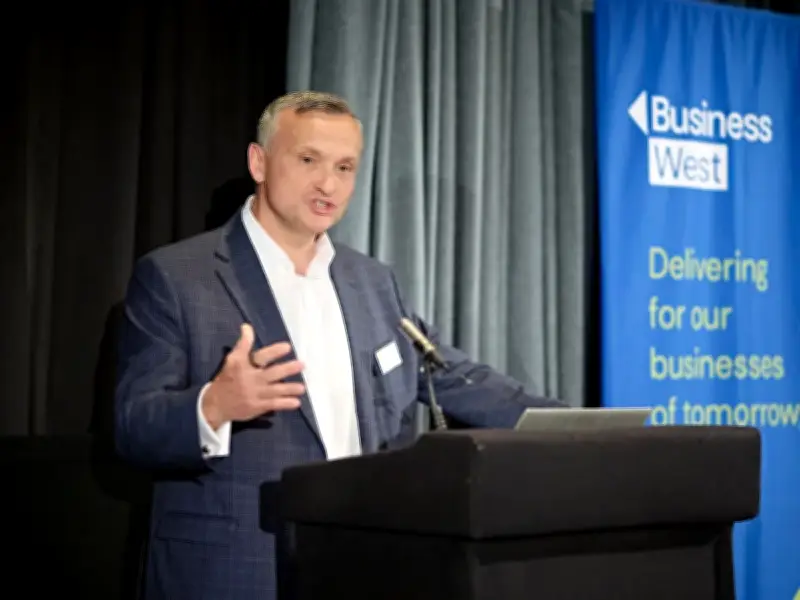
Douglas Ure, the new chief executive of Business West, has outlined his strategy for the organisation, focusing on boosting revenue, reviewing its real estate footprint, and embracing artificial intelligence. In his first interview since taking the helm in January, Ure spoke to Brum Daily about his priorities for the historic West Country business support organisation and chamber of commerce.
A Commercial Background and a Clear Strategy
Ure, who previously spent over a decade in South East Asia working for US insurance giant Marsh, including a two-year stint as its Jakarta chief executive, says his commercial background was a key reason for his appointment. “That is probably one of the reasons Business West brought me in; it was that commercial background I have,” he explains. “I don't see us dramatically shifting our purpose [but] there are opportunities.”
He acknowledges the scale of the role, which was held for three decades by former boss Phil Smith, who retired in the spring. Ure says he is “massively mindful” of the legacy, but he is already implementing a clear strategy. Aside from growing membership, which has been flatlining, a main priority is to bring more money into the not-for-profit organisation, which employs around 150 people and is headquartered at Leigh Court near Bristol.

Revenue Generation and Consulting Opportunities
Business West currently relies heavily on public sector contracts, but Ure is keen to pursue consulting work. “We want to be an active player in those [government] contracts but is there an opportunity to pivot into a more commercial consulting opportunity?” he asks. “The idea would be providing support for a fee to businesses – less than a large consulting business as we are not looking to make the same level of profit, but we do want to make sure we have money coming in.”
The organisation reinvests any money it raises into the business, and Ure wants to ramp up revenue generation. He has given himself 12 months to reach a place where Business West “has room to move financially” and invest in more projects.
Real Estate and Hybrid Working
Another major focus is Business West's real estate footprint. Leigh Court, a grade II listed country house in Abbots Leigh, was put up for sale for £5.5m last year. Ure declined to comment on the buyer, but confirmed that once the sale is complete, Business West will become a leaseholder in the short-to-medium term. “The offices will transfer to the buyer and we will continue with our space there,” he said. “Our members are predominantly Bristol and Bath based so we would want to be around [that area].”
Ure wants to make a decision on where staff are based in the next 12 months, noting that around 90 per cent of the 150 staff have a hybrid-working pattern. He admits that staff working on government contracts in Cornwall being based in an office in Bristol “makes zero sense”, but he has a “genuine concern” about collaboration with younger employees and new staff learning about the business. “I get quite a lot of value from sitting up in the office with the West of England Combined Authority (Weca) as that is where we hear from policy and the communications team,” he says.
Economic Outlook and Regional Devolution
On the economy, Ure refuses to be “too pessimistic” but admits the current landscape is a challenge, with concerns around inflation and the geopolitical situation impacting trade, exports, and energy. “There is definitely uncertainty but there is also resilience and optimism,” he says. “A lot of businesses are quite bullish about their own growth opportunities with many feeling they will do better this year and next year than previously.”
He is critical of high business taxes and planning delays. “Some of our members tell us it is easier to get things done in the North of England than in the West of England,” he says, attributing this to local authority planning and political decision-making. He supports devolution, but believes combining the Weca region with Devon and Cornwall “definitely won't happen”.

Transport and AI Priorities
Ure is a strong supporter of Bristol Airport's expansion plans to increase capacity from 12 million to 15 million passengers a year. “Bristol Airport is an important transport hub for the West of England,” he says. “Economically I think it is definitely the right thing to do,” while acknowledging local community concerns. He also highlights the need for better transport links, such as the Portishead to Bristol rail link, but notes the challenge of funding.
On artificial intelligence, Ure believes its impact will be “super important” for small firms. “It is difficult to overemphasise what an impact AI is going to have,” he says. “We want to get our exec team and heads of department all well versed in the different AI tools and agents that are there to help them do their job better and then cascade that down. We are starting at the top.”
Describing his leadership style as “democratic”, Ure says he is keen to engage, listen, and learn. His immediate goal is to strengthen Business West's financial position, and he has set a 12-month timeline to achieve that, saying, “Let's talk in 12 months from now and see how I've done.”