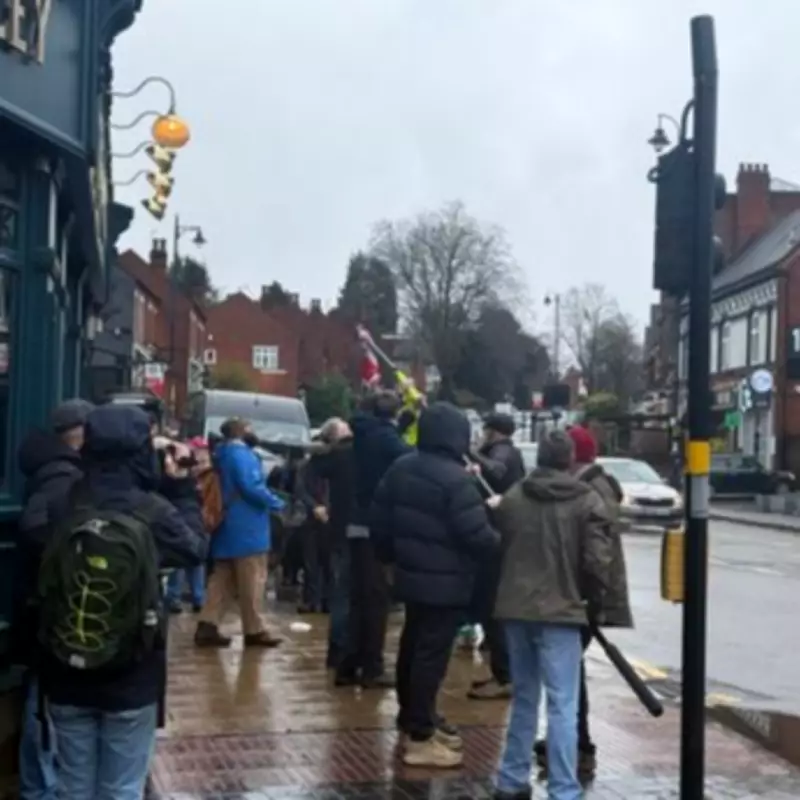
Residents of the Moseley area in Birmingham have taken direct action to remove Union flags from public lampposts, organising a community event that drew hundreds of participants and was met with rounds of applause. The gathering, named "Moseley Is For Everyone," was staged as a direct response to the installation of British flags by the group Raise The Colours earlier in the week.
A Community United Against External Influence
The Union Jack flags had been displayed for only a few days before local residents decided to take matters into their own hands. On February 7, 2026, a day of unity was organised, culminating in the removal of the flags from public property. David Masters, a key participant in the event, played a significant role by providing a PA system and curating a musical selection that ranged from Bob Marley to Panjabi MC, fostering an atmosphere of inclusivity and celebration.
Speaking to reporters, Masters emphasised that the event was about "making a statement about what Moseley means to people." He described the community as "very diverse with a good sense of cohesion" and expressed strong objections to outsiders imposing their views. "We object to outsiders taking over the public realm by putting up flags the way it's been done," Masters stated. "It's like they (Raise The Colours) are trying to impose a particular view of xenophobia and nationalism on our community. We're just not having that."
Concerns Over Links and Intentions
Masters further criticised Raise The Colours, highlighting alleged connections to the English Defence League and questioning the group's motives. "Everyone is welcome to put up flags in their home, but Raise The Colours has links to the English Defence League," he asserted. "They're not doing it as an act of patriotism. They're putting flags up as an act of provocation on a mixed community."
The event saw broad political support, with Stephen Pihlaja, the Labour candidate for Moseley, among those in attendance. Pihlaja praised the area as "a unique place, a beautiful and diverse village in the city with people from all backgrounds." As an immigrant from the United States who became a British citizen, he shared his personal appreciation for the Union Jack, noting, "I used to have a Union Jack up in my dorm room at university."
Focus on Public Property and Community Autonomy
However, Pihlaja clarified that the issue was not about the flag itself, but rather about its placement without permission. "The real problem with flags is putting it on public property without permission," he explained. "Moseley should decide what it wants on its lampposts without people from outside the area doing it." He added that "almost all political parties have come together today to show that the flags going up is not okay in Moseley," underscoring a rare cross-party consensus on the matter.
In contrast, Raise The Colours defends its actions as patriotic and unifying. The group's website states: "We believe patriotism should be visible, positive and inclusive. Our flags are not about division — they are about belonging, togetherness, and celebrating the identity we hold in common. By raising the colours, we raise a message of unity and determination that can be seen on every street."
Despite this, the Moseley community's response highlights a deep-seated desire to protect local autonomy and reject what they perceive as divisive symbolism imposed from outside. The event has sparked broader conversations about community identity, public space, and the boundaries of patriotic expression in a multicultural society.