I recently acquired two masterpieces by Birmingham Surrealist John Melville from a charity shop in Moseley, which is more than you will see at Birmingham Museum and Art Gallery (BMAG). Following a four-year renovation and rehang, much of the permanent art collection is missing.
A Lost Cultural Treasure
When I first moved from London to Birmingham a decade ago, friends asked me: 'So, what culture does Birmingham have?' Inside BMAG, I discovered David Cox, an early Impressionist, local Pre-Raphaelite hero Edward Burne-Jones, and women artists from the Arts and Crafts Movement, including Mary Newill, Georgie Gaskin, and May Morris.
Inside the Industrial Gallery, lined with glass cabinets, I found ceramics, jewellery, stained glass, and metalwork, all integral to Birmingham's inspiring 19th-century history. Among my favourites were beautifully decorated tiles by Victorian artist William de Morgan and stained glass by Florence Camm.
Dumbed-Down Displays
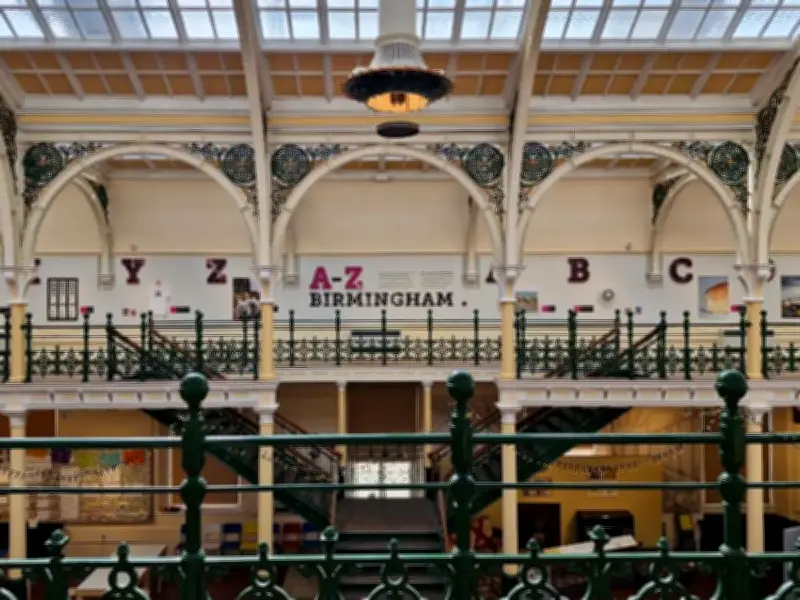
Now, that beautiful gallery space has been revamped with pretend roadworks, a mocked-up vintage poster of a pedestrian ramp, and old pub signs. Visitors are greeted with an ugly notice: 'Diversion: Road Closed for Event,' as if forming a literal barrier to seeing any art or historical items.
Where once there were handmade crafts is a large photograph of a piece of bread mounted on a tacky board. 'Crusty Cob' is the caption, asking 'What is your favourite filling?' It is part of an A to Z of Birmingham that projects lazy views of the city in a race to the bottom. B is for Balti, Y is for 'Yes Bab,' X is for BHX airport, and so on.
As a city, we should be more brave and progressive, which is exactly what we used to be! But these bland displays read like ChatGPT-generated AI slop. What has been put on show reveals a low estimation of local audiences' intelligence, curiosity, and interest in art. This inverted snobbery only adds to misconceptions that Birmingham is a cultural wasteland, the very thing I have been fighting against in my curatorial projects.
Citizen's Jury Controversy
Audiences deserve exhibitions developed by experts with imagination and vision. Instead, the museum has appointed a Citizen's Jury to consult on its role and output. In 2024, 5,000 letters were sent to houses across Birmingham; only 87 people replied, from which 28 participants were chosen in a self-selecting group. You would not run the World Cup by committee, nor should you run a museum by one.
I miss BMAG as it was before these worrying redevelopments. The Round Room, formerly jam-packed with jewels of the collection on warm red walls, has been painted an uninviting white. A limited selection of mostly modern works has been arranged by colour. This opening space has lost its 'wow' factor. Where are the old masters which once hung here?
Missing Masterpieces
Noticeably absent is Sandro Botticelli's 'The Descent of the Holy Ghost', c.1495-1505. Among other significant pieces missing from view are paintings by Orazio Gentileschi (you have to travel to London's National Gallery to see that beauty), Simone Martini, Petrus Christus, Eugene Delacroix, and Canaletto, to name just a few.
In addition, prints and drawings by Albrecht Durer, Rembrandt, and Picasso are nowhere to be seen. Where are modernist sculptures by Barbara Hepworth and Henry Moore? These works of national and international importance, among a collection developed since the 1860s, are markedly absent.
Impact on Visitors
In 2022, Arts Council England gave BMAG £3 million 'to draw in visitors from around the world to Birmingham.' What will those international visitors make of these dull and dumbed-down displays? But I am more concerned by the impact on local people. After all, this civic museum, which first opened its Grade II* listed doors in 1885, was built on city pride. It also extended its opening hours to Sundays to ensure the working classes had access to art, most of which is now locked away in a collections centre in Nechells.
Among them are paintings and drawings by Birmingham's Surrealists Conroy Maddox, John Melville, Emmy Bridgwater, Oscar Mellor, and Desmond Morris. They brought Surrealism to the West Midlands, but none of this revolutionary group are represented. Nor is Peter Phillips, the pioneering Pop artist who drew inspiration from the industrial city in his dynamic paintings, sculptures, and collages. 'Pop goes Brum!', a new, free-to-view street exhibition celebrating this true trailblazer, which I have curated, will open in Snow Hill Square on 9th June.
A Call for Pride
If we want more pride in our city, we must share these significant artworks and stories from our radical past. We must also support local artists, and I am shocked that Turner Prize finalist Barbara Walker has not yet been given a solo show at BMAG, although Manchester gave her one last year. The museum should create dialogue between groundbreaking new works and the cherished masterpieces of old.
Fortunately, there are four galleries of Pre-Raphaelite works, where I can see that visitors are more absorbed by these great works of art. But I cannot find any works by artist and muse Elizabeth Siddall.
While the museum is not yet fully reopened, there is not endless space. But as a curator, I can see that poor choices have been made, with jewels from the collection replaced by dumbed-down displays. It now feels more like a regional museum than a world-class art gallery. I worry for its future, having seen the fate of other institutions in the Midlands, where underinvestment, the pandemic, and cost-of-living crisis have created a perfect storm. Coventry's Herbert Art Gallery and Museum has recently been taken over by leisure company CV Life and is charging entry to see fewer objects, with more than 600 items being disposed of. Meanwhile, Walsall Council has decided to sell the Leather Museum building.
Poverty of Expectations
What I see here is a poverty of expectations reflected in BMAG's new displays. It has been decided that our wonderfully diverse local audiences do not deserve, or will not appreciate, masterpieces on show. In turn, this reinforces the false idea that art is elitist and only for certain groups of people, which goes against its mission of inclusion to foster 'greater community engagement.'
Inside BMAG is a lack of pride and aspiration, despite our hugely significant cultural assets. Yes, in Birmingham there is great deprivation on the streets. But the free-to-visit public museum is rich in its remarkable art collection, which belongs to the city's people and is a great equaliser. It is the job of the museum to make it engaging and relevant to the audiences of today. Please, put it back on the walls.