Number 16 Burscough Street in Ormskirk is set to swap retail for a museum later in the year, when the Ormskirk History Hub takes over the premises. The pop-up museum, also referred to as the Ormskirk Heritage Hub, is expected to open on Saturday 5 September, with the official opening schedule due to be announced in the coming weeks.
A Singer sewing machine legacy
The site has a rich commercial past, with the pre-1960s building once housing the Singer Sewing Machine franchise. In the early 1900s, Joshua Eveson brought his family from Shropshire to Ormskirk to run the shop. Joshua and his wife Mary Anne (née Beresford) had a large family, including six sons.
The eldest son, Thomas Edward, attended Ormskirk Grammar School and went on to Liverpool University, earning a BA in English Literature and Education followed by a second BA in Botany and Sociology. He later became Chief Inspector of Schools for Bristol, having previously served as Captain in the Royal Field Artillery in 1915. The second son, Newman, served with the Royal Engineers during the First World War. The third son, Wesley, became a Special Constable in Ormskirk and lived at Newlands, Grimshaw Lane; he was also a lifelong chorister at the Parish Church. The fourth son, Stanley, served with the Royal Engineers and was wounded at Cambrai in 1918 before emigrating to Australia. Another son, Morris, became a shipping clerk in Southport. The family lived on Southport Road while the boys were growing up.
A Victorian marine store dealer
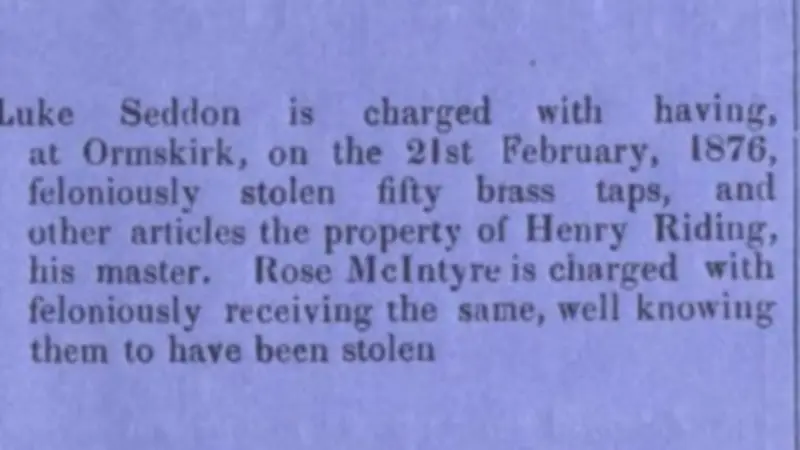
Long before the Singer shop, and probably before some serious rebuilding, the premises were occupied by Rose McIntyre, a marine store dealer. Irish-born Rose was a character in the trade that Charles Dickens famously described as often a cover for receiving stolen goods. In 1876, she came close to a prison sentence when she was hauled before Ormskirk Magistrates and sent to the Quarter Sessions charged with receiving stolen goods.
The case involved 15-year-old Luke Seddon, an apprentice plumber to Henry Riding, who stole 50 brass taps from his master. The taps somehow ended up in Rose's shop. Luke was sentenced to three months in Kirkdale Gaol, while Rose was acquitted. She later moved her business to 36 Aughton Street and died in 1883 at the age of 62. Marine store dealers bought nearly anything for a few pennies and sold it on at a profit; many such premises were rag-and-bone stores packed to the roof with strange oddities.
The street and its inns
The old buildings on this part of Burscough Street were considerably altered during the first half of the 19th century. Before the mid-century adoption of odd and even numbering, Number 16 had no official street number. The premises sat between two inns: the Wheatsheaf to the north and the White Horse to the south. The rear of these properties was expansive, and the White Horse at one time also used an area behind the old Town Hall in Church Street as a stabling yard.
William Borringham had run the White Horse for more than 20 years until his death in 1831, aged 69. Burscough Street was clearly a lively thoroughfare, with a total of six pubs and inns and at least one beer house squeezed into the short row between the Market Cross and where Derby Street starts. With yards and stabling behind each inn, the area would have been among the most crowded and noisy parts of town.
Anyone who thinks they have an item deserving a place in the museum is invited to contact ormskirkhh@gmail.com. Further details about the opening schedule for the Ormskirk Heritage Hub will be published in the coming weeks.