A captivating selection of six archival photographs from Cheshire Archives and Local Studies has been released, offering a detailed look at Macclesfield and Poynton's rich history. From an Edwardian cattle market to a steam locomotive pulling into a now-closed railway station, these images capture everyday life in a bygone era.
Water's Green: A Glimpse of Edwardian Macclesfield
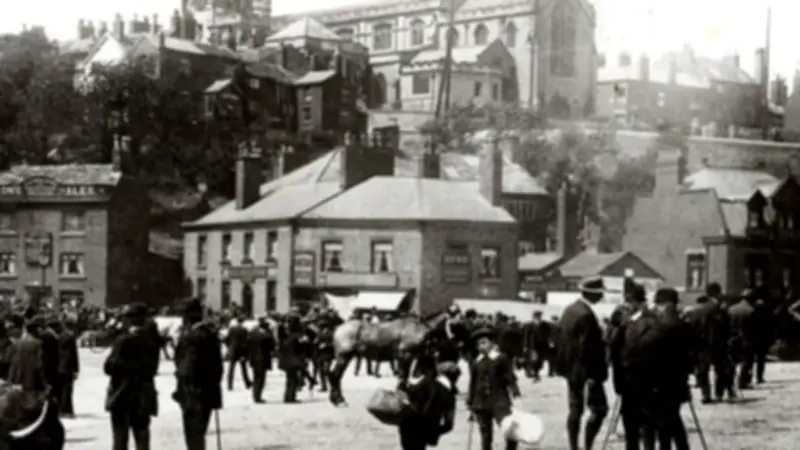
The cover image, captured in the early 1900s, shows Water's Green in Macclesfield. This area was a focal point for the town's commercial and social activities. The photograph, preserved by Cheshire Archives and Local Studies, reveals an open space that would later be used for the cattle market, surrounded by buildings that have since been redeveloped.
A companion postcard, postmarked around 1910, depicts Macclesfield Cattle Market on Water's Green in full swing. The scene is crowded with traders, livestock, and onlookers, with the town's Parish Church standing prominently in the background. This postcard offers a rare visual record of an era when the market was the beating heart of the local economy, attracting farmers and merchants from across the region. For residents today, it provides a striking contrast to the modern town centre, showing how much the area has changed in little more than a century.
School Days at Vernon Boys School, Poynton
Another photograph transports viewers to Vernon Boys School in Poynton during the 1930s. The image shows a group of pupils arranged in rows with their teacher, Mr McCall. The black-and-white snapshot captures the formal classroom atmosphere of the period, with the boys dressed in collared shirts and jackets. Such school photographs were treasured keepsakes for families, and this one serves as a valuable historical record of the school's staff and pupils.
Vernon Boys School was one of several educational institutions in Poynton at the time, reflecting the area's growing population during the interwar years. The photograph, now part of the Cheshire Archives, helps preserve the memory of a generation that grew up in the shadow of economic hardship but still found moments of community pride and educational achievement.
The Lost Railway Station of Higher Poynton
Among the most evocative images is a scene from Higher Poynton railway station, which served the eastern side of Poynton. The photograph clearly shows the station's layout, with the way out located on the right and separate toilets for ladies and gentlemen on the left. This level of detail provides a fascinating insight into the social customs of the era, when distinct facilities were seen as essential.
According to Cheshire Archives and Local Studies, Higher Poynton railway station opened in 1869 and operated for over a century before closing in 1970. The buildings were subsequently demolished, leaving no physical trace of the station at the site today. The archival photograph is therefore a vital piece of local heritage, documenting a transport hub that once connected Poynton to the wider national network. Its closure, part of a wave of railway rationalisation during the 1960s and 1970s, was a significant loss for the community.
Steam Age Grandeur: Locomotive No. 42322 at Poynton
A separate photograph captures a moment of steam-age history at Poynton station. The London, Midland and Scottish Railway Class Four 2-6-4 passenger tank locomotive, number 42322, is seen gliding into the station on its way from Manchester Piccadilly to Stafford. The 2-6-4 wheel arrangement indicates two leading wheels, six coupled driving wheels, and four trailing wheels, a configuration designed for stability and speed on busy suburban services.
Unlike traditional locomotives that pulled a separate tender, this tank locomotive carried its own water in side-mounted tanks and coal in a rear bunker. According to the accompanying notes, it was a heavy-duty workhorse of commuter lines, built for efficient, fast-paced suburban travel. The photograph is preserved in part seven of the Basil Jeuda Collection at the Cheshire Record Office, a renowned archive of railway history. For railway enthusiasts, this image is a treasure, capturing an era when steam locomotion was at its zenith.
Macclesfield's Changing Streetscape in the 1970s
Moving forward to the 1970s, another photograph shows the Cheshire Building Society at the junction of Castle Street and Churchill Way in Macclesfield. This scene reflects a period of urban transformation, as the town centre was modernised to accommodate traffic and new commercial developments. The building society, with its prominent corner position, was a familiar landmark for residents, and the photograph now serves as a nostalgic reminder of a streetscape that has since evolved beyond recognition.
The image also highlights the architectural style of the decade, with clean lines and large windows that were typical of post-war commercial design. For those who remember Macclesfield in the 1970s, this photograph will spark a deep sense of nostalgia, while younger readers can compare it to the modern town centre and appreciate the changes that have occurred.
Preserving Local Heritage for the Future
These six photographs, all taken from the collections of Cheshire Archives and Local Studies, underline the importance of archival preservation. According to the archive, the images are part of ongoing efforts to document the region's history and make it accessible to the public. The Basil Jeuda Collection, in particular, offers a deep dive into Cheshire's railway and transport heritage, with many more photographs waiting to be rediscovered.
For those eager to explore further, the archive also supports a dedicated InYourArea feed for Macclesfield and surrounding areas, providing news, updates, and information about local history events. As Macclesfield and Poynton continue to evolve, these old photographs remain an invaluable link to the past, reminding residents of the vibrant community life that has shaped the modern towns.