
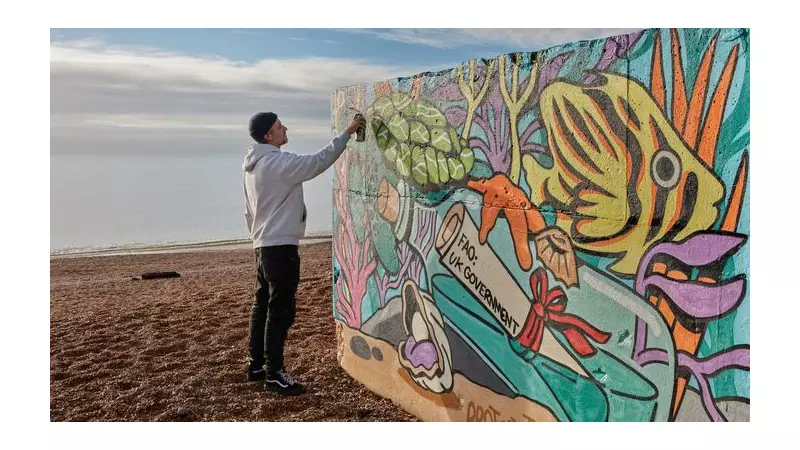
This weekend, the coastal town of St Leonards-on-Sea in East Sussex became the canvas for a powerful celebration of a historic environmental victory. A striking new mural, unveiled on the side of the beachfront Bathing Hut Cafe, marks the moment the High Seas Treaty officially comes into force on Saturday, January 17.
A Global Celebration with a Local Message
The colourful artwork, measuring twice the length of a double-decker bus, is part of a coordinated global Greenpeace action. Artists, Indigenous communities, and activists from 13 countries across five continents have created similar street art to commemorate this major milestone for ocean conservation. The St Leonards piece, painted by Bristol-based artist Richt, features a poignant message in a bottle resting on the ocean floor amongst marine life like a turtle and an angelfish, symbolising a desperate call for help.
The mural's central theme is a direct appeal to the UK government. While 81 nations including France, Spain, and China have already ratified the treaty, the UK has yet to complete the process of signing it into domestic law. The artwork transforms this local seaside spot into a focal point for international pressure.
The Treaty: A Race Against Time for Our Oceans
The High Seas Treaty represents the most significant global environmental agreement since the 2015 Paris Climate Accord. Its enactment triggers a critical four-year countdown with a monumental goal: to protect 30% of the world's oceans by 2030. For the first time, it provides governments with the legal framework to establish protected areas in international waters, which cover nearly half the planet.
This protection is vital to:
- Mitigate the impacts of the climate crisis.
- Halt and reverse the collapse of marine biodiversity.
- Safeguard food security for billions of people who depend on the ocean.
Chris Thorne, a senior oceans campaigner at Greenpeace UK, emphasised the urgency: "It fires the starting gun on a four-year race... the minimum scientists say is needed to halt and reverse biodiversity loss." He noted that currently, less than 1% (0.9%) of the High Seas is fully protected, making the leap to 30% an unprecedented conservation challenge.
From Mural to Movement: A Direct Call to the Foreign Secretary
The St Leonards mural is designed to have an impact far beyond the Hastings coastline. The image will be turned into a digital postcard for the public to send directly to Foreign Secretary Yvette Cooper, the minister responsible for the treaty. This ensures the message demanding urgent UK ratification is heard clearly in Westminster.
Artist Richt explained his inspiration, linking a childhood by the sea to the current environmental imperative: "The focus of the work is a message in a bottle, widely understood as an act of desperation and devotion... In the case of the Treaty, that last chance is being held up by red tape."
Greenpeace UK stresses that while global communities celebrate, UK delay is holding back progress. They call for the government to not only ratify the treaty but also to put forward ambitious proposals to protect vast ocean areas, specifically naming the Sargasso Sea and other parts of the Atlantic.
The mural in St Leonards-on-Sea stands as a vibrant symbol of both hope and profound urgency, reminding all who see it that the health of our global oceans hinges on immediate and decisive political action.