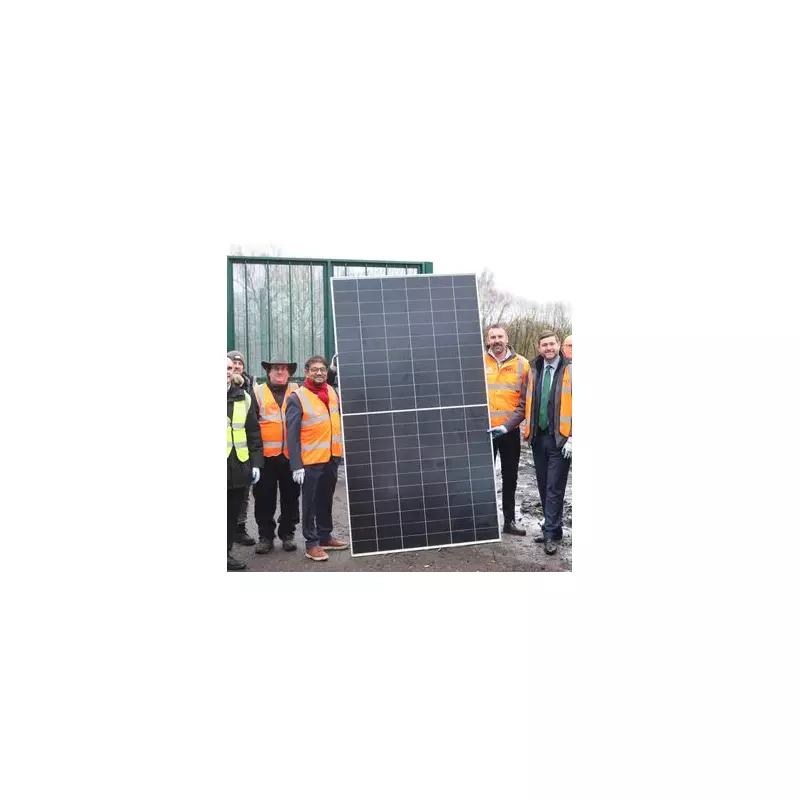
Construction has officially begun on Oldham's first-ever solar farm, a landmark council-funded project set to transform a derelict plot of land into a source of clean, renewable power for the borough.
A Green Powerhouse for Failsworth
The development, located on a 3.5-acre site at Wrigley Head in Failsworth, is bound by the Rochdale Canal and the Metrolink line. Contractor Vital Energi, a North West-based firm, has started work installing approximately 2,700 solar panels. The facility is scheduled to become fully operational by spring 2026.
Once complete, the solar farm is projected to generate around 830,000 kWh of electricity annually. This output is enough to meet the annual power needs of roughly 310 local homes. Initially, the electricity will be sold to a power company, with the scheme aimed at reducing both the council's carbon footprint and its energy costs.
More Than Just Energy: Jobs and Ecology
Councillor Abdul Jabbar MBE, Deputy Leader and Cabinet Member for Finance, Corporate Services and Sustainability, hailed the project as a critical move for Oldham. He emphasised that it would not only generate green energy but also support local jobs and training opportunities while protecting the environment.
Echoing this sentiment, Oldham West MP Jim McMahon described the solar farm as a "positive development for the community". Vital Energi has committed to using local suppliers wherever possible during construction.
The project is also designed to deliver significant ecological benefits. Plans include planting new trees and flowers to enhance biodiversity. Furthermore, the security fencing has been specially designed to allow wildlife to move freely through the area, improving conditions for local animals.
Overcoming Delays for a Sustainable Future
The Wrigley Head Solar Farm represents the first major clean energy generation project under Oldham's Green New Deal programme. It aims to cut CO2 emissions by an estimated 50 tonnes per year.
The journey to this point has faced several hurdles. First conceived in 2018, the plans were shelved during the pandemic before being resurrected and approved in 2021. Recent delays were caused by late changes to plans, including adjustments to underground cabling routes and the location of a substation, which will now be situated closer to the Metrolink line.
The council last estimated the construction cost at approximately £1.35 million in a 2023 feasibility study, with the final bill to be covered by its capital spending budget. An updated cost has not yet been released.