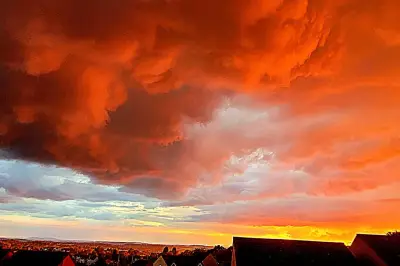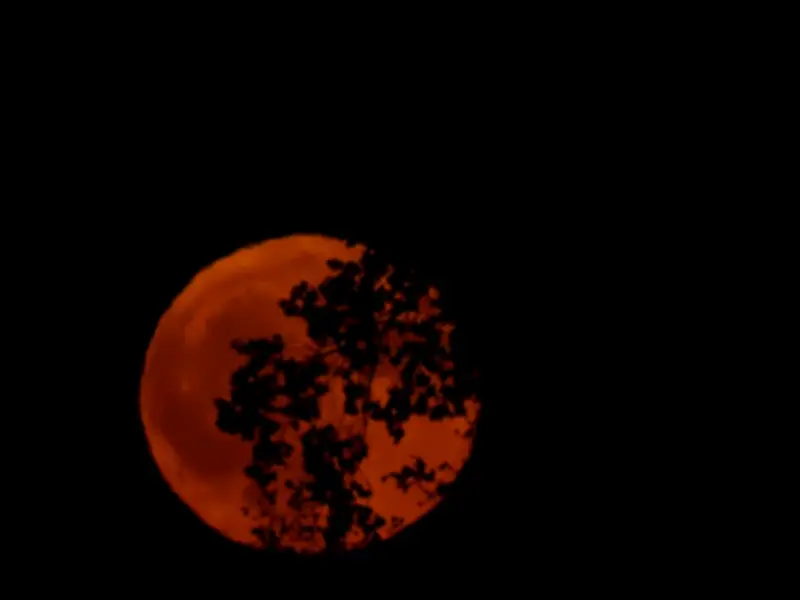
A partial lunar eclipse will see 93% of the Moon's surface covered by Earth's darkest shadow in the early hours of Friday, August 28, with the Met Office warning that cloud could obscure views across much of the UK.
The eclipse will begin at 2.23am when the Moon enters the penumbra, the lighter outer area of Earth's shadow. The partial phase starts at 3.33am as the Moon moves into the umbra, the darker central part of the shadow, and reaches its peak at 5.12am. At that point, around 93% of the Moon will be covered by the umbra, creating the conditions for the most dramatic views of the night.
As sunlight filters through Earth's atmosphere and reaches the lunar surface, the Moon could take on a deep red or copper-coloured glow. The partial phase will continue until around 6.51am, but the Moon will have already set for some observers before the eclipse comes to an end. In London, it is expected to set at around 6.15am, meaning those hoping to see as much of the spectacle as possible may need to get up well before dawn.

Met Office forecast: Best chances in south and east England
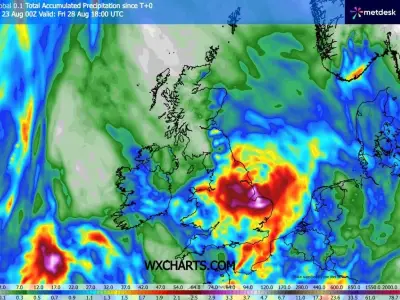
The Met Office has said southern and eastern England are expected to have the best chance of seeing at least some of the eclipse. A spokesperson said: "The greatest chance of seeing something is likely to be across southern and eastern England during its earlier stages, before cloud becomes more extensive. Elsewhere, any temporary breaks in the cloud could still provide brief views."
Cloud is forecast across Cornwall and Devon, Wales and the Midlands, as well as parts of north-west England. Most of Scotland and Northern Ireland are also expected to see cloudy conditions, while north-east England could experience patchier cloud. The weather picture means that even areas expected to be cloudy could still get short windows in which to see the eclipse.
People hoping for the clearest view should try to find a high point with an unobstructed view towards the south-western horizon.
Why does a lunar eclipse happen?
A lunar eclipse occurs when the Sun, Earth and Moon align with the Earth positioned between the Sun and the Moon. The Earth then casts its shadow across the lunar surface. The first shadow the Moon enters is the penumbra, where the effect is relatively subtle. As it moves into the umbra, the darker central part of Earth's shadow, the eclipse becomes much more obvious.
Unlike a solar eclipse, which can only be viewed from particular areas where the Moon blocks the Sun, a lunar eclipse can be seen simultaneously by people across the night side of Earth. That means the eclipse will happen at the same time across the UK, although the Moon's position above the horizon will vary depending on location.
Why is it known as a Blood Moon?
The reddish appearance occurs because some sunlight still reaches the Moon even when it is inside Earth's shadow. That sunlight passes through the Earth's atmosphere, where shorter wavelengths are scattered more strongly. Redder light is able to pass through and is bent towards the Moon, giving it a red, orange or copper-coloured appearance. The exact colour can vary depending on conditions in Earth's atmosphere.
Unlike a solar eclipse, there is no risk from looking directly at the Moon during a lunar eclipse. Anyone fortunate enough to have clear skies can watch the spectacle with the naked eye, with no specialist equipment required.