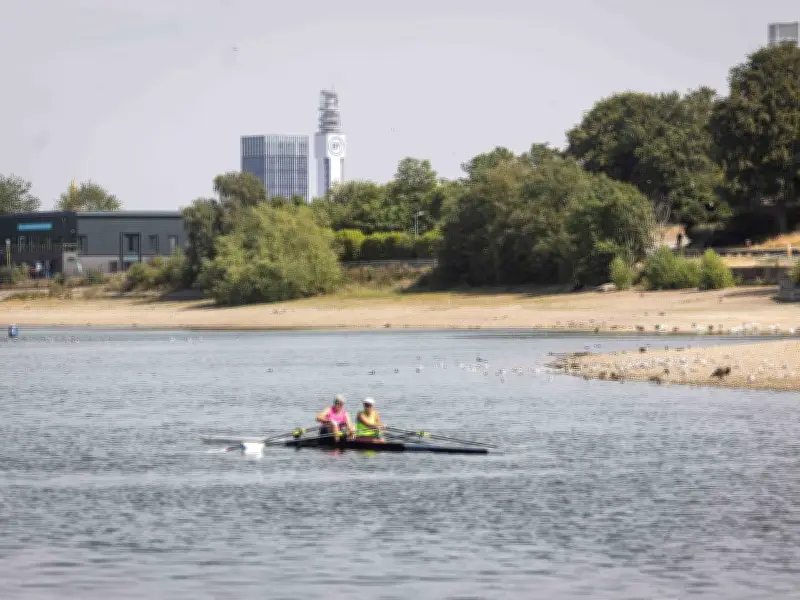
The historic Edgbaston Reservoir in Birmingham has seen water levels plummet dramatically following the driest July on record, leaving vast areas of the reservoir bed exposed and transforming the landscape into an arid, sunbaked terrain.
For centuries, the reservoir has been a sanctuary for walkers, watersport enthusiasts, anglers, and wildlife. Now, sunbathing has become the newest activity as visitors take advantage of the dried-up bed, with one sunbather laying out a mat on the pebbles to read a book as water gently lapped nearby.
Historic Feeder for Canals Now in Need of Water Itself
Built in 1827 by Thomas Telford, the reservoir in Ladywood was designed as a feeder for Birmingham's canal network. However, tell-tale grey markings on trees reveal how much the water has receded this summer, with walkers using the exposed reservoir base as a shortcut.

The drastic drop in water levels has created stark surroundings, prompting visitors to stop and film videos of the unusual scene. The reservoir, which once supplied water to keep the canals navigable, now appears to be in need of replenishment itself.
Rowing Club Members Face Longer Carries
Members of Midlands Rowing Club have been particularly affected. Maggie Jameson and Rhian Prichard now face a much longer walk to reach the water's edge with their boats.
"Usually we've got to carry the boat to the steps, but now we have to carry the boat a good distance," said Jameson. "You can't go directly into the water because of the mud. Some of our recreational sessions have to carry heavy boats. We haven't got the distance to train. It's gone down quicker than it did last year."
Prichard added: "It's usually about 800 metres from the creek to the sailing club, and now it's down to around 600 or less. We're only in August and it's a puddle."
Visitors Shocked by Unprecedented Low Levels
Long-time visitors expressed their shock at the transformation. Antony Kavanagh, from Bournville, was enjoying a Monday afternoon stroll along the 2.8km path surrounding the reservoir.
"I come here often for a walk and it's a lovely place," he said. "It's really arid and dry. I've never seen it like this."
Graham Singh, from Edgbaston, has been visiting for over 40 years and described the scene as unprecedented. "I've been coming for more than 40 years and I've never seen it this low," he said. "The reservoir was made to keep the canals topped up, and I'm in shock myself. The water used to come up close to the path."
Impact on Wildlife and Recreation
The receding water has not only affected human visitors but also the reservoir's rich wildlife. The exposed bed has become a new habitat for some species, while others that depend on deeper water may be under threat. The reservoir, which is a Site of Special Scientific Interest (SSSI), supports a variety of birdlife, including great crested grebes and herons.
Recreational activities such as sailing, rowing, and angling have been disrupted, with clubs forced to adapt to the changing conditions. The dry conditions have also raised concerns about the risk of fires, as seen elsewhere in Birmingham's green spaces this summer.
Future Outlook and Calls for Action
As the region continues to experience prolonged dry spells, questions are being raised about the long-term sustainability of the reservoir and its role in the canal network. Local authorities and environmental groups are monitoring the situation closely, with some calling for increased investment in water management and conservation measures.
While the reservoir has historically been a vital component of Birmingham's canal system, the current crisis highlights the broader challenges posed by climate change and water scarcity. For now, visitors are left to marvel at the unusual sight, hoping for rain to restore the reservoir to its former glory.