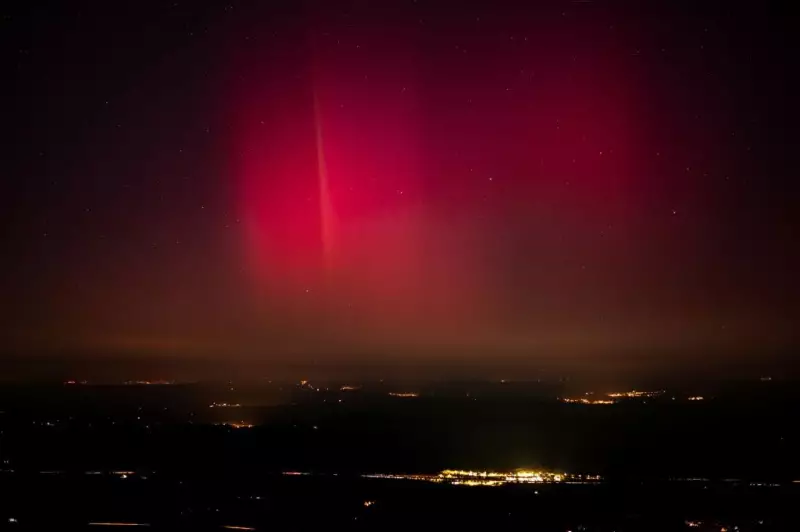
A breathtaking display of the Northern Lights could grace skies across much of the United Kingdom on Wednesday night, offering a rare opportunity for stargazers to witness this celestial phenomenon far further south than usual.
Solar Activity Sparks Spectacular Light Show
The spectacular display results from three significant coronal mass ejections (CMEs) from the Sun that began reaching Earth on Tuesday, November 11th, with the final burst expected to arrive on Wednesday, November 12th. These massive eruptions of plasma from the Sun's outer atmosphere travel at millions of kilometres per hour before interacting with Earth's magnetic field.
When these charged particles collide with molecules in our atmosphere, they excite them, causing them to release energy in the form of light - creating the dazzling colours of the aurora. The varying colours result from interactions with different atmospheric gases, primarily oxygen and nitrogen.

Geomagnetic Storm: What to Expect
The Met Office has issued a G4 to G5 geomagnetic storm watch from Wednesday noon through to midnight on Thursday, classifying these events as 'severe' to 'extreme' respectively. While these storms pose no direct danger to people, they can cause significant technological disruptions.
Potential impacts include interference with high and low frequency radio communications, disruptions to GPS and satellite-based navigation systems, and in extreme cases, possible damage to transformers that could lead to localised power cuts. Geomagnetic storms represent powerful disturbances in Earth's magnetic field caused by solar activity, specifically when bursts of charged particles known as solar wind or CMEs reach and disturb our planet's protective magnetosphere.
How to Maximise Your Aurora Viewing Chances
The enhanced auroral activity may persist through to Thursday morning, with the Met Office forecasting visible displays across northern UK regions and potential sightings extending as far south as England and Wales. However, cloud cover presents a significant challenge for many hopeful viewers.
Current Met Office predictions indicate substantial cloud coverage across much of the country, particularly affecting Northern Ireland, southern Scotland, and northern England. Clearer conditions are expected in Scotland's far north, south-east England, Wales, and the English midlands at various points throughout the evening and early morning.
For optimal viewing, the British Geological Survey recommends waiting until complete darkness falls - fortunately occurring early during November evenings. Seek out locations as far from artificial light sources as possible, ensure you have a clear northern horizon view, and plan your observation between 10pm and 2am when auroral activity typically peaks.
If the lights prove elusive to the naked eye, try using your smartphone or camera, as these devices often capture the aurora's colours more effectively due to their enhanced light sensitivity. This rare celestial event offers Britons an extraordinary opportunity to witness one of nature's most spectacular displays without travelling to polar regions.