Later today, millions across the country will witness a partial solar eclipse, a rare celestial event where the Moon passes in front of the Sun, casting a shadow and briefly dimming daylight. However, with specialised eclipse glasses sold out in many retailers, experts are urging the public to prioritise eye safety and offering alternative ways to enjoy the spectacle.
The eclipse will obscure more than 90% of the Sun, but even that fraction is enough to cause serious eye damage if viewed directly without proper protection. Only solar eclipse glasses certified to the ISO 12312-2 international safety standard are considered safe; regular sunglasses, no matter how dark, are not sufficient.
Risk of permanent vision loss
The dangers are well-documented. Following the 1999 total solar eclipse, a Royal College of Ophthalmologists survey recorded about 70 cases of eclipse-related visual loss. Mohamed Elalfy, a consultant ophthalmologist and president of the college, stressed that the retina has no pain receptors, so damage can occur unnoticed.
“The safest way to enjoy the eclipse is to observe it indirectly,” Elalfy said. “Looking directly at the Sun during a solar eclipse can cause damage to the retina, potentially damaging the cells responsible for sharp central vision. Crucially, the retina has no pain receptors, so people will not feel the damage as it happens. Symptoms may only become apparent several hours later and can include blurred vision, a central blind or dark spot, distorted vision, reduced colour perception and increased sensitivity to light. While some people recover over weeks or months, others can be left with permanent visual impairment.”
Safe viewing methods: certified glasses and DIY options
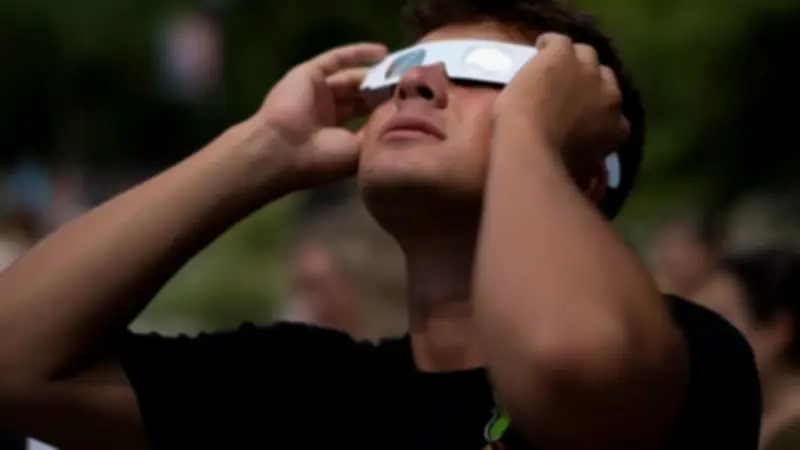
For those who have secured ISO-certified eclipse glasses, proper use is essential. Inspect lenses for scratches or punctures before use, and discard if damaged. When putting them on, turn away from the Sun, secure the glasses over your eyes, then look up. Turn away again before removing them.
If glasses are unavailable, indirect projection is the safest and easiest alternative. A simple kitchen colander can serve as a pinhole projector: stand with the Sun behind you, hold the colander in one hand, and place a piece of white card about 50cm away. Each hole in the colander will project a tiny crescent sun onto the card.
DIY pinhole camera and smartphone photography
For a more structured setup, a homemade pinhole camera can be made from a cardboard box, white paper, aluminium foil, tape, and a pin. Tape white paper to the inside bottom as a screen, cut two square holes on top, cover one with foil and poke a pinhole, and use the other as a viewing window. Stand with the Sun behind you, align the pinhole, and view the projection on the paper screen.
Smartphone users can also capture the eclipse, but must protect both eyes and the camera sensor. Directly pointing an uncovered lens at the Sun can permanently damage the phone's camera. Secure a certified solar filter over all active lenses, or cut a piece from spare ISO-certified glasses. Never look at the Sun with bare eyes; keep glasses on and use the phone screen to frame the shot. Turn off flash, tap the Sun on the screen, and drag the exposure slider down to avoid a bright glare. Use optical zoom rather than digital, and a tripod with a timer to prevent shake.
What not to do
Experts warn against common unsafe practices: standard sunglasses, even polarised ones, offer no protection. Unfiltered camera lenses, binoculars, or telescopes can cause immediate, irreversible blindness. Smoked glass, exposed X-ray film, CDs, and space blankets are also unsafe substitutes. The safest option remains a live broadcast on news channels or the Royal Observatory's YouTube stream.