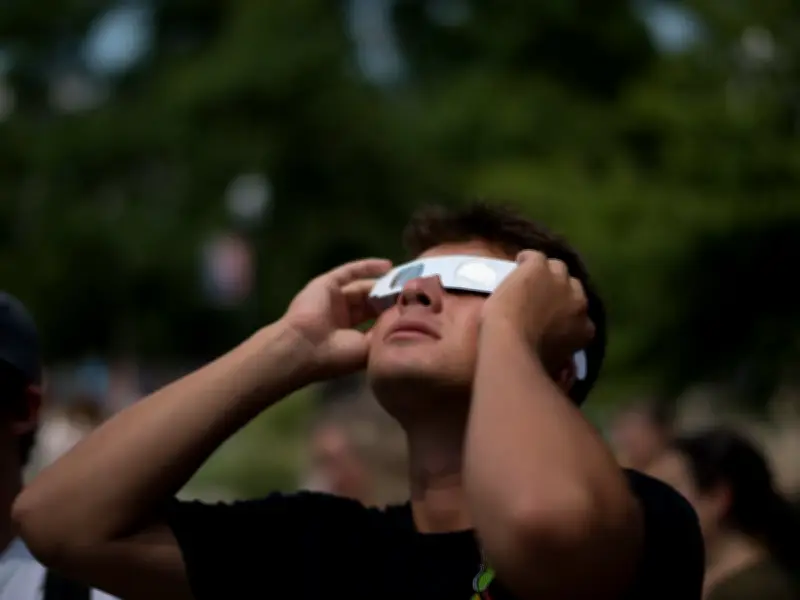
Millions of people across Europe will look to the skies on Wednesday, August 12, 2026, as a rare solar eclipse casts its shadow over the continent. The Moon will pass directly between the Earth and the Sun, blocking light and creating a dramatic celestial spectacle. For those who cannot witness it in person, the European Space Agency (ESA) will host a live broadcast, ensuring no one misses the event due to weather or location.
What Will the Eclipse Look Like?
The eclipse's path of totality—where the Sun will be completely obscured by the Moon—will cross Greenland, Iceland, and parts of Portugal and Spain. In these areas, daytime will briefly turn to night. Other parts of Europe, including the UK, will experience a partial eclipse, with the Moon appearing to take a "bite" out of the Sun and dimming daylight temporarily.
For UK viewers, the partial eclipse will be visible, but the extent of coverage depends on location. The event is a rare opportunity for skywatchers, as total solar eclipses over Europe are infrequent.
ESA Livestream Details
The ESA will broadcast the eclipse live from the Observatorio Astrofísico de Javalambre in Teruel, Spain, starting at 5:30pm BST (7:30pm CEST). The stream will be hosted by British space scientist Dame Dr Maggie Aderin-Pocock, known for co-presenting The Sky At Night, and will be broadcast in English.
The broadcast will feature live interviews, explainers, and spectacular imagery. Viewers can learn about the Sun's corona, how a famous eclipse in 1919 confirmed Einstein's theory of general relativity, and how ESA is now creating artificial solar eclipses in space with its Proba-3 mission.
Totality Moment
At 6:31pm BST (8:31pm CEST), the Moon will plunge Javalambre into complete darkness for one minute and 21 seconds. This will be the peak of the eclipse for the observatory, offering a rare view of the Sun's corona—the outer atmosphere—which is normally hidden by the Sun's bright light.
Viewers can ask questions during the broadcast using the hashtag #AskESA on Bluesky or X, with a selection answered live. This interactive element allows the public to engage directly with space scientists.
The Observatorio Astrofísico de Javalambre
Located within the path of totality, the observatory is a world-class facility consisting of two professional telescopes designed for large-sky astronomical surveys. These surveys help astronomers study galaxies, dark energy, and the structure of the cosmos. The location offers excellent viewing conditions, with rare cloud cover and low light pollution, providing a clear view to the western horizon where the Sun will set during the eclipse.
Additional small telescopes will be set up at the observatory to observe the eclipse. A live feed from these telescopes will provide continuous close-up views of the Moon passing in front of the Sun, showing different phases of the eclipse in detail.
Safety Tips for Viewing
Anyone planning to watch the eclipse must use properly certified solar viewing glasses. Looking directly at the Sun, even when partially obscured, can cause serious eye damage. The ESA and astronomers emphasize this safety measure, as the Sun's rays can harm the retina without immediate pain.
For those in the UK, the eclipse will be partial, but the same safety rules apply. Never look at the Sun without proper protection, and use filters on cameras or telescopes if photographing the event.
Where to Watch the Livestream
The ESA will stream the eclipse on its website and social media channels, including YouTube, Instagram, and TikTok. Several videos about the eclipse have already been posted to prepare viewers. The livestream will be available globally, so anyone with an internet connection can join the experience.
This event marks a significant moment for European space science and public engagement. As the Moon casts its shadow, millions will share in the wonder of the universe, whether in person or through the ESA's broadcast.