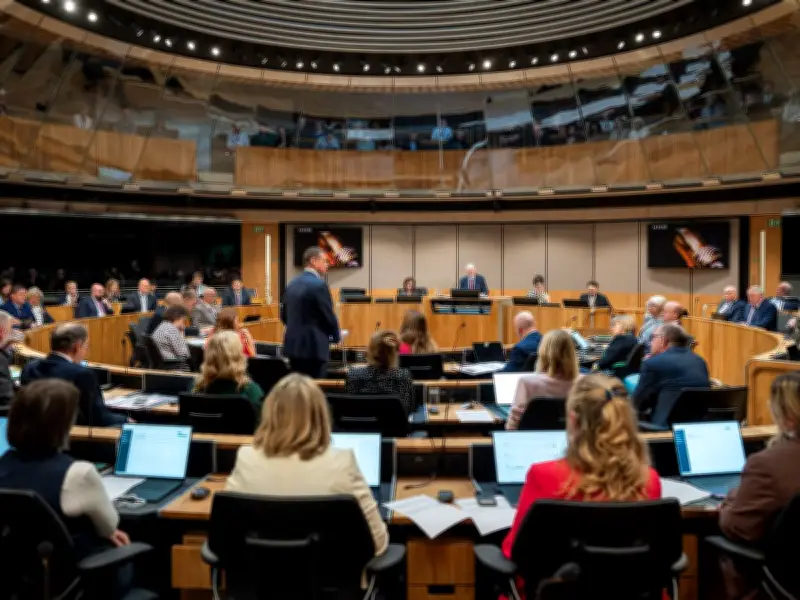
The Senedd has narrowly rejected a Welsh Government motion calling for a reform of the Barnett Formula, the mechanism used by the UK Treasury to allocate funding to devolved administrations. The motion, put forward by Welsh Government Trefnydd Heledd Fychan, was defeated by 46 votes to 45, with opposition parties tabling amendments that effectively killed the proposal.
What Happened in the Senedd
The motion sought to secure support from Members of the Senedd (MSs) for the Welsh Government's efforts to change the Barnett Formula, which has been in use since 1979. Originally intended as a temporary solution, the formula calculates devolved budgets by adjusting the previous year's block grant based on changes in comparable spending per person in England. According to the Institute for Government, this method multiplies changes in UK government department spending by a comparability factor and the population proportion of each nation.
Each opposition party proposed amendments to the motion. Labour's amendment sought to delete the entire Plaid Cymru motion and instead recognize that redistribution of wealth is a major benefit of being part of the United Kingdom. It also stated that Scottish resistance to Barnett formula reform should be the primary focus in the Welsh Government's engagement with the Scottish Government.

Reform's amendment similarly called for deleting the motion entirely, arguing that reforming the formula could result in Wales receiving £1 billion less a year, according to analysis from the Institute for Fiscal Studies. It urged the Welsh Government to focus spending on devolved areas and called on the UK Government to cut international spending to deliver fairer funding for Wales.
The Conservative amendment called on the Welsh Government to use existing budgets to deliver better value for money for Welsh taxpayers, noting the 2016 introduction of a need-based factor into the funding formula for Wales by a previous Conservative UK government.
First Minister's Remarks
First Minister Rhun ap Iorwerth told the Senedd that fair funding for Wales is more than just politics or political party rhetoric. He said: "It relates to Wales, which has the tools in its hands to build a better future for ourselves. The current fiscal arrangements in the United Kingdom aren't just unfair to Wales, they make economic failure more likely, and through reforming the current system we will ensure that the Welsh Government has the resources and the powers… to invest in public services, in infrastructure and in economic growth."
Mr ap Iorwerth vowed to work constructively with the UK Government, noting that Andy Burnham, the likely next Prime Minister, has experience of devolution from his time as Mayor of Manchester. He urged Labour MSs to vote for his party's motion, highlighting their manifesto commitment to fair funding.
When questioned by Conservative MS Andrew RT Davies on whether he had reached out to opposition parties to find consensus, the First Minister expressed concern that Mr Davies believed consensus was needed on such a fundamental issue. He said: "This is the fundamental of what we are here as a Senedd to do. This is the fundamental of us being able to speak with one voice as a nation."
Concluding, Mr ap Iorwerth added: "This Senedd has voted unanimously in favour of fairer funding for Wales before. It's my sincere hope that we can do so once more today, in the interest of the wellbeing and prosperity of our people."
Labour's Position
Caerdydd Penarth MS Huw Thomas spoke of Welsh Labour's belief that Wales benefits from being part of a union. Describing Wales and the UK as stronger together, he said: "The Welsh Government continues to receive over 20% more per person than equivalent UK Government spending in the rest of the UK. That means that, for every £1 spent by the UK Government in devolved policy areas, the Welsh Government is able to spend at least £1.20 on devolved priorities like health and education."
He acknowledged the Barnett Formula is not perfect but noted that reforming it requires negotiation between all four nations. He said: "Fundamentally reforming the Barnett formula in favour of a needs-based system will require negotiation, and ultimately agreement between all four nations. No single nation can do this alone, and yet, that agreement between nations is not forthcoming."

Mr Thomas, former leader of Cardiff Council, said the Scottish Government stops short of calling for a needs-based system because the current system benefits Scotland further. Quoting the Institute for Fiscal Studies, he said: "'No needs-based factor has been introduced for Scotland, likely reflecting the fact that it currently receives more funding per person than Wales, despite assessments suggesting it has lower needs.'"
Reform and Conservative Perspectives
Reform's Welsh leader Dan Thomas described the debate as more about Plaid's unfunded manifesto than securing fair funding. He said: "The First Minister is taking his begging bowl to London not because Wales doesn't get enough funding, but because Plaid, in my opinion, misled voters when they said that their manifesto was fully costed."
He called on the Welsh Government to focus on waste within the Welsh public sector and to make solid business cases for investment, including the M4 relief road and A45 upgrades. He added: "Make no mistake, Reform is in favour of making the case for capital investment above and beyond our block grant. But we need to do some of the heavy lifting ourselves, and we need to be much more ambitious."
Welsh Conservative leader Darren Millar described the Barnett Formula as beyond its shelf life and out of date. He said there is a need for a new funding mechanism but noted the risk involved in asking for a review of funding arrangements. He also criticized what he described as the political game played by Plaid Cymru.
Impact and Aftermath
Responding to the debate, Mr ap Iorwerth said: "There's a straightforward question at the heart of this debate. Should we always seek to stand up for Wales and stand up for fairness? [...] Or do you believe Westminster is being generous to Wales and we should be grateful for what we get?"
He criticized Reform's position, stating: "To seek fairness for Wales is to hand out a begging bowl. That is their level of respect for Wales. They are happy for Wales to languish." He also criticized Labour's shift in tone, addressing calls to tackle Scottish resistance to reform. He stressed the need for a fair and transparent funding system reflecting Welsh needs.