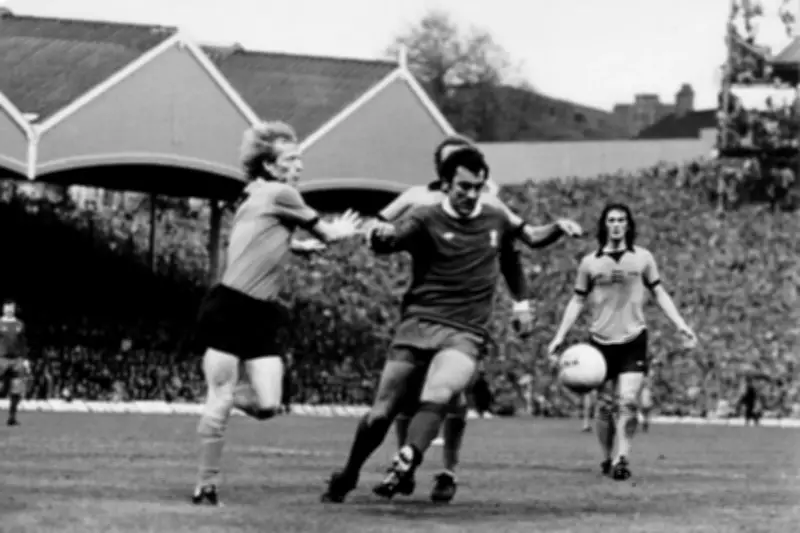
A football match at Molineux 50 years ago was the focus of a theatre production 86 miles away on Monday evening, reviving memories of a night when Wolverhampton came to a standstill due to 90 minutes of football. Paul Berry reports.
The Historic Clash
Wolves versus Liverpool, May 4, 1976. Fifty years ago on Monday. Wolves needed a win and Birmingham City to lose at Sheffield United to avoid relegation from the top division. Liverpool needed victory to overtake Queens Park Rangers and win the league title.
The matches had been rescheduled from 10 days earlier because several players were away with Wales facing Yugoslavia in the European Championship quarter-finals. Thousands of Liverpool fans, up to 20,000 by many estimates, travelled to Wolverhampton in hope and expectation of seeing their team claim the league championship.

Although it ended in disappointment for Wolves supporters, the night remains etched in the history of both famous clubs.
"Even in defeat, it remains a memorable night for everything that happened," says Wolves legend and now vice-president John Richards. "It was very different to a normal midweek game. If I think about memorable league games under the floodlights, I would add our win against Leeds in 1972 and drawing with Chelsea to go up as Second Division champions in 1977. That Liverpool side was a great side, and we did so well for so long that night."
The 50th Anniversary Show
The game is more fondly remembered on the red half of Merseyside. On Monday evening, the 50th anniversary, a special show called 'Dancing At Wolves' took place at the Epstein Theatre in Liverpool. The performance featured live music and oratory, hosted by Elton Welsby, with former Liverpool greats Phil Thompson, John Aldridge, and David Fairclough looking back at the events from half a century ago.
Wolves were represented by Steve Kindon, who opened the scoring in the famous game, and indirectly by Dave Thomas, who was part of the QPR side that would have won the title had Liverpool fallen short.
The show was the brainchild of journalist and author Hyder Jawad, who spent many years working in the Midlands. He wrote, co-directed, and co-produced 'Dancing At Wolves'.
"This was the sliding doors moment for Liverpool," says Jawad. "If they lose to Wolves on May 4, 1976, there is no European Cup final victory in 1977. Kevin Keegan likely leaves Anfield in 1976, Liverpool never sign Kenny Dalglish. Perhaps even Bob Paisley decides, after two difficult seasons, he does not want to stay in the job. Imagine how different the past 50 years for Liverpool had been had they lost at Molineux and handed the title to Queens Park Rangers."
The Build-Up and Atmosphere
Long before kick-off, the impact of the hordes of Liverpool fans was already being felt. Wolves usually had a light training session including set pieces in the morning, but those arrangements were affected on that day half a century ago.
"I always remember that the police got in touch with Bill McGarry on the morning of the game because there were so many Liverpool supporters walking around the town," recalls Wolves defender Geoff Palmer. "They opened the gates to Molineux because they wanted to know where all the fans were, and so they came in while we were training. We would often go to Castlecroft to train on the morning of a night game but went to Molineux this time, although we did not end up doing any set pieces due to the crowd! When it came to the evening, I needed a police escort to get back to the ground. A few of us needed that, along the Stafford Road from Fordhouses, because the traffic was so bad."
"We had all been told to give ourselves an extra half an hour to get to Molineux," adds Richards. "It is not like now when all the players come in together on the coach; we made our own way. Fortunately, I lived on the south side and most of the fans were coming from the north, from Liverpool, but even with that, the town was rammed with traffic and it was difficult to get to the stadium."
For the fans, it was even worse. The gates were closed half an hour before kick-off with over 46,000 already inside and an estimated 10,000 locked out. It was reported that 3,000 managed to scramble in by climbing walls and breaking down doors. The attendance was announced as 48,918, but the reality was far more.

"Our crowds had been about half that number in the games before, but I am sure it was way more than what was said at the time," says Palmer. "At Molineux back then, especially playing at full back, you were very close to the fans, and every time I went to take a throw-in, it felt like all I could hear was Scousers! It was absolutely rammed in Molineux that night, there were fans on the stanchions, climbing up the floodlights, the atmosphere was incredible."
Wolves fan Ian Smith, then a 14-year-old attending with his Dad, recalls: "The amount of people milling around Molineux that night was phenomenal. After we had negotiated the swaying masses attempting to get through the turnstiles, finally making it onto the terraces, we found that the normal empty spaces synonymous with the crowds at Molineux at that time were non-existent. The big time had returned to Molineux and this was how I imagined footballing life was every week at Anfield or Old Trafford. Only that night it was happening at my home ground, a great feeling. When the players finally emerged onto the pitch, the ground was heaving. There were fans who had climbed the various platforms of the floodlights to gain a better vantage point, ignoring the PA announcer's pleas to come down for their own safety. Fat chance!"
The Match
This was not just a match but an event. The atmosphere was intense. Wolves set out to spring a huge surprise that would deny Liverpool their ninth league title and mastermind their own Great Escape. Amid the raucous atmosphere, it started well. Richards played a pinpoint through pass behind the Liverpool defence, and Kindon fired the ball home to give Wolves a 14th-minute lead.
"That certainly livened things up a bit," Richards recalls. "We played well in that first half, we took the game to Liverpool and gave ourselves a bit of hope. We probably should have added a second as well because we were really going for it. That was the only way we could play at that time, by attacking. We did not have any other style and were not a team that could sit back and hold a lead. The longer the game went on, the more it looked as if we had a chance of spoiling the party."
At half-time, Wolves were in pole position to survive, as an Alan Woodward goal had Sheffield United ahead against Birmingham. But as the second half wore on, Liverpool's pressure mounted. Eventually, Wolves' resistance cracked. It was huge credit they held on until the 77th minute, when Kevin Keegan equalised, followed by Toshack (85) and Ray Kennedy (88) securing the points.
This was especially notable because Wolves had a makeshift back four. Regular centre-backs Frank Munro and John McAlle were both missing with knee injuries, leaving inspirational skipper Mike Bailey to move back from midfield for his 500th league game, and Derek Parkin to shift across from left-back. Palmer moved from left to right, with the attack-minded Alan Sunderland filling in as right-back.
"I always remember when we played Liverpool, it just felt a bit different," says Palmer. "Back then, the away coach would park directly outside their dressing room on Waterloo Road, and as soon as you saw their players in the corridor, there was an aura about them. But we were also fired up that night, I remember Jimmy Case was on the right-hand side for them, so he was my direct opponent. We did so well in the first half, but over the second half we started to tire, and what happened just felt inevitable in the end. When they eventually did get all those goals, in front of the South Bank, I am not sure I had ever heard noise like it from a set of away fans."
Aftermath and Relegation
There was honour in defeat for Wolves, especially with that patched-up defence. With Birmingham equalising to earn a point at Bramall Lane, even victory would not have staved off relegation. Nor did it save Bill McGarry's job. Just 48 hours later, on the Thursday night, he was sacked after a five-and-a-half-hour board meeting during which chairman John Ireland and director Harry Marshall were split. Marshall, who would soon become chairman, favoured a change, which McGarry slammed as a 'witch hunt'.
"It is the first time I have ever had the sack in 14 years as a manager and it is not a pleasant thing to happen to anyone," said McGarry. "The last week has been nothing more than a witch hunt."
McGarry's assistant Sammy Chung became caretaker manager, a role that then became permanent, and he guided Wolves to the Second Division title and an immediate top-flight return.
"That Liverpool game proved a really disappointing way to end the season, and I do not think anyone could really believe we had been relegated, just over two years after winning the League Cup," recalls Richards, who notched 25 goals in all competitions that year. "We had a fair few players knocking in the goals and I think it is unusual you get relegated with a top scorer around the 20-mark of league goals. There are always times when results go against you, but we always felt we were playing well enough to get out of trouble. Because of that, we also felt confident we would be able to come straight back up, but the Board did not share that opinion and so they sacked Bill McGarry. I actually had a knee operation the day after that Liverpool game and missed the start of the next season, but that proved a great year under Sammy, when four or five of us ended up scoring double figures."
"There were a couple of occasions in my time at Wolves when we won the League Cup, got relegated a couple of years later, and then came straight back up," adds Palmer. "Under Sammy, we went down with experienced players who could handle the Second Division, and a manager who was a very good coach and already knew us all. The hardest thing was trying to change to call him gaffer, so in the end he just said to forget it and call him Sammy!"
Fan Memories
Returning to that night against Liverpool, supporter Smith recalls the surreal scenes of the pitch covered by a sea of red as jubilant supporters swarmed the playing surface to get a glimpse of their heroes who had made their way into the Directors Box.
"As I climbed the South Bank steps to go home, I stopped and turned to look at this scene, as that evening became the first of only two occasions my team has had me in tears. The other was when John Richards returned from injury after everyone else had said he was finished. I stood there thinking that another 13 minutes and it would have been Wolves fans on the pitch celebrating. This was a season we were relegated when we did not deserve it; every other relegation year we deserved it but not this one."
For Liverpool, the emotions were very different. A league title in the bag, a night of celebrations, and a trip to Molineux that will never be forgotten. And one that was restored to the public consciousness in Merseyside with 'Dancing At Wolves' on Monday night.
"I won seven League championships with Liverpool, but this is one that stood out, not just for the way that we won it, in the final match of our season at Wolves, but also for the stories surrounding the match," said legendary defender Thompson. "When we got to Molineux, we found that all four sides of the ground were full of Liverpool fans - I had never seen anything like it for an away match. My brothers were outside and could not get in. They had been to every Liverpool match home and away that season. The dressing room opened out to the road outside, where my brothers were, and I convinced Bob Paisley to get the door opened to let them in. Then, about 40 people went in. Bob shouted: 'how many brothers have you got, Tommo?'"
As one door opened for Liverpool, another slammed firmly shut for Wolves. But at least it was followed by an immediate return to the top division, one which the modern day Molineux faithful would love to see again, all these 50 years on.