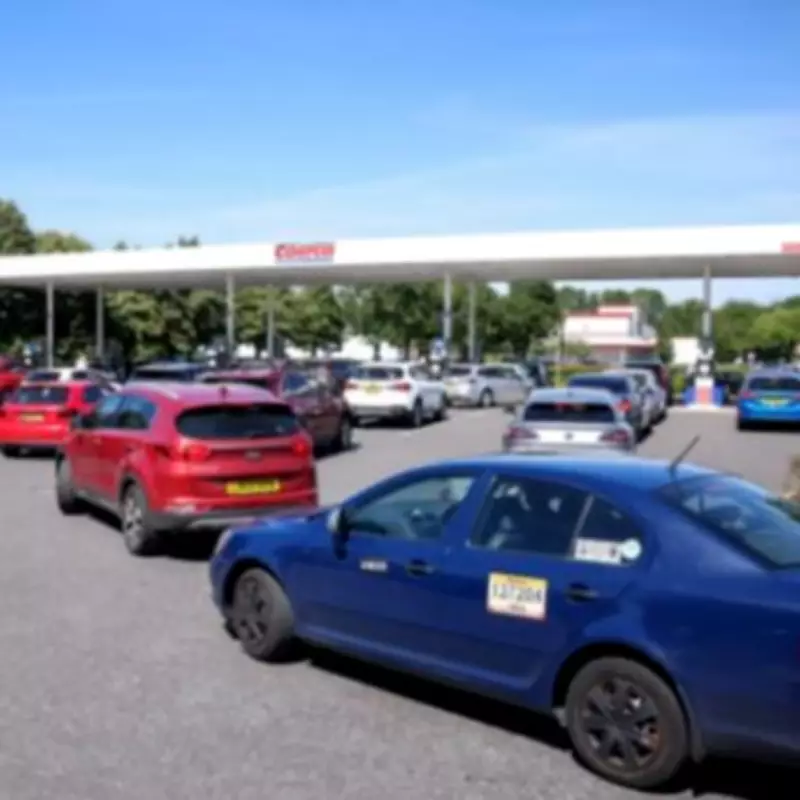
Motorists across the UK are being issued a stark warning that a seemingly "quick" habit at petrol stations could land them with a substantial £200 fine. The caution specifically targets drivers who check their mobile phones while edging their vehicle forward at the pump, a common practice that many mistakenly believe is permissible.
The Law on Mobile Device Use While Driving
It is illegal to hold and use any device capable of sending or receiving data while you are driving or riding a motorcycle. This comprehensive law covers mobile phones, sat navs, tablets, and similar electronic gadgets. Crucially, you must not use a handheld device for any purpose, regardless of whether it is connected to the internet or operating in an offline mode.
Prohibited activities include texting, making phone calls, taking photographs or videos, and browsing the web. The legislation is designed to ensure full attention is on the road at all times when a vehicle is in motion or under the driver's control.
Common Misconceptions at Petrol Stations
Oliver Weston, a representative from Four Pillar SEO, highlighted a frequent area of confusion. "People often search for queries like 'is it illegal to use my phone at a petrol station' because they see payment apps and assume it's acceptable while they are still edging forward," he explained.
"The key point is whether you are driving. If you are in control of the vehicle and it is moving, even slightly, you can still find yourself in legal trouble." This clarification is vital for drivers who might think stationary moments, such as waiting to refuel, provide a legal loophole.
When the Law Applies: Broader Scenarios
The regulations extend beyond simply driving on the open road. You are still bound by this law in several common situations, including:
- Being stopped at traffic lights.
- Queuing in stationary or slow-moving traffic.
- Supervising a learner driver.
- Driving a vehicle with a stop-start engine system.
- Using a device that is in flight mode or otherwise offline.
The fundamental principle remains: if you are in the driver's seat and in control of the vehicle, the prohibition on handheld device use is in effect.
Permitted Uses of Handheld Devices
There are limited, specific circumstances where using a handheld device is legally allowed. These exceptions include:
- Calling 999 or 112 in a genuine emergency where it is unsafe or impractical to stop the vehicle.
- When you are safely parked, with the engine switched off.
- Making a contactless payment while the vehicle is completely stationary, such as at a drive-through restaurant.
- Using the device to park your vehicle remotely.
Understanding Hands-Free Access
Drivers can legally use devices with proper hands-free access, provided the device is not held at any point during use. Acceptable hands-free methods include:
- A Bluetooth headset or earpiece.
- Voice command functionality.
- A secure dashboard holder or mat.
- A windscreen mount.
- The vehicle's built-in satellite navigation system.
These systems allow for communication and navigation without physically handling the device, thereby maintaining focus on driving.
Penalties and Consequences
The penalties for breaking this law are severe and can have long-lasting effects. If caught holding and using a phone or similar device while driving, you face:
- A fixed penalty notice of £200.
- Six penalty points endorsed on your driving licence.
For drivers who have passed their test within the last two years, accumulating six points will result in the revocation of their licence, forcing them to retake both the theory and practical tests.
Additionally, you can receive three penalty points if using any device causes you to lose proper control of the vehicle or fail to have a full view of the road and traffic ahead. This underscores the law's primary goal: to enhance road safety for all users by minimising distractions.
This warning serves as a crucial reminder for all motorists to prioritise safety and comply with the law, even during brief stops or slow manoeuvres like those at petrol forecourts.