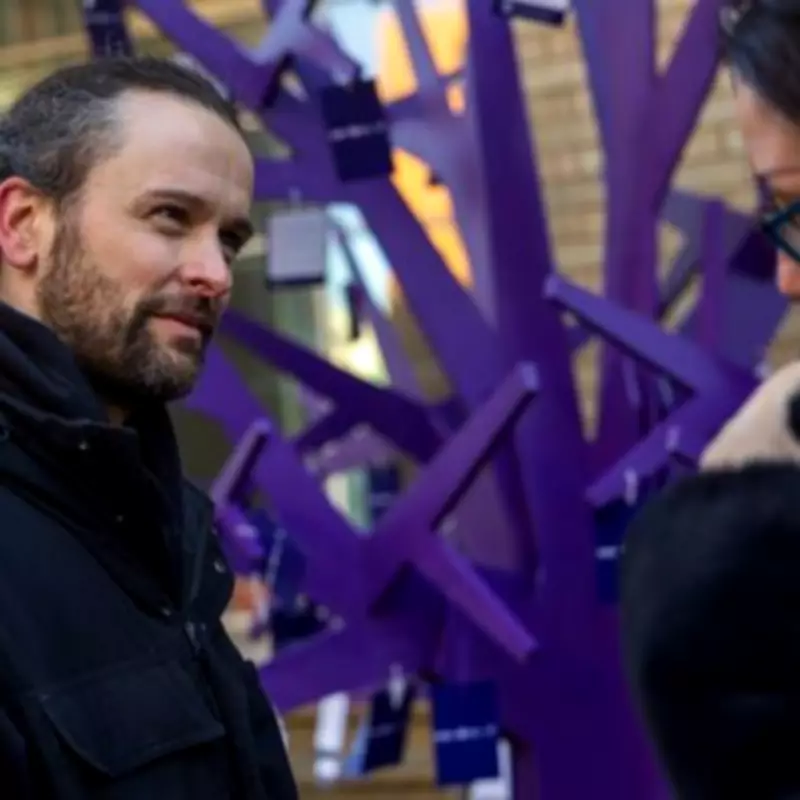
Addressing the profound injustices experienced by families who have lost loved ones on West Midlands roads represents the fundamental motivation for the region's dedicated safety commissioner. Dr Mat MacDonald was appointed to the pivotal role of Road Safety Commissioner for the West Midlands Combined Authority with the explicit mission of preventing fatalities and serious injuries resulting from reckless driving behaviours.
A Year of Progress and Future Ambitions
During his inaugural twelve months in this crucial position, the NHS doctor has focused on advancing several key developments. These strategic initiatives include the systematic reduction of speed limits, the introduction of advanced red-light camera technology, the enhancement of physical safety measures, and the active encouragement of more sustainable transport options across the region.
Dr MacDonald emphasised that significantly more work lies ahead if the West Midlands is to achieve its ambitious 'Vision Zero' target. This goal aims to completely eliminate deaths and serious injuries on the region's roads by the year 2040, representing a transformative shift in road safety policy.
Personal Motivation and Political Alignment
"Throughout my campaigning work, I have had the profound privilege of meeting numerous families who have endured the most unimaginable losses on our roads," Dr MacDonald stated. "Rectifying the injustices these families have faced is genuinely what has propelled me into this vital work. Knowing that Mayor Richard Parker shares that same sense of injustice and possesses a parallel desire to reform our road systems—which are currently failing people far too often—has presented an incredible opportunity for meaningful change."
Key Developments in Enforcement and Infrastructure
One of the commissioner's major achievements has been spearheading the development of a joint working agreement focused specifically on speed and red-light enforcement. Ongoing work now concentrates on securing sustainable funding models and planning the comprehensive rollout of this enforcement strategy across the entire West Midlands region.
"This agreement marks a critically important milestone," Dr MacDonald explained. "It will enable us to deliver more extensive average speed enforcement across our communities. Birmingham has already embraced this approach, initiating a programme to establish several average speed enforcement locations. Furthermore, the city has undertaken excellent work in reducing speed limits from 40 mph to 30 mph on several major arterial roads that traverse urban areas."
He confirmed that these measures are already producing a noticeable impact on vehicle speeds, which will ultimately help prevent collisions and reduce the number of fatalities and serious injuries. The commissioner's unique position, providing direct access to the Mayor and senior transport officials across the region, has been instrumental in overcoming various implementation challenges.
Addressing Specific Tragedies and National Influence
Plans to pedestrianise a specific road where four-year-old Mayar Yahia was tragically killed while returning from an Eid celebration in Birmingham during 2024 have experienced delays. However, Dr MacDonald was able to conduct direct discussions with Birmingham City Council leadership, receiving firm assurances that the vital safety scheme will ultimately proceed.
His influential role also afforded the opportunity to contribute to the development of the first national road safety strategy published in over a decade. "This represents a genuinely exciting first step at the national level," he remarked. "At the highest echelons of government, there is now a movement to challenge the widespread acceptance that approximately 1,600 people should be killed on British roads annually. This figure becomes utterly unacceptable when we acknowledge that with appropriate infrastructure and legislation, we can prevent death and serious injury entirely."
The Human and Economic Cost of Road Collisions
Dr MacDonald provided a stark analogy to illustrate the scale of the problem: "Currently, the equivalent of a jumbo jet full of people loses their lives on our roads every six weeks. If an actual jet were crashing with that frequency, you can be certain that aircraft would be grounded immediately, and the entire aviation industry would halt operations to investigate the cause. Yet we seem to passively accept this level of death occurring on our road networks."
He argued that this pervasive danger fundamentally restricts society in multiple ways, affecting children's freedom to play and travel independently, diminishing how communities connect within neighbourhoods, and degrading the overall appearance and atmosphere of our streets.
Changing Travel Culture and Future Initiatives
While current efforts are beginning to positively influence serious injury statistics, with the full impact expected to become clearer in coming years, Dr MacDonald acknowledges substantial work remains. Several new initiatives are scheduled for introduction in the forthcoming year. With major transport schemes in development, he stresses that safety considerations must form an integral component from the very beginning of all planning processes.
Nevertheless, persuading individuals who remain strongly attached to car travel continues to present a significant challenge. "We have historically shaped our infrastructure and legal frameworks to make private car use the most convenient travel option," Dr MacDonald observed. "Most people, quite understandably, do not spend time deliberating over transport choices; they simply select the easiest available option. In cities like Copenhagen, which exhibit much higher rates of cycling and walking, people choose bicycles because it is often the simplest way to navigate. Our task is to make safer, non-car travel options both more accessible and more appealing."
He concluded with a powerful economic argument: "Collisions carry a tremendous financial burden. While we can never assign a monetary value to a human life, we can quantify the economic damage caused by road collisions. In our region alone, this amounts to £444 million every single year. Ensuring that new infrastructure projects incorporate safety from the outset will not only prevent immense personal heartache but also conserve considerable regional resources."