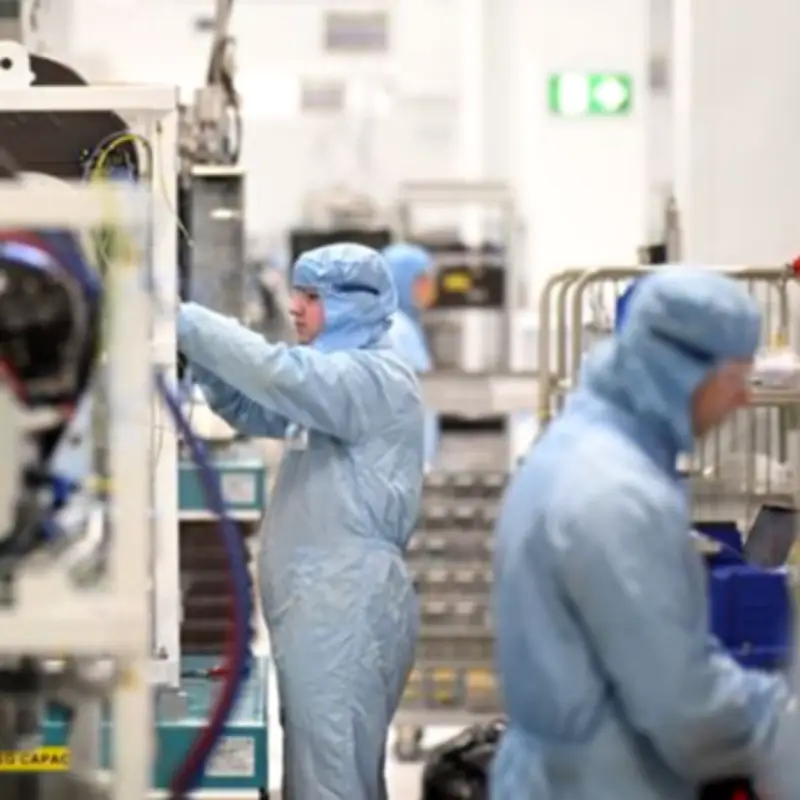
The compound semiconductor cluster in South Wales holds immense potential, but Dr Wyn Meredith, chair of CSconnected, warns that the new Welsh Government must act swiftly to secure its future for the people of Wales.
A hidden powerhouse
Somewhere in South Wales, an engineer is working on technology that will end up in electric vehicles, 5G signals, and aircraft radar systems. This industry, largely unknown to the public, has been quietly building since the 1980s. Today, it is globally recognised for its expertise in compound semiconductors—the chips essential for modern technology.
Since the formal launch of a cluster strategy in 2015, the sector has gained political recognition. Plaid Cymru, now forming the new Welsh Government, committed to its "continued development" in its manifesto. Welsh Labour called it "world-leading," and the Welsh Conservatives referenced it as a national priority.
For those who have spent nearly two decades building this cluster—the world's first of its kind—this recognition is a source of pride. But recognition alone is insufficient. The first 100 days of the new government represent a defining window of opportunity to realise its potential.
The new industrial revolution of Wales
Cardiff University's Welsh Economy Research Unit recently documented the impact of targeted industrial investment in Wales. The South Wales compound semiconductor cluster now supports £436 million of Welsh GVA and 3,140 Welsh jobs. These jobs pay an average salary of around £66,000—roughly twice the Welsh median. More than 90% of output is exported, making it one of the most export-led sectors in the Welsh economy. Every £1 million of GVA generated supports an additional £630,000 in Welsh supply chains and communities. Since 2020, Welsh jobs supported by the cluster have grown by 51%.
This growth occurred while UK manufacturing employment faced pressure and much of Welsh heavy industry declined. The cluster did not grow despite these conditions; it grew because of deliberate, structured development. Targeted public investment attracted significant private capital, while academic and industrial partners worked together in a quadruple helix model, supported by the not-for-profit convenor CSconnected.
The model has proven effective, and a structure is now in place for further growth. The newly appointed Welsh Government must act quickly to elevate the cluster to its next level and prevent competing nations from moving faster.
The global race Wales cannot afford to lose
The United States has committed billions under its Chips Act. The European Union has mobilised the European Chips Act. South Korea and Taiwan are scaling aggressively. Every month that passes without the necessary decisions narrows Wales's global head start. Wales has built something remarkable—the world's first compound semiconductor cluster, a globally recognised hub for an industry projected to be worth a trillion dollars by 2030. The new Plaid Cymru government has inherited this asset, with Adam Price, the new Cabinet Minister for Enterprise, Connectivity and Energy, taking direct responsibility for its future.
The cluster's ambitions are clear: £1 billion in revenue and 6,000 skilled jobs by 2030. These targets are achievable, but they require accelerating the conversion of committed public investment into operational funds. Decisions that have often moved in different directions must now align. Inward investment, planning, skills, and infrastructure must work together. Wales must also collaborate with Westminster to advocate for the cluster at the UK level, where the next phase of catalytic investment will be decided.
What this means for the people of Wales
While the cluster's infrastructure is concentrated in South Wales, its economic reach extends far beyond this region. The cluster supports £567 million of GVA across the UK, with £436 million staying in Wales. Supply chains stretch across the entire country, and the skills pipeline draws from universities and colleges nationwide.
The high-wage, export-led, Welsh-rooted jobs created by the cluster are exactly the kind of employment that benefits the people of Wales: well-paid, rewarding, future-proof work in a growing industry. These jobs have been developed locally and can remain here, with Welsh engineers and researchers working alongside world-class global partners.
An invitation
To the new Welsh Government: the compound semiconductor cluster is ready to work with you from day one. Our door is open. Come and see what has been built across Newport, Cardiff, and Swansea. Meet the engineers. Walk the facilities. Experience the career opportunities available. Your first 100 days are an opportunity to turn this combination into something lasting.
Dr Wyn Meredith is Chair of CSconnected and founding director of the Compound Semiconductor Centre. He has worked in the compound semiconductor industry for more than 25 years.