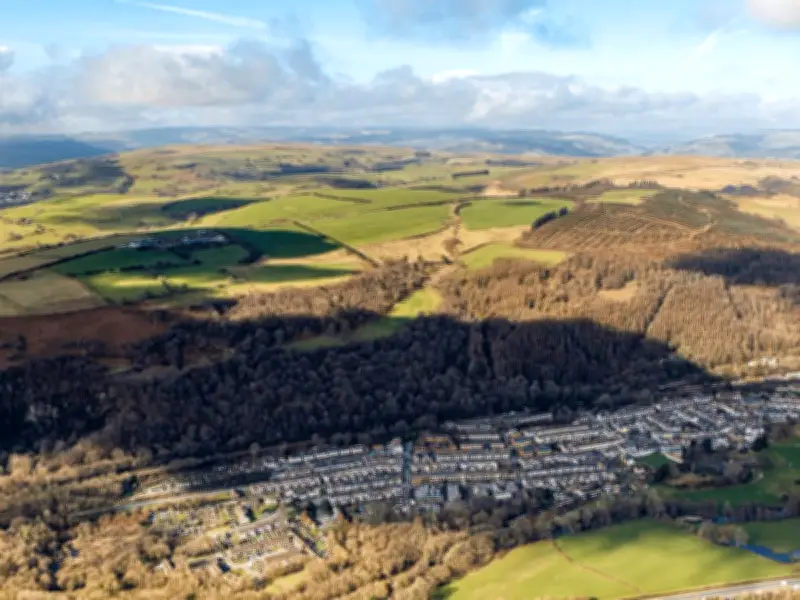
Construction of a major wind farm project near Caerphilly, which at capacity will generate clean electricity to power 81,000 homes annually, can start following a £160 million funding deal. Bute Energy has closed a finance agreement to fund construction of its Twyn Hywel Energy Park with Rabobank and Lloyds.
The project, located on the border of Caerphilly and Rhondda Cynon Taf, will comprise 14 wind turbines with a total installed capacity of 93.4 megawatts. It is expected to become operational next year.
Power Purchase Agreement and Community Benefits
Renewables-focused energy company SmartestEnergy has entered into a 20-year contract for difference (CfD) power purchase agreement (PPA) with Bute for energy produced by the wind farm. The project was awarded a CfD in the UK Government’s allocation round seven (AR7), back in February.
Twyn Hywel is the first to move to the construction phase in Bute Energy’s planned £3 billion portfolio of onshore wind farms. If all are delivered, they could power the equivalent of 2.25 million homes over the next decade.
Martin Chown, chief executive at Bute Energy, said: “This is a defining moment for Twyn Hywel and for the role renewable energy can play in building long-term prosperity in Wales. We are now moving from plan to delivery, bringing jobs, investment and opportunity into the communities closest to the project. The project will support up to 300 jobs during construction, with an annual community benefit fund of £704,000 once the project is completed. Our approach to delivering sustainable investment means that communities will feel the benefit from our investment in clean energy infrastructure – from jobs and skills, community energy, the community benefit fund and a share in the ownership of the project.”
Bute Energy is developing a new shared ownership model, giving communities the opportunity to own up to 15% of Twyn Hywel Energy Park.
Government and Industry Reactions
Cabinet Minister for Enterprise, Connectivity and Energy, Adam Price, said the new Welsh Government is keen to build an “open and collaborative relationship” with the offshore wind sector and other key partners such as UK Government and the Crown Estate. Speaking at the Global Offshore Wind 2026 conference, hosted by RenewableUK in partnership with the Global Wind Energy Council, Mr Price said: “I believe that the offshore wind sector has the potential to deliver high quality sustainable career opportunities for people in Wales, which directly aligns with our productivity mission and retaining value for Wales. The offshore wind sector has a key role to play in bringing about the regeneration of coastal communities in both north and south Wales. Our role is to remove the blockers faced by the sector – whether in planning, access to finance or infrastructure. We will focus on getting things done at pace and working collaboratively with the relevant organisations to make things happen.”
Wales currently has three operational offshore wind farms that generate 726 megawatts of electricity. Three development contracts for three huge floating offshore wind farms in the Celtic Sea have been approved by the Crown Estate with developers. One will be solely in Welsh waters, one will straddle Welsh and English waters, with a third solely in English waters.
Mr Price added: “The Port of Mostyn is one of the biggest successes of Wales’s offshore wind sector with commercial-scale experience. It has contributed to the build-out of seven fixed bottom offshore wind projects and has created 240 highly skilled jobs for Wales. We also welcome the UK Government’s commitment of up to £64 million to support the development of Port Talbot as the first port in the Celtic Sea to deliver floating offshore wind. Working in close partnership with UK Government, the Crown Estate, NESO (National Energy System Operator) and Great British Energy will be critical to unlocking the barriers to investment and deliver the market conditions for this to work for Wales and the wider UK.”
Jessica Hooper, director of RenewableUK Cymru, said: “Offshore wind is Wales’ next big industrial opportunity - from ports to production lines, powering a new wave of Welsh industry that over the next decade could be worth almost £5 billion to Welsh businesses, and deliver more than 3,000 long-term, secure jobs. The new Plaid Cymru government has made it clear that renewable energy is central to Wales’ economic renewal and energy independence. To unlock this opportunity at the scale Wales deserves, we need decisive, coordinated action, investment in critical infrastructure, accelerated planning pathways, and a business environment that gives Welsh firms the confidence to grow, anchoring jobs and a long-term industrial legacy into communities. We look forward to working in partnership with the new Welsh government, and putting the right conditions in place so Wales can play to its strengths - and play a leading role in the next exciting chapter of offshore wind development.”
Opposition Concerns
Janet Finch-Saunders, Tory MS for Bangor Conwy Môn, has called on the First Minister to introduce a moratorium on large wind farm developments in Wales. She said: “Wales is blessed with some of the most beautiful landscapes in the world, and they are a major reason why millions of visitors come here each year. While renewable energy has an important role to play, we must ensure that development is proportionate and does not come at the expense of our natural environment, tourism industry or food security and rural communities. The prospect of 200-metre high turbines dominating our countryside raises legitimate concerns for local communities. We must carefully consider cumulative impact on our landscapes, wildlife and the productive farmland that sustains rural Wales. The First Minister has previously recognised that large-scale renewable projects can lead to the loss of productive farmland, farming jobs, and valuable economic activity in rural communities. In light of the scale of development now being proposed, I believe there is a strong case for the Welsh Government to declare a moratorium on large wind farm developments, and put in place a plan that prioritises food security in Wales.”