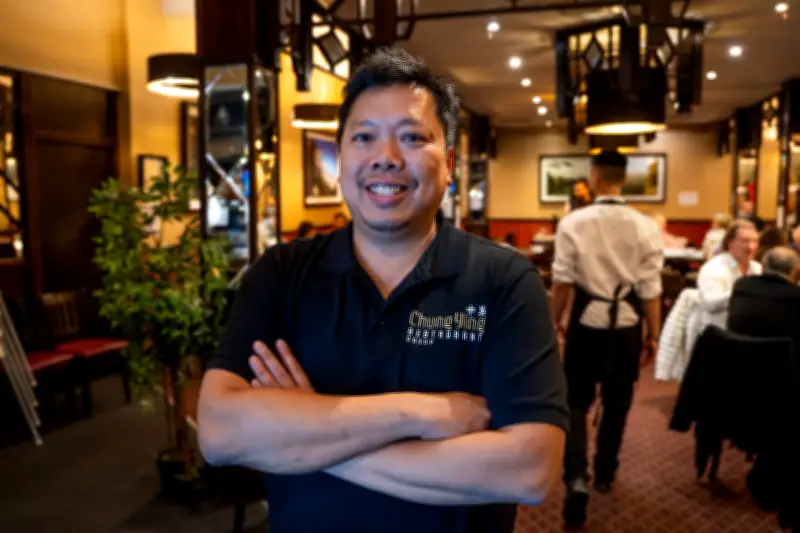
The Lucky Claw arcade above the Han Dynasty Food Hall on Bromsgrove Street offers a neon-lit respite from the culinary marathon below. My companion, James Bond Wong, is paying, so I have little to lose. We have already visited several eateries, including Wong's own Chung Ying, a long-established Cantonese restaurant, and my stomach is full of dim sum, pork belly, and chicken feet.
This area, Birmingham's China Town, appears to have achieved the impossible. Every week, new restaurants and cafes open, their tables consistently full. Data from our analysis of Food Standards Agency records confirms the boom: the number of East Asian eateries and cafes on ten streets in Southside has increased by two-thirds in just four years, from 47 in 2022 to 77 in 2026. Chinese, Vietnamese, Japanese, Korean, and other East Asian cuisines now represent nearly three-quarters of the area's restaurants and cafes, up from just over half in 2022.
A Legacy of Opportunity
As the rest of Birmingham's—and indeed the country's—hospitality sector limps along, China Town has bucked the trend. To understand why, I called on Wong. But as I soon learn, major success does not mean plain sailing. Behind the curtain, some of the area's major players are locked in what might be described as one of Birmingham's most low-key power struggles.
Chung Ying has stood on the same spot on Ladywell Walk since it opened in 1981. The street was largely derelict then. Though a few Chinese restaurants dotted Bromsgrove Street, the neighbourhood was better known for nights out. Where others saw empty lots, Wong's father saw opportunity. Hoping to capitalise on theatre goers heading to the nearby Hippodrome, Wong senior opened the city's first Cantonese restaurant.
When I meet Wong at the restaurant, he wears a zipped cream jumper and jeans. He directs my attention to the certificate-covered walls, from 'Best Dumplings' to 'Restaurant of the Year'. Wong tells me they have won so many awards they have stopped applying: "it's become embarrassing," he says.
Catalyst for Growth
Wong describes Chung Ying as "the catalyst for the building of China Town." Over the next decade, many more Asian restaurants appeared on the surrounding streets. In 1991, the Arcadian opened just across the road from Chung Ying, providing more space for bars and restaurants, designed specifically to allow China Town to expand.
Wong, whose middle name 'Bond' comes from his father's obsession with the 007 films, has carried on the family legacy. As with the restaurant, the love of spies is a patrimonial trait—Wong Jr has personalised 007 number plates. Today, he is a community figurehead, organising most of the neighbourhood's events, including Chinese New Year. He also heads up the Midlands Chinese Federation, a charity he founded this year.
From the windows of Chung Ying, he has watched the area grow and change. This growth is not a nationwide trend. "London China Town is confined to Soho," he says. "The only way it could grow is if it moved to another area…Manchester China Town is just a square and all the big restaurants I used to go to are gone." He pauses. "And Liverpool China Town is dead."
Space for Expansion
Why is Birmingham's China Town thriving? Wong believes the answer is simple: space. He gestures towards Digbeth, drawing a sweeping line towards Curzon Street where the HS2 station will one day stand. "All of that area is kind of untapped if you go further down Hurst Street, all that is being bought up by Chinese people."
The area's expansion shows no signs of slowing, with new developments and eateries continuing to emerge. The combination of a strong legacy, community leadership, and available land positions Birmingham's China Town for continued growth, even as other urban China Towns contract.