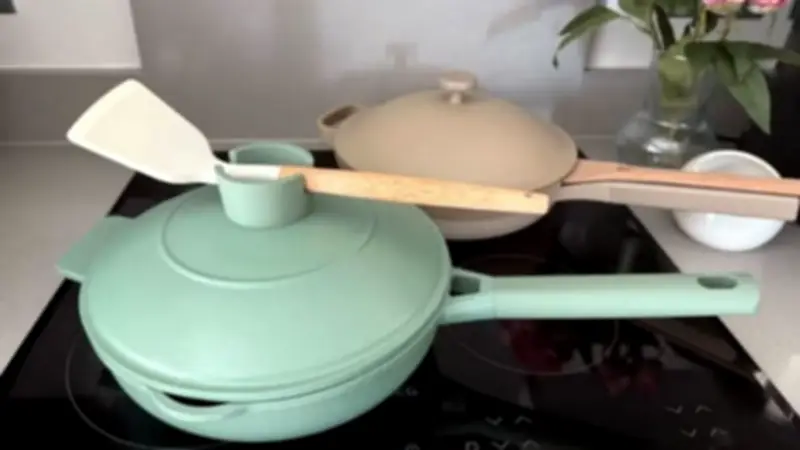
Lakeland's Only Pan, priced at £59.99, offers a budget-friendly alternative to the popular Always Pan from Our Place, which retails at £125. After a side-by-side test, the Only Pan impresses with its larger capacity and lower price, but the Always Pan counters with more cooking functions and a higher oven tolerance. The choice ultimately depends on your cooking habits, kitchen space, and budget.
What's the Difference Between the Two Pans?
The Always Pan, launched in the UK in 2021, quickly became a cult favourite, selling out repeatedly. It's a 10-in-1 non-stick pan that can steam, strain, sauté, and more. The Only Pan from Lakeland offers 8-in-1 functionality, including steam, simmer, pan-fry, boil, sauté, stir-fry, braise, and strain, but lacks the roast and bake options found on the Always Pan. A key difference is oven safety: the Only Pan is oven-safe up to 150°C, while the Always Pan can withstand up to 230°C.
Lucy Addicott, who used the Always Pan daily for a year, tested both pans for The Mirror. She noted that the oven temperature difference was significant when cooking a chicken pie. "This difference stood out to me when cooking a chicken pie in the Only Pan – while I was easily able to cook the pie filling in one pan, I then had to transfer it to another dish that would be suitable for the oven temperature. This meant more washing up, time and effort," she wrote. Since many recipes call for 180°C or higher, the Always Pan's higher tolerance is a real advantage.
Capacity and Accessories
The Only Pan holds 3.1 litres and measures 26cm in diameter, while the Always Pan holds 2.46 litres and is 26.7cm wide. The extra capacity in the Only Pan is handy for larger meals. Both pans come with a lid, a stainless steel steamer basket, and a spatula. The Always Pan includes a beechwood spatula, while the Only Pan uses silicone. Lucy preferred the Only Pan's angled silicone spatula for stirring and cleaning, but noted that the Always Pan's spatula rests inside the pan, preventing drips on the worktop. "Both built-in spoon rests eliminate the need for a separate spoon-rest, however, I did find that food sometimes dropped onto the top of the Only Pan which was messy," she said.
Cooking Performance and Design
In a bacon-frying test, the Always Pan reached cooking temperature one to two minutes faster, but both produced crispy, well-cooked bacon. Visually, Lucy found the Always Pan sleeker and more high-end, thanks to its heavier weight. "It feels a little heavier in weight, giving it a high-end feel and look, plus I'm not keen on the bulky lid on the Only Pan," she explained. The Always Pan comes in six colours, including forget-me-not, spice, sage, steam, char, and blue salt, while the Only Pan offers four: sage green, slate grey, vanilla cream, and dusky clay.
Non-Stick Coating and Cleaning
Both pans feature a non-toxic ceramic coating that prevents sticking. After a year of heavy use, the Always Pan's non-stick surface remains effective, and the Only Pan performed equally well out of the box. The Only Pan is dishwasher-safe, though hand-washing is recommended, whereas the Always Pan should never go in the dishwasher.
Price and Value
The Only Pan costs £59.99, making it less than half the price of the Always Pan at £125. This price difference is a major factor for budget-conscious shoppers.
The Verdict: Which Pan Should You Buy?
Lucy admits neither pan is a clear winner. "They're both top performers that in my opinion certainly live up to the hype and make cooking a lot easier, less time-consuming and more fun," she said. The right choice depends on your cooking style and budget. "I cook most days and I enjoy experimenting with different recipes so I found the versatility of the Always Pan crucial," she added. "I also love keeping my cookware out on the side to add to the look of my kitchen and the Always Pan ticks that box for me." For those cooking for one or two, the Only Pan's larger capacity and lower price make it a compelling option. Prices were correct at the time of publication.