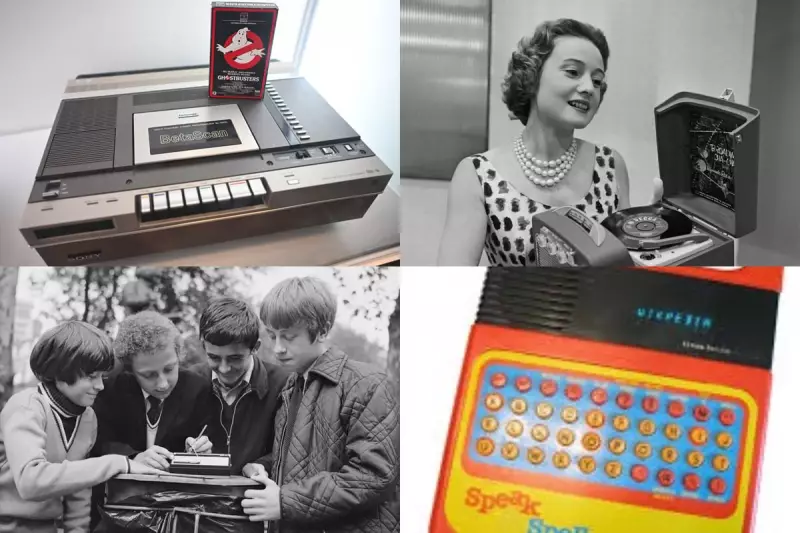
They were the must-have items that defined generations, flying off shelves by the millions and representing the very peak of technological innovation. Yet today, these pioneering gadgets from the 60s, 70s, 80s and 90s have largely faded into obscurity, rendered obsolete by relentless technological progress and shifting consumer tastes.
From living room centres to pocket-sized novelties, these devices changed how we worked, played, and connected with the world. Many ended up discarded in attics or thrown away, becoming mere footnotes in consumer history. Yet their legacy as design classics that paved the way for modern technology deserves recognition.
The Sound Revolutionaries
The Stylophone, launched in 1967, became an unlikely musical phenomenon. This miniature analogue synthesiser, designed primarily for children, captured the imagination of professional musicians worldwide. Legends like David Bowie and John Lennon incorporated its distinctive synthetic sounds into their work, helping it secure a place in music history. Its remarkable durability and simple design ensured its survival far beyond expectations, leading to a successful relaunch in 2007 for a new generation to discover.
Before personal music players became commonplace, the Dansette record player dominated portable audio. First introduced in 1952, it sold over one million units throughout the 50s and 60s. Designed for mobility with its built-in handle, front-facing speakers, and protective latches, it became the social centrepiece for teenagers who would transport them to parties to share the latest vinyl releases with friends.
Visual Pioneers and Format Wars
The home entertainment landscape was forever changed by the fierce battle between video formats. Betamax video recorders, launched by Sony in 1975, initially seemed destined for victory with their superior picture quality. However, their limited one-hour recording capacity proved a fatal flaw against the VHS rival. Despite efforts to extend recording time by sacrificing resolution, Betamax had clearly lost the format war by the late 1980s. Surprisingly, Sony continued manufacturing the machines until the early 2000s, before both formats were ultimately superseded by DVDs and streaming services.
In photography, the Kodak Instamatic camera created a revolution upon its 1963 debut. Its brilliant combination of affordability and simplicity democratised photography, making it accessible to millions. The camera's extraordinary popularity saw more than 50 million units sold between 1963 and 1970. Its success spawned numerous imitators, and the name 'Instamatic' became synonymous with any cheap, point-and-shoot camera.
Educational Tools and Quirky Novelties
The Speak & Spell computer, launched in 1978, represented many children's first encounter with computing technology. This educational toy used synthetic speech to help children aged seven and above learn to spell and pronounce over 200 challenging words. The thrill of interacting with its electronic voice created lasting memories for 70s and 80s children, leading to its nostalgic relaunch in 2019.
Among the more eccentric inventions, the Sinclair C5 emerged in 1985 as a potential future for sustainable transport. Created by home computer millionaire Clive Sinclair, this one-person electric tricycle featured cutting-edge technology for its time. However, its limited 15mph top speed and restricted battery life failed to convince the public. Only 5,000 of the 14,000 manufactured units sold before the company entered receivership. Despite its commercial failure, it has since been reappraised as a cult design classic and become highly collectable.
The late 80s and early 90s witnessed the bizarre craze of sound effects keyrings. These noisy novelties, featuring eight coloured buttons that produced imitation gunfire and falling missile sounds, became particularly popular—and annoying—on school buses. They served as popular Christmas stocking fillers until mobile phones arrived with their own ringtone craze, rendering the keyrings obsolete.
These forgotten gadgets represent more than just obsolete technology; they capture moments of cultural and technological transformation. While they may have disappeared from daily use, their influence echoes in the devices we use today, reminding us that today's cutting-edge innovation often stands on the shoulders of yesterday's forgotten pioneers.