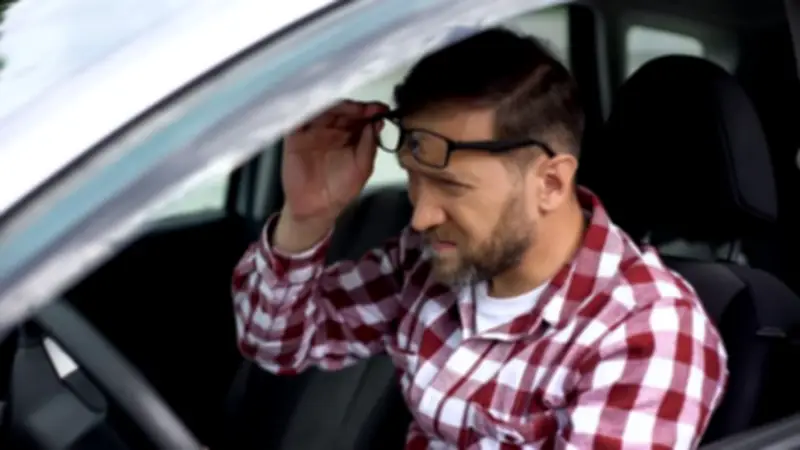
Motorists are being reminded that their eyesight must meet certain standards as the Government considers new road safety measures. Failure to do so could lead to a fine and points added to their driving licence.
Alicia Hempstead, from MoneySuperMarket, issued the warning following news that drivers over 70 could soon be subject to mandatory vision checks as part of a new road safety strategy. Under those proposed plans, motorists who fail to meet the required eyesight standards could have their driving licences withdrawn.
Public Support for Compulsory Eye Checks
A YouGov poll reveals that 37 million UK drivers (88%) support introducing compulsory eye checks for older road users. The proposed change is not without its opposition, however. A petition opposing age-related eye tests is currently live on Parliament's petition website.

The law currently states under Section 96 of the Road Traffic Act 1988: “If a person drives a motor vehicle on a road while his eyesight is such that he cannot comply with any requirement as to eyesight prescribed under this Part of this Act for the purposes of tests of competence to drive, he is guilty of an offence.”
Millions Overdue for Eye Tests
New data from MoneySuperMarket shows that nearly 11 million UK drivers, or 26%, are currently overdue for an eye check or have not had one in the past two years. Around 5.5 million motorists (one in seven), have never attended an eye test appointment in their lives.
The investigation also found that 7.6 million drivers, nearly one in five, admitted to driving without their required glasses or contact lenses. This comes despite 67% of motorists, around 28.2 million people, acknowledging that driving without corrected vision could harm their insurance cover.
Legal Requirements and Penalties
To remain legally compliant on the road, drivers must be able to read a vehicle registration plate from a distance of 20 metres, which is roughly equivalent to five parked cars. Experts strongly recommend booking an optical check every two years so motorists continue to meet official visual standards.
Hempstead explained the specific legal obligations facing motorists. She said: “Section 96 of the Road Traffic Act 1988 says that if a driver has a visual impairment, they must not get behind the wheel without the proper means to see clearly.”
She added that failing to meet these standards carries clear statutory penalties. “Drivers must be able to read a number plate from 20 metres away, the equivalent of around five parked cars. Breaking this rule could lead to a £1,000 fine, as well as three penalty points.”
She also warned that uncorrected vision can lead to severe financial trouble following a collision. “Not only are there legal ramifications to not wearing glasses or contact lenses behind the wheel, but there are also financial ones too, should you get into an accident, as your car insurance could be invalidated if you do not meet the standards of vision.”
Finally, she stressed the importance of routine optical appointments for every road user. “People’s vision can change over time, sometimes without them realising. That’s why it’s important to have an eye test every two years to make sure you still meet the legal standard for driving safely and confidently.”