The 1840 Auction That Reshaped West Lancashire
In September 1840, a landmark auction at Ormskirk Town Hall set in motion profound changes across West Lancashire. Over two days, a vast estate encompassing 1,415 acres of farmland across Aughton, Ormskirk, Bickerstaffe and Lathom was offered for sale. The auction notice, advertised throughout the North West, explicitly highlighted the land's suitability for constructing substantial villa-style residences, particularly targeting the Aughton area.
Valuable Resources and Aristocratic Acquisition
The sale included not only agricultural land but also three exceptionally valuable coal seams located in Bickerstaffe. These underground resources measured an impressive 34 feet thick and lay approximately 500 feet beneath the surface. Additionally, the Vicarial Tithes belonging to Bickerstaffe formed part of this comprehensive auction.
The vendor was Sir William Massey Stanley, the 10th Baronet of Hooton in Cheshire, born in 1806. The principal purchaser emerged as Edward Smith-Stanley, the 13th Earl of Derby, whose acquisition would significantly influence the region's development. Following this transaction, many local tenants found themselves with the Earl of Derby as their new landlord.
Community Development and Religious Foundations
The Earl of Derby's vision extended beyond mere land ownership. Three years after the auction, he commissioned the construction of Holy Trinity Church in Bickerstaffe, demonstrating his commitment to community infrastructure. In September 1843, exercising his patronage rights, the Earl appointed Reverend T E Abraham to the Perpetual Curacy at Bickerstaffe.
Beyond religious institutions, the Earl developed numerous tenants' cottages on the acquired plots, creating essential housing for the agricultural workforce needed to maintain the extensive farmlands. This strategic development helped establish sustainable communities across the purchased territories.
The Stanley Family Legacy and Sir William's Extravagance
The Stanley family's aristocratic lineage traced back to 1661 when the Stanley Baronetcy of Hooton was created. Sir William Massey Stanley, the bachelor 10th Baronet, lived a remarkably lavish lifestyle that included hunting expeditions in the Scottish Highlands with royalty, extended visits to London for social engagements, and frequent attendance at horse racing events.
His Hooton estate featured a pedigree kennel of champion greyhounds and a specially designed steeplechase course that attracted noble guests with their prized horses for competitive events. Sir William generously provided substantial prize purses, often reaching 100 guineas for winners.
The Birth of Eastham Ferry Hotel
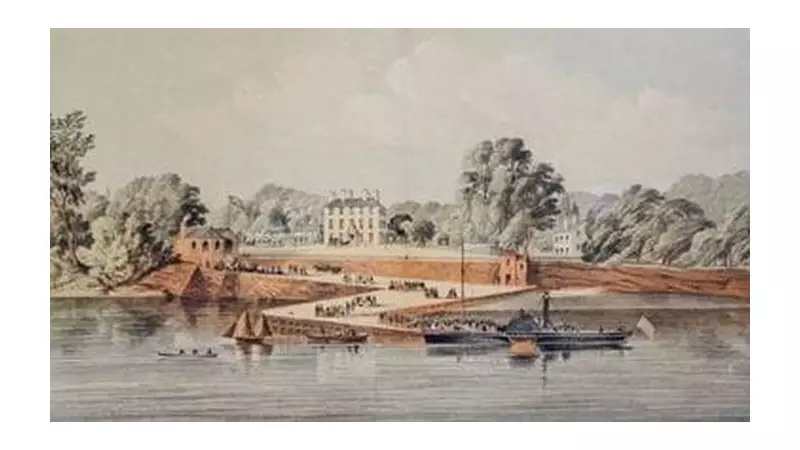
In 1854, a significant development emerged from Stanley's investments: the construction of the Eastham Ferry Hotel near the historic Eastham Ferry Pier. To finance this ambitious seaside venture, Sir William auctioned 80 acres of prime land overlooking the River Mersey, strategically positioned near the hotel, ferry terminal, and railway connections.
The hotel rapidly gained fame and success, transforming the area into a popular seaside destination accessible to visitors from all social classes. This development represented one of the most enduring legacies of the Stanley family's influence in the region.
Financial Strains and Changing Fortunes
Sir William's extravagant lifestyle eventually led to financial difficulties, contrasting sharply with his younger brother Rowland's more stable circumstances. Rowland had married the daughter of the Adjutant-General to the Duke of Wellington and would later inherit the Errington estate in Northumberland, prompting his name change to Errington.
Following Sir William's death in Paris during June 1863, his estate was purchased by Richard Christopher Naylor, a prominent racehorse owner and banker. Naylor transformed Hooton Hall into an art gallery housing significant collections, including John Gibson R A's celebrated Venus sculpture, now displayed at Liverpool's Walker Art Gallery.
Preservation of Heritage
Although the Stanley dynasty's physical presence faded after Naylor sold the estate in the 1870s, important family artifacts were preserved. Rowland Errington received several family portraits, including depictions of Sir Thomas Stanley and his wife, Sir William Stanley and his wife, six Stanley family miniatures, a bust of Sir William Massey Stanley, and the comprehensive History of the Stanley Family. His descendants committed to maintaining these as cherished heirlooms, ensuring the family's legacy endured beyond their landholdings.
This remarkable sequence of events, beginning with that pivotal 1840 auction, demonstrates how strategic land transactions, aristocratic vision, and community development fundamentally shaped West Lancashire's social and physical landscape throughout the nineteenth century.