Nottingham's Anglo-Saxon Treasures Reunited After 60 Years in Groundbreaking Exhibition
A remarkable collection of early medieval artefacts from one of England's most significant sixth-century burial grounds has been reunited for the first time in over six decades in a major new exhibition opening in Nottingham. The University of Nottingham Museum and Nottingham City Museums have collaborated to bring together forty extraordinary objects from the Broughton Lodge cemetery at Willoughby-on-the-Wolds, creating what experts describe as a landmark moment for British archaeology.
Rediscovering Nottinghamshire's Wealthiest Medieval Cemetery
The exhibition, titled The Anglo-Saxon Cemetery at Broughton Lodge, Willoughby-on-the-Wolds, opens to the public on Friday, January 30, 2026, and will run until Sunday, July 12 at the University of Nottingham Museum at Lakeside Arts. Admission is completely free, with the museum open Thursday to Sunday from noon until 4pm. This represents the first time since the 1960s that these important archaeological finds have been displayed together, offering visitors a unique opportunity to examine Nottinghamshire's richest early medieval burial site.
Curated by Professor Christopher Loveluck from the University of Nottingham's Department of Classics and Archaeology, alongside Ann Inscker of Nottingham City Museums and Galleries, the exhibition showcases objects excavated between 1948 and 1968 from approximately 120 graves dating from 475 to 580 CE. The site, now recognised as the wealthiest cemetery of its period in Nottinghamshire, was originally discovered during roadworks in 1963 when construction began on a flyover linking the A46 with roads to Willoughby and Upper Broughton in Leicestershire.
Community Archaeology Saves Threatened Heritage
The story of how this important archaeological site was preserved represents a triumph of community action. When road construction threatened the area in the 1960s, local mathematics teacher and amateur archaeologist Malcolm Dean organised volunteers to meticulously record the cemetery between 1963 and 1968. Their efforts saved what would become one of England's most important Anglo-Saxon burial grounds from destruction.
"The Broughton Lodge excavations are a fantastic example of the power of a local community to save their own threatened heritage," said Ann Inscker, Curator of Human History at Nottingham City Museums. "This new exhibition demonstrates community archaeology at its very best, and I am delighted the public can enjoy the two collections together for the first time."
Revealing Sixth-Century Global Connections
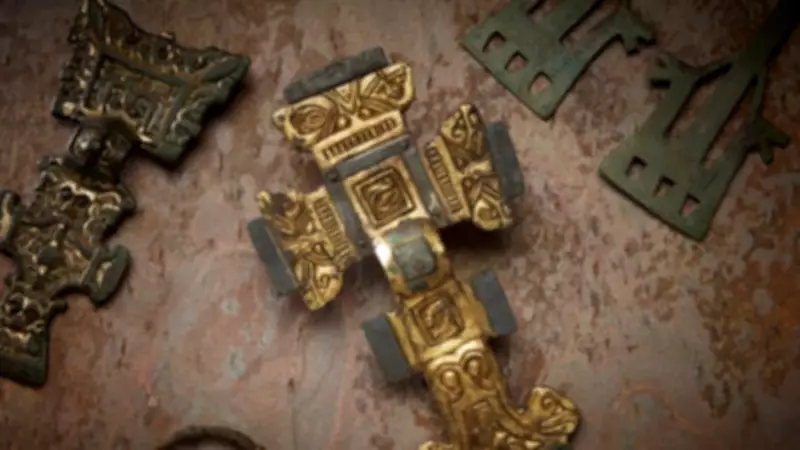
The exhibition presents groundbreaking new research that reinterprets the cemetery evidence using recent advances in archaeological science. The forty artefacts on display reveal astonishing connections between sixth-century Nottinghamshire and distant regions across Europe and beyond. Highlights include elephant ivory purse rings traced to eastern African elephants and richly gilded brooches whose materials originated in the Byzantine world, demonstrating that raw materials travelled from the Baltic Sea, Mediterranean, and even the Indian Ocean to reach Nottinghamshire.
Professor Loveluck explained: "The remains of the sixth-century community at Broughton Lodge show us people in Nottinghamshire using objects and materials imported via river and sea-routes from across Europe, the Baltic and Mediterranean Seas, in a time of abrupt climate change and pandemics that has resonance with the present day."
Multiple Burials Tell a Story of Crisis and Resilience
One of the exhibition's most significant revelations concerns the cemetery's extraordinary concentration of multiple burials – single graves containing two or more individuals. The site contains twelve such burials, the largest number yet identified in any sixth-century English cemetery. These burials, many dating to the mid-sixth century, provide compelling evidence of societal stress during a period of significant environmental and epidemiological challenges.
"The number of multiple burials is startling and clear evidence of societal stress or change in mid-sixth-century Nottinghamshire," Professor Loveluck noted. "This perhaps resulted from a combination of volcanic-induced climate change making the climate wetter or colder and impacting on food production; bubonic plague, known to have been in eastern England from the mid-540s, and local stimuli."
The exhibition explores how these burials align with wider evidence for population stress, famine, and disruption across early medieval Europe, including the Justinianic plague pandemic and climatic disruption following a major volcanic eruption in 536 CE. While ancient DNA preservation at Broughton Lodge is poor, preventing definitive identification of plague victims, the cemetery's evidence strongly suggests a community experiencing multiple crises.
Transforming Understanding of Early Medieval Britain
Since the cemetery's full publication in 1993 by archaeologist Gavin Kinsley, which first revealed the site's exceptional character and rare features including four horse burials, advances in archaeological science have given Broughton Lodge renewed international significance. The exhibition demonstrates how new scientific approaches continue to transform our understanding of early medieval Britain, showing how a community excavation begun over seventy years ago now speaks to global questions of identity, crisis, connectivity, and environment.
Dr Clare Pickersgill, Keeper of the University of Nottingham Museum, commented: "This exhibition has provided a wonderful opportunity to bring the finds together, show pioneering community archaeology work and share exciting new interpretations." The museum has organised a wider public programme starting during the February half term with a free family drop-in event on Saturday, February 14, where visitors can undertake craft-related activities inspired by Anglo-Saxon metalwork.
Looking to the Past to Understand the Present
By uniting archaeological finds with cutting-edge research, the exhibition highlights the long histories of resilience, adaptation, and interdependence that underpin society today. It reminds visitors that responses to climate stress, pandemics, and cultural change have deep roots, and that understanding historical patterns can help inform how we face similar challenges in the present and future.
Professor Loveluck and Gavin Kinsley of York Archaeology will present an accompanying lecture at Lakeside Arts on June 3, 2026, discussing the original 1993 research and adding new perspectives on pandemics, climate change, and biodiversity. The exhibition ultimately demonstrates how Nottinghamshire's archaeological heritage continues to provide valuable insights into both our past and our contemporary world, showing how local discoveries can illuminate global historical patterns.