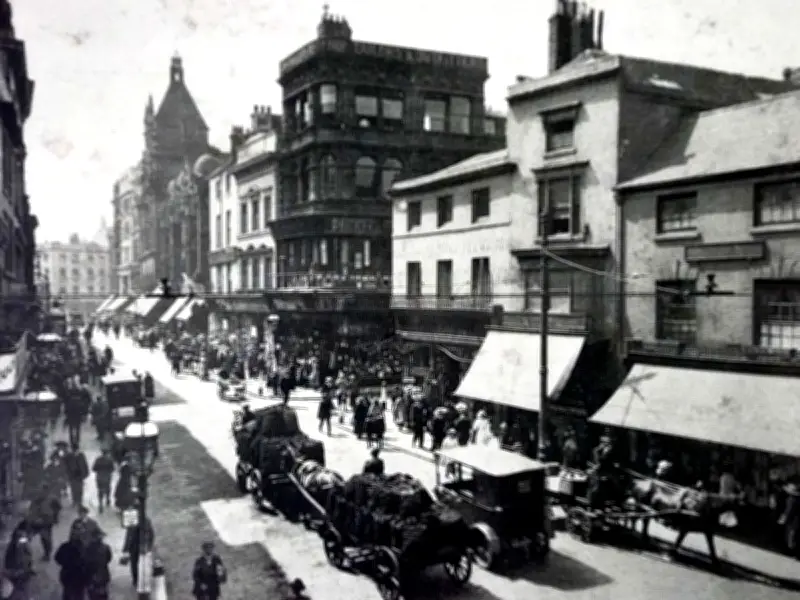
While the 2020s bin strike caused a stink, Birmingham in the 1800s was far worse. Overcrowded courts, open sewers, and contaminated wells led to disease and death, prompting the demolition of entire neighbourhoods.
Chadwick's Shocking Report
In 1842, social reformer Edwin Chadwick presented his Report On The Sanitary Conditions of the Labouring Population to Parliament. He wrote that Birmingham 'discloses a similar extent of evil' to other industrial cities. 'The courts in the parish of Birmingham, alone are above 2,000 in number, and their inhabitants exceed 50,000,' he noted. He described 'open privies, close to which there is often one or more pigsties, tubs full of hogs' wash, and heaps of offensive manure.'
Life Expectancy and Disease
In 1871, average life expectancy in Birmingham was just 37, compared to the national average of 41. Infant mortality was staggering: 30 per cent of babies died before their first birthday. The main cause of death in 1873 was diarrhoea, claiming more lives than scarlet fever, typhoid, whooping cough, smallpox, measles, or diphtheria. Poor sanitation and contaminated wells fuelled the crisis.
Dr Alfred Hill and Public Health
From 1873, Dr Alfred Hill expanded Birmingham's Public Health department, but with only eight inspectors for the entire city, progress was slow. Health visitors for mothers and babies only arrived in 1899.
Joseph Chamberlain's Improvement Scheme
In 1875, with Joseph Chamberlain as mayor, Birmingham adopted the Artisans' Dwellings Act. This allowed the Corporation to level slums where death rates were high. Entire areas were wiped off the map: Upper and Lower Priory, The Minories, London Apprentice Street (Prentice Street), Thomas Street, Oxygen Street, and the St Mary's and St Martin's wards. Residents were rehoused in the suburbs. In their place came the grand Corporation Street and its side streets, but many old road names were lost.
Still a Slum in 1903
Despite the clearances, conditions remained dire. In 1903, JC Walters wrote in the Birmingham Daily Gazette: 'The air is heavy with a sooty smoke and with acid vapours, and here it is that the poor live - and wither away and die.' He described 'ill-lit, ill-paved, walled-in squares, with last night's rain still trickling down from the roofs' and 'large families eat and sleep every day and every night, amid rags and vermin.' He concluded: 'The poor have nowhere else to go.'