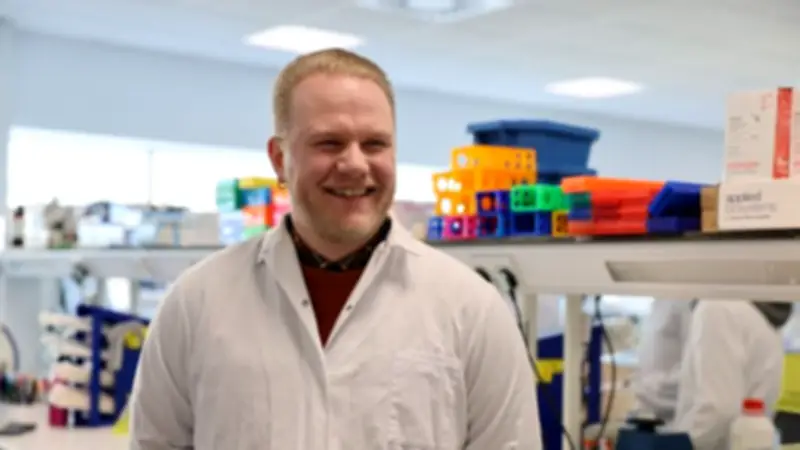
Dr Aidan Seeley, programme director for medical pharmacology at Swansea University Medical School, has been honoured with a global award from the International Union of Basic and Clinical Pharmacology for his outstanding contribution to education. He received the prize at a major conference in Melbourne, Australia.
Innovative teaching with blackworms
The judging panel praised his pioneering research laboratory which uses blackworms as an ethical and affordable way for students to test how drugs affect living organisms. This unique teaching model has now been adopted by higher education institutions across the UK and Ireland, helping thousands of students gain hands-on scientific experience.
Award and recognition
Dr Seeley, who previously won the Rang Prize for exceptional teaching, delivered a special lecture to mark his latest achievement. He said: “One of the most rewarding parts of leading the Medical Pharmacology programme is helping students develop the knowledge, skills and confidence to become the next generation of pharmacologists who will discover new medicines and improve those already used to enhance people’s lives.”

He continued: “This award is particularly special because it recognises not only my work, but also the enthusiasm and contributions of the many students, colleagues and collaborators who have helped develop these ideas.”
Impact on pharmacology education
He added: “I am incredibly proud that educational innovations developed at Swansea are helping to shape pharmacology education internationally.” At SWIRL, the Swansea University lab, Dr Seeley has developed classes that allow students to explore how drugs affect living organisms ethically, affordably, and accessibly, while contributing to research using this model organism. He concluded: “Education is at its best when learners are actively involved in discovery rather than simply learning established facts. Through SWIRL, we are creating opportunities for students to experience real scientific research, ask questions, test ideas and learn from unexpected results in the same way that professional scientists do.”