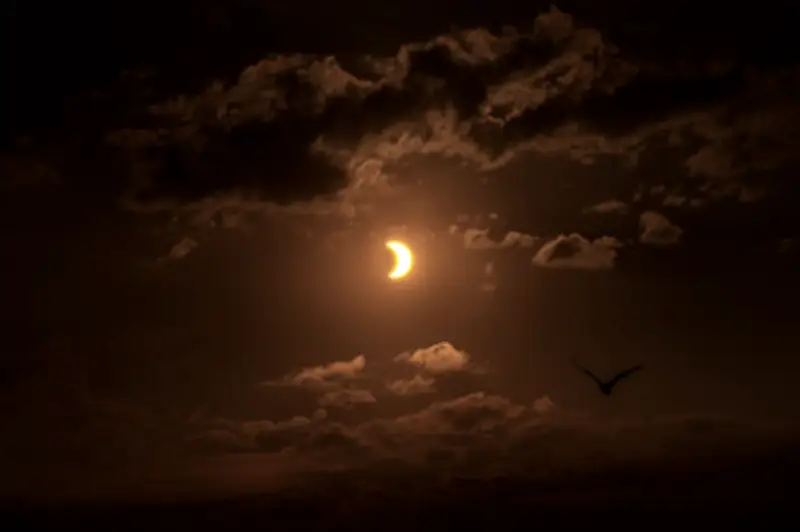
The next solar eclipse visible from the United Kingdom will take place on Saturday, 29 March 2025, when a partial eclipse will be observable across the country. This event will be the first solar eclipse visible from the UK since 10 June 2021, according to information from the Royal Observatory Greenwich.
What to Expect on 29 March 2025
On 29 March 2025, the Moon will pass between the Sun and Earth, casting a shadow on Earth. In the UK, the eclipse will be partial, meaning the Sun will appear as a crescent shape as the Moon covers a portion of it. The exact percentage of the Sun that will be obscured will vary depending on the observer's location, with the northwest of Scotland expected to see the greatest coverage, according to the Royal Observatory.
The eclipse will begin in the UK in the mid-morning, with the maximum eclipse occurring around 10:00 to 11:00 GMT, depending on the exact location. The entire event will last for about two hours, from the first contact to the last, as the Moon gradually moves across the Sun's disk.
How to View the Eclipse Safely
It is crucial to never look directly at the Sun, even during an eclipse, as this can cause permanent eye damage. The Royal Observatory advises using special solar viewing glasses that meet the ISO 12312-2 international safety standard, or using a pinhole projector to watch the eclipse indirectly. Regular sunglasses, smoked glass, or camera lenses are not safe for solar viewing.
For those who miss the 2025 eclipse, the next total solar eclipse visible from the UK will occur on 23 September 2090, according to the Royal Observatory. However, partial eclipses will be visible more frequently, with the next one after 2025 expected on 12 August 2026, although that will be a total eclipse visible from parts of Europe and a partial eclipse in the UK.
Significance of Solar Eclipses
Solar eclipses occur when the Moon passes directly between the Sun and Earth, blocking the Sun's light. While total eclipses are rare for any given location, partial eclipses are more common. The 2025 event will be a significant astronomical occurrence for UK sky-gazers, offering a chance to witness the celestial mechanics of our solar system.
The Royal Observatory Greenwich provides detailed information and guidance for observing eclipses, including safe viewing methods and explanations of the science behind them. Their website offers resources for both amateur and experienced astronomers.