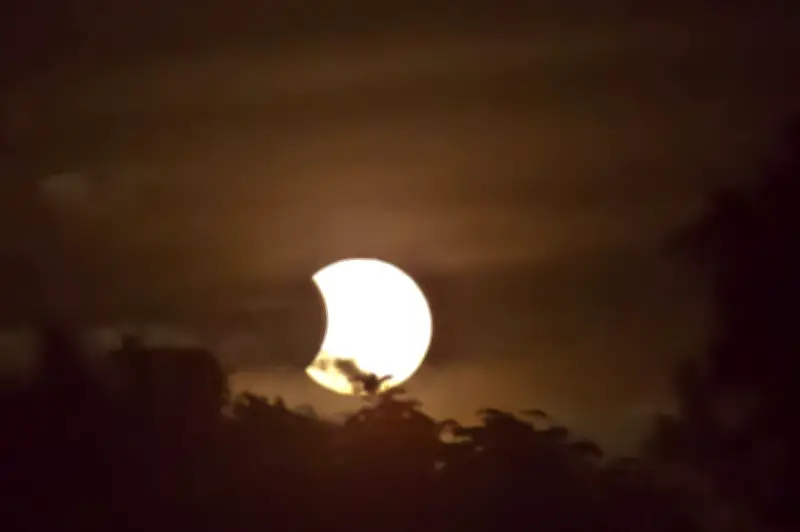
On 29 March 2025, the UK will witness its most significant solar eclipse since 1999, with the West Midlands and Shropshire expected to see up to 40% of the sun obscured by the moon. This partial eclipse, starting around 10:00 AM and peaking at 11:00 AM, is a rare celestial event not to be missed.
Eclipse Timing and Visibility
According to the Royal Astronomical Society, the eclipse will begin at approximately 10:00 AM BST, reaching its maximum coverage around 11:00 AM, and concluding by 12:00 PM. In the West Midlands, including Birmingham, and across Shropshire, viewers can expect between 30% and 40% coverage of the sun's disc, depending on exact location. Areas further north, such as Scotland, may see up to 50% coverage.
Dr. Emily Drabek-Maunder, an astronomer at the Royal Observatory Greenwich, stated: "This is a fantastic opportunity for people across the UK to witness a partial solar eclipse. Even though it won't be total, the sight of the moon taking a bite out of the sun is truly remarkable."

Safety Precautions for Viewers
Experts stress that looking directly at the sun without proper protection can cause permanent eye damage. Special eclipse glasses or solar filters for telescopes and cameras are essential. The Royal Astronomical Society advises using certified solar viewers that meet the ISO 12312-2 international standard. Pinhole projectors are a safe and simple alternative for indirect viewing.
Dr. Robert Massey, deputy executive director of the Royal Astronomical Society, warned: "Never look at the sun directly without appropriate protection. Even during an eclipse, the sun's rays are powerful enough to cause serious eye injury."
Weather Forecast for the West Midlands
Clear skies are crucial for optimal viewing. According to the Met Office, the West Midlands and Shropshire are expected to have partly cloudy conditions on 29 March, with a chance of some sunny intervals. However, forecasts may change closer to the date. The Met Office recommends checking local weather updates in the days leading up to the eclipse.
Historical Context and Significance
The last major eclipse visible from the UK was the total solar eclipse of 11 August 1999, which was partially obscured by clouds in many areas. The 2025 event is the most significant since then, though it will be a partial eclipse rather than total. The next total solar eclipse in the UK will not occur until 2090, making this a rare opportunity for skywatchers.
Dr. Drabek-Maunder added: "While we won't see a total eclipse, the 2025 event is still a wonderful chance to engage with astronomy and appreciate the dynamics of our solar system."
Where to Watch
Public viewing events are being organized at several locations in the region. The Birmingham Astronomical Society, for instance, plans to host a gathering at the Thinktank Birmingham Science Museum, providing telescopes and expert guidance. Similarly, the Shropshire Astronomical Society will set up viewing stations at the Shrewsbury Museum and Art Gallery. Both events are free to attend.
For those unable to attend organized events, any location with a clear view of the southern sky will suffice. The eclipse will be visible across the entire UK, but the best views will be in areas with minimal light pollution and unobstructed horizons.
Educational Opportunities
Schools and educational institutions in the West Midlands and Shropshire are encouraged to use the eclipse as a teaching moment. Resources from the Royal Astronomical Society and the UK Space Agency are available online, including lesson plans and safe viewing guides. The eclipse provides a unique opportunity to inspire students about science and astronomy.
In summary, the 29 March 2025 partial solar eclipse is a must-see event for residents of the West Midlands and Shropshire. With proper safety measures and favorable weather, it promises to be a memorable celestial display.