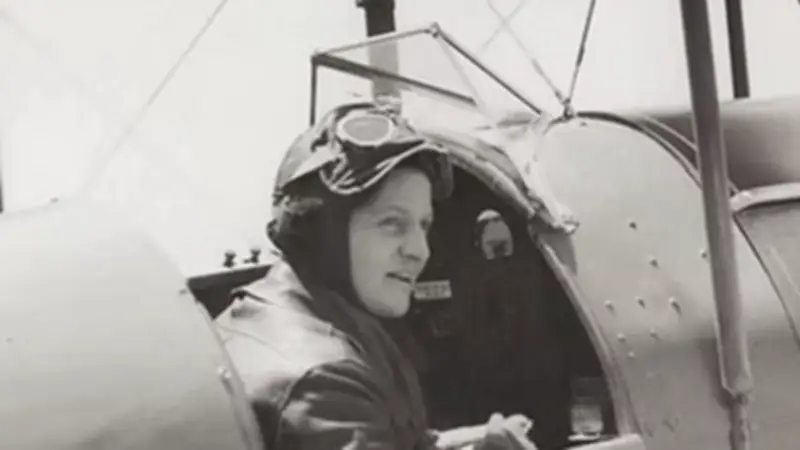
In 1934, Freda Mary Thompson etched her name into aviation history by becoming the first Australian woman to fly solo from England to Australia. Her journey, which began at Lympne Airfield in Kent, concluded with a landing in Darwin, Northern Territory, after 39 days, of which only 19 were spent in the air.
A Pioneering Career Takes Flight
Born in Yarra, near Melbourne, Victoria, in 1906, Thompson's fascination with aviation began early. Her first flight was as a passenger from London to Paris in 1926, an experience that ignited a passion for flying. She learned to fly at Essendon, Melbourne, and earned her A Licence two years later, officially becoming a pilot.
In 1932, she obtained her B commercial pilot's licence, making her only the fifth woman in Australia to hold such a credential. The following year, in 1933, she achieved another milestone: becoming the first woman in the British Empire to qualify as a flying instructor.

The Solo Flight to Australia
In April 1934, Thompson sailed to England to collect her De Havilland Moth Major from the factory, naming it Christopher Robin. The aircraft, which cost £1,000, was initially registered G-ACUC, later changed to VH-UUC for the Australian register. By this time, she had accumulated 250 hours of flying experience, making her well-prepared for the long journey back home.
Thompson had originally intended to enter the MacRobertson Mildenhall-to-Melbourne air race, but she enrolled too late to participate. Undeterred, she decided to make the trip alone anyway, starting from Lympne on September 28, 1934. Her aircraft was fitted with extra fuel tanks, one of which was located in the luggage compartment, so she carried only a flask of water and a small bag of luggage for the journey.
During the flight, she encountered a setback when she was involved in a landing accident in Megara, Greece, which cost her 20 days as she waited for a spare part to repair a wing. Despite this, she landed in Darwin on November 6, after 19 days of actual flying. She continued on to Mascot, Sydney, arriving on November 20.
War Service and Later Life
With the outbreak of World War Two, Thompson sold the Moth Major and applied to join the Women's Auxiliary Australian Air Force, but received no response. Instead, she became a Commandant of the ATC in Victoria in 1940. In 1942, she enlisted in the Australian Woman's Army Service, driving an ambulance, and was promoted to Acting Sergeant before her discharge on August 25, 1944.
After the war, Thompson bought a De Havilland Hornet Moth, which she named Christopher Robin II and registered VH-UYO, flying it extensively across Australia. During the post-war period, she won 47 trophies for air races and formation flying events.
Thompson later served as President of the Royal Victoria Aero Club and, in 1950, became a founding member of the Australian Women's Flying Association. Her final flight was as a co-pilot in a Tiger Moth in 1980, by which time she had logged 3,330 flying hours.
Recognition and Legacy
Thompson's contributions were recognised with the King George VI Coronation Medal in 1937 and the Queen's Coronation Medal in 1953. She was belatedly awarded an OBE in 1972. She passed away from cancer on September 11, 1980, in Malvern, a suburb of Melbourne.
The Lympne Airfield History Society will continue to celebrate such stories at its upcoming meetings. On Tuesday, September 1, John Simpson will present Where Do You Think They Were Kidding Mr. Hitler?, focusing on the local Home Guard and their connections with the airfield. On November 3, church warden Rachel Cornish will present Wings of Nature, Wings of Flight, comparing the natural world with manmade aircraft. Meetings are held at Lympne church, with doors opening at 6.30pm and entry costing £3. For more information, call 07508 708725 or email johnsimpson43@btinternet.com.