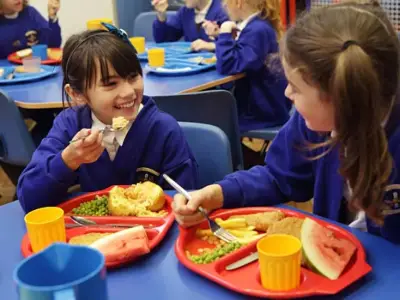
Birmingham schools will be required to overhaul their lunch menus from next September under the first new school food standards introduced in over a decade, with rules that limit sausages, restrict deep-fried foods and ensure every main meal includes a portion of vegetables or salad.
The changes, announced by the Department for Education (DfE), are designed to tackle childhood obesity and tooth decay. They apply to all schools across England, including those in Birmingham, and follow the recent expansion of free school meals to all pupils from families in receipt of universal credit.
What the new standards require
Under the new standards, schools must reduce the number of sweetened baked desserts and fried foods served to pupils. Sugary drinks, ice cream and waffles will be restricted, while deep-fried foods will be reduced. High-fat and high-salt items such as pizzas and sausages will also need to be limited.

Main meals must include or be accompanied by a portion of salad or vegetables. Desserts must contain or be accompanied by fruit. Higher-fibre wholegrains and pulses such as lentils and chickpeas must appear on menus alongside main meal options at least once a week.
The standards are due to come into force next September, with secondary schools given until September 2028 to implement certain changes. Each school will be expected to publish their menus and food policies online to help improve compliance. They will also be required to appoint a school food governor to hold schools accountable for the meals they provide.
Support from Jamie Oliver and others
The reforms have received backing from celebrity chef Jamie Oliver, who described it as a "brilliant day" following 25 years of campaigning on the issue. "Back 20-plus years ago when I started School Dinners I could not believe that we had standards for dog food but not what we serve our children at school," he said. "And I've never stopped banging that drum. So it's brilliant to see new school food standards based on the latest science, to make sure the food children get at school is actually supporting their health and helping them thrive. And that those standards won't just live on paper, but have proper monitoring to make sure they're followed, so we know where we need to deploy care, love and support."
A poll of more than 1,400 headteachers and senior leaders in primary and secondary state schools across England, carried out in September by Teacher Tapp on behalf of School Food Matters, revealed that 68% believe the standards would prove more effective if compliance were independently monitored.
Impact on children's health
Roughly one in three children are leaving primary school overweight or obese, while tooth decay remains the leading cause of hospital admissions among children aged five to nine. Education Secretary Lucy Powell said: "These are once-in-a-generation changes that will transform school food for children across the country. From our historic expansion of free school meals to the rollout of free breakfast clubs and new school food standards, we are making sure that every child has access to the healthy meals we know children need to learn, grow and succeed. No child should spend the school day hungry, and no family should have to struggle to put food on the table. This is what change looks like: healthier food, fuller stomachs and a fairer start for every child."
The DfE will collaborate with the Food Standards Agency on a monitoring plan for schools, with further details to be announced in the coming months.
Concerns over funding and criticism
Trade unions cautioned that schools will require additional financial support to meet the requirements. Pepe Di'Iasio, general secretary of the Association of School and College Leaders, said: "The current funding rate for free school meals is not enough to cover costs and many schools have to divert money from teaching and learning in order to afford this vital provision. It is a case of having to rob Peter to pay Paul."

Paul Whiteman, NAHT general secretary, said: "If the government is serious about them working in practice it must provide significant additional funding to reflect the real costs of school meals, which these new requirements are likely to increase. Many schools already have to raid stretched core budgets for staffing and the curriculum to subsidise the costs." He further warned that any inspections must not impose "additional burdens" on "already over-stretched" school leaders.
Actress Dame Emma Thompson, who campaigns for the Food Foundation charity, said: "This is a milestone worth celebrating and an investment in a healthier future for the next generation." The Conservatives were quick to condemn the reforms, arguing there are "much bigger things on the nation's plate". Matt Vickers, deputy chairman of the Conservative Party, said: "Our Armed Forces are crumbling, but Andy Burnham has decided his priority is taking pudding off the menu. The only thing wobblier than Andy Burnham's defence policy is the jelly he's trying to ban."
The new standards will come into force in September 2027, with secondary schools given until 2028 to comply, and schools in Birmingham will need to adjust their menus and publish their food policies online by then.