
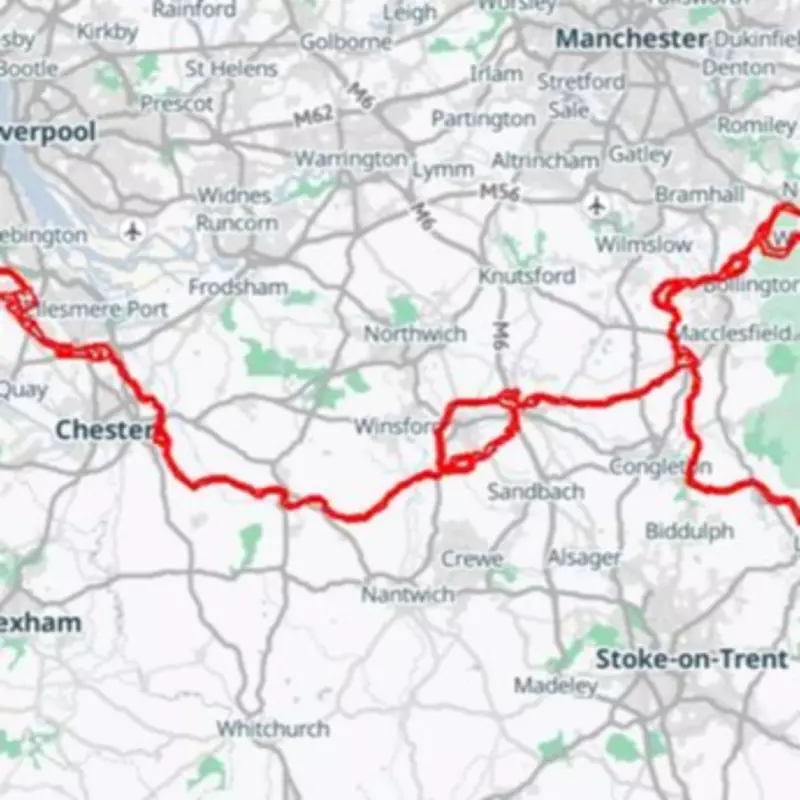
A world-first giant pipeline will run under a huge part of the Midlands under new proposals. Plans have surfaced to construct a massive world-first 121-mile subterranean CO2 pipeline stretching from Derbyshire's Peak District, beyond Liverpool, to the Irish Sea.
The Peak Cluster Pipeline would run under much of Staffordshire, although once it is there you would never know. The plan has been conceived by Derbyshire's quarrying and cement companies which spearhead the UK's manufacturing of essential construction materials, yet as a consequence also generate numerous tonnes of carbon emissions.
Project Consortium and Funding
Tarmac, Holcim, Breedon, Buxton Lime and Spirit Energy, collaborating closely with the SEEL Summit Energy Revolution, Progressive Energy and the Government's National Wealth Fund, comprise the joint project consortium. From the present £59.6 million project expenditure, £28.6 million is being provided by central Government, granted last July, with the remainder being supplied by private companies.
Given the enormous magnitude of the project, which would require three years to construct across four counties, the proposal is to be determined nationally, with local authorities simply serving as consultees, together with residents, interest groups and businesses. It is anticipated the proposal would generate 1,200 temporary construction positions, while protecting 2,000 current jobs.
Environmental Impact and Capacity
The proposal would represent the world's largest cement decarbonisation initiative, redirecting three million tonnes of carbon dioxide annually from being released into the atmosphere, and instead being stored in the east Irish Sea, within the exhausted Morecambe gas fields, via pipelines from Derbyshire to the Wirral, in Merseyside. Morecambe Bay would have the capacity to store a gigatonne of carbon dioxide, equivalent to three years of the UK's total carbon emissions, with a storage licence approved in 2023.
Derbyshire and Staffordshire account for 40 per cent of the UK's cement and lime production, while cement manufacturing is responsible for 7.5 per cent of global carbon dioxide emissions.
Timeline and Construction Details
The proposal is scheduled to be submitted towards the end of this year, targeting a government decision, a development consent order, by 2029, with the pipeline becoming operational from 2032. In total, the pipeline corridor will stretch 300 metres wide and 121 miles in length, though this would ultimately be reduced to 100 metres in width to allow for modifications, while the pipes themselves would measure approximately a metre across, according to Peak Cluster diagrams.
The depth at which the pipe will be laid is yet to be determined, and will require approval from the Environment Agency and other regulatory bodies to establish how far below watercourses it must sit. Certain locations may see sections of the pipeline remain above ground, documents reveal, particularly where it passes alongside roads, railways or areas of ancient woodland.
Route Details
If given the green light, the scheme would span 121 miles (195 kilometres) from Breedon's Hope Valley cement works, nine miles north-east of Buxton, just above Bradwell; linking to Tarmac's Tunstead facilities near King Sterndale and Fairfield; with both lines converging at a new junction facility on what is currently open countryside between Dove Holes and Chapel, before continuing south of Chapel, around the east and north of Tunstead Milton and north of Whaley Bridge, then heading west, diverging around either side of Lyme Park.
From there, the route would pass north of Bollington, around the west of Prestbury and Macclesfield to Gawsworth, where a connecting spur line from Cauldon in Staffordshire would be joined. The Staffordshire spur would originate from Holcim's Waterhouses works, adjacent to Cauldon, to the east of Leek, running round the north of Rudyard and Biddulph.
Beyond Gawsworth, Cheshire, the line continues westward, north of Holmes Chapel, divides either side of Middlewich, pressing on west north of Church Minshull, south of Tarporley, heading north through Waverton and the eastern fringes of Chester, before veering west past Ellesmere Port. The Merseyside final section sees the route travel to the south and west of Capenhurst, before dividing and circling Willaston, running east of Thornton Hough, east of Barnson, appearing to pass through Arrowe Park Golf Course, coming close to but avoiding Royden Country Park, north of Thurtaston, before heading north between Frankby and Greasby, continuing to Meols, joining with the Irish Sea near the Leasow Lighthouse.
An additional 41 miles of pipes would link the pipeline from Meols to Morecambe Bay to the north, beneath the water.
Changes and Environmental Considerations
Lhoist UK had intended to join the Derbyshire companies forming the Peak Cluster project, connecting the pipeline to its Hindlow facilities near Harpur Hill, but it has now pulled out, while Buxton Lime has stated it does not require a new facility at its Hindlow site, consolidating its Tunstead operations. Present maps for the selected route show the pipeline being routed closely past scheduled monuments and sites of special scientific interest and conservation.
The Derbyshire section from Hope Valley to Dove Holes would encompass approximately four miles through the Peak District, with the remainder utilising the purpose-built corridor through the Peak District which has consistently excluded Chapel, Whaley, Dove Holes and Buxton.
Documents submitted to central government indicate that additional sites alongside the Derbyshire and Staffordshire quarries would be able to link to the Morecambe Bay carbon store in the future. Carbon capture infrastructure, comprising new facilities, would be constructed at Breedon's Hope Valley cement plant and Tarmac's Tunstead cement plant, channelling carbon dioxide into the proposed pipeline.
Construction and Employment
Building work on these fresh structures and related technology is anticipated to span four years from 2029 at Hope and approximately two years at Tunstead, according to documents. Between 20 and 56 permanent positions would be generated at Hope Valley, while information regarding new posts at Tunstead remains unavailable. The Holcim facility in Staffordshire would require four years to finish and establish 28 fresh positions.
Additional new installations would need constructing along the route, with one identified for a substantial location between Dove Holes and Chapel. A wide search zone commences 500 metres south of Chapel and reaches to Dove Holes, with predicted significant impact on the landscape and Peak District National Park. Accompanying these would be installations near Gawsworth, Middlewich, Chester, Ellesmere Port, Hoylake and Meols.
The coastal connection at Meols Beach would feature a 50-metre tall chimney and accompanying infrastructure requiring 18 months to construct, within the 500-metre stretch between the Park Lane Holiday Homes location and the Leasowe Lighthouse, standing at 34 metres high.
Statements and Future
Papers lodged with the Government assert the alternative to the pipeline of changing the fuel type employed in production procedures only offer a marginal reduction in emissions, meaning the carbon capture solutions would still be necessary. John Egan, chief executive of Peak Cluster Ltd, stated: "Peak Cluster is focused on securing a sustainable future for the cement and lime industry. Together with the Morecambe Net Zero Project, the UK's biggest carbon store, we will capture, transport and store CO2 to support industry to thrive in a low carbon future."
Speaking last year, Chancellor Rachel Reeves said: "We're modernising the cement and lime industry, delivering vital carbon capture infrastructure and creating jobs across Derbyshire, Staffordshire and the North West to put more money into working people's pockets."