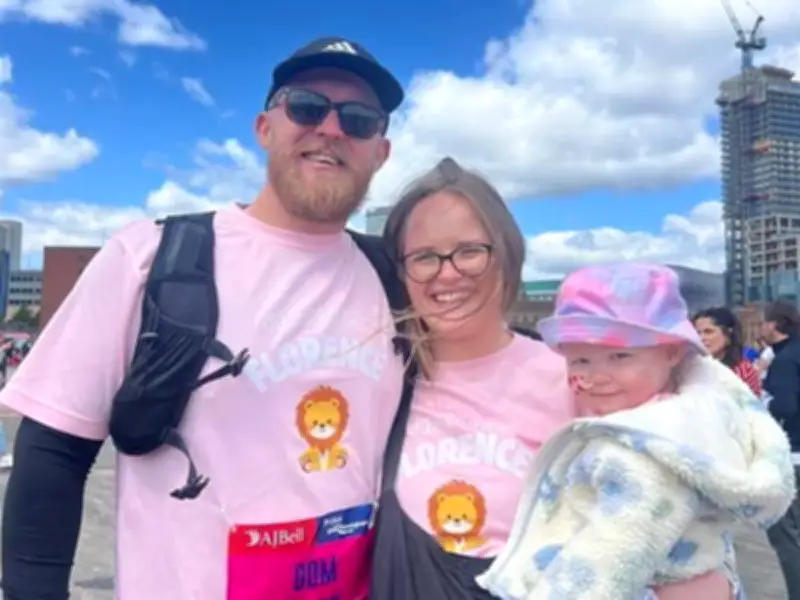
Florence Wilde, a two-year-old from Stourbridge, was diagnosed with neuroblastoma, a rare childhood cancer, after doctors initially attributed her symptoms to constipation. Her parents, Anna Chattaway and Dom Wilde, both 32, were told on at least six separate occasions during the three weeks before the diagnosis that her swollen stomach was due to constipation.
Florence was taken to her GP after her stomach began swelling and she was persistently unwell and fatigued. She was given laxatives, which caused the toddler to cry out in distress. When her tummy kept expanding, Anna returned Florence to the GP only to receive reassurance it was constipation once more. On one occasion, a doctor even said: "Let's address the elephant in the room, we don't think it's cancer."
Diagnosis after blood test
Only when the family insisted on a blood test was she diagnosed with neuroblastoma in November 2024. Anna, a clinical psychologist from Stourbridge, said: "She was diagnosed a month after her first birthday. There was a period of six weeks beforehand where she was poorly with one thing or another. She picked up infections, she had hand foot and mouth, she had antibiotics but remained off for a while."

"She started to get a swollen tummy and for three weeks we were back and forth to the GP. We were told she was constipated at the GP - for three weeks I had to force-feed her laxatives which was horrendous. When her stomach hadn't gone down, they gave her more laxatives, but it was getting bigger. She wasn't right and the laxatives weren't helping so we had to keep pushing the doctors."
Florence couldn't sleep independently due to severe pain and required Anna to hold her upright throughout the night to achieve any rest. Anna said: "They struggled to examine her. On one occasion a GP said she's fine and: 'Let's address the elephant in the room, we don't think it's cancer.'"
30cm tumour removed
"We went to the GP again for the final time, and my mum pushed for a blood test. Her bloods were heightened and they referred us to the PAU immediately. We had another doctor who felt her stomach. As soon as he felt her tummy he said he didn't think it was poo, there were lumps and bumps."
Florence underwent surgery at Birmingham Children's Hospital on November 26, 2024, with emergency chemotherapy beginning the following day. She had three months of induction chemotherapy to try and shrink the tumour. The tumour measured 30cm and weighed 2kg, while Florence weighed just 13kg herself, accounting for nearly 15 per cent of her body weight.
Anna said: "When the tumour was discovered it was 30cm, which was heartbreaking. She's only small so that took up quite a lot of her." It wasn't until further scans in January 2025 that they realised she had metastatic disease, with the disease in her spine.
Family raising £100,000 for treatment
Surgeons removed up to 95 per cent of the tumour in March 2025, with Florence beginning her initial rounds of high-dose chemotherapy just three weeks afterwards. Florence embarked on five cycles of immunotherapy last October before her parents received the news that the tumour had stopped progressing in April this year.
Anna said: "All throughout we were told she was doing great. Every admission she was full of life throughout it, she was incredible. We've met families along the way who have been pushed back by GP's and doctors more than what Florence's has. I think if she was diagnosed sooner it might have not been that large. We sat in that headspace for many months and it was horrifying. There was a lot of anger there."
The family are raising £100,000 to fund anti-relapse treatment that is no longer available on the NHS. Anna said: "Florence has finished the gold standard NHS treatment, after that you can either watch and wait to see if the cancer comes back, or other families chose to do a relapse prevention treatment, but they aren't NHS protocol. We decided we wanted her to have a treatment called DFMO. It came to the UK in 2024 and then it was withdrawn in April, a week before she became eligible to start. We've decided to now raise the money to fund it ourselves as it costs £100,000. She's been doing incredibly, she's such a happy little girl. Life is good at home."

Neuroblastoma is an uncommon form of cancer which originates from undeveloped nerve cells in children aged up to five. Donations can be made via the family's GoFundMe page.