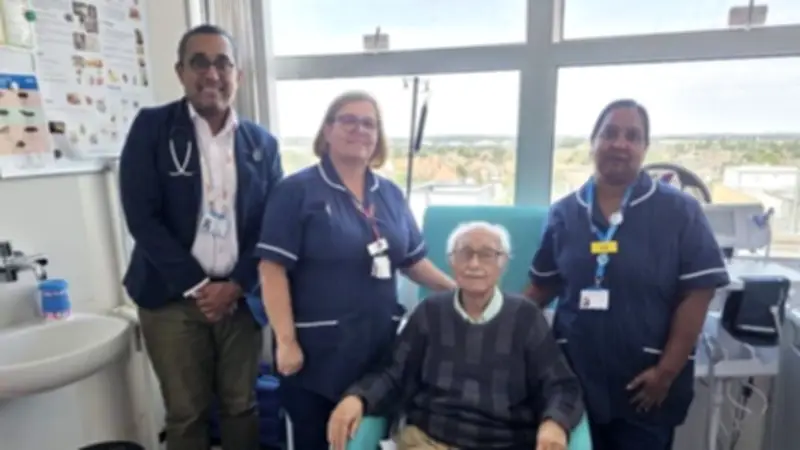
A new service at Southend Hospital is helping kidney patients start home dialysis sooner and avoid surgery, shortening recovery times and giving them more independence.
Minimally Invasive Day-Case Procedure
Patients now have a dialysis catheter inserted under local anaesthetic as a minimally invasive day-case procedure, allowing them to begin treatment at home instead of spending hours in hospital several times a week. One of the first patients to benefit from this is 81-year-old Neil Rumbol, from Hadleigh, who has been living with progressive kidney failure for several years.
Patient Story: Caring for His Cat
Having home dialysis was particularly important to Neil as it means he can continue caring for his beloved cat, Pepsi, who needs twice-daily insulin injections for diabetes. Neil said: “Being able to continue looking after Pepsi means everything to me. She’s all I’ve got to worry about, and I want to keep her as healthy as I can in her elderly years.”

Consultant Praises Team
Neil praised consultant nephrologist Dr Madhu Potluri and the renal team, who lead the service, for his care, describing it as 'excellent'. “Home dialysis gives patients much more freedom and independence,” said Dr Potluri. “Instead of spending three half-days every week attending hospital, they can carry out their treatment at home, often overnight, and continue with their normal daily activities. For many patients, that has a huge impact on their quality of life, their wellbeing and their ability to remain independent.”
Procedure Details and Benefits
The new procedure is carried out using local anaesthetic and X-ray guidance, with a small incision measuring less than two centimetres. Patients are typically able to go home the same day and recover more quickly than with a traditional surgical procedure. The team believes the service, which was in development for 18 months, will benefit increasing numbers of patients in the future, particularly those who may not be suitable for general anaesthetic or those who need dialysis urgently.
Patient-Centred Care
Dr Potluri added: “This is about giving patients the treatment they want, in a way that fits around their lives. It reduces time spent in hospital and gives them a better experience right at the start of their dialysis journey.”