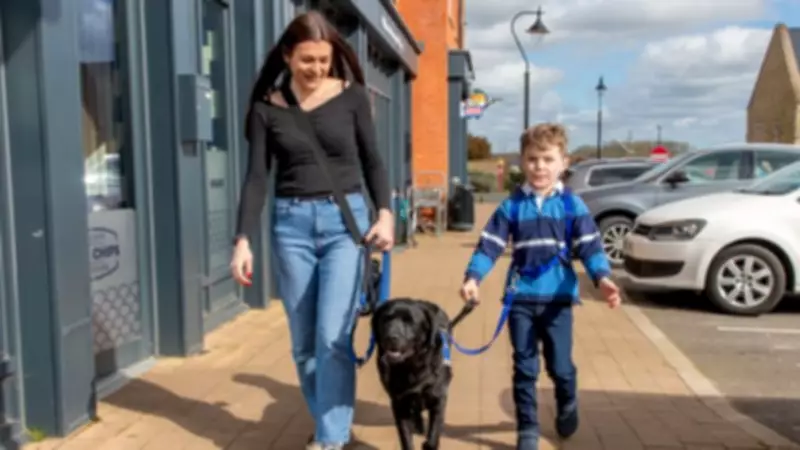
Lucy Rodas recalls the time before support dog Davey bounded into her life and that of her autistic son, Carter. “It was just constantly living in fear, for me especially,” says Lucy. Seven-year-old Carter, who is non-verbal, was prone to ‘bolt’ or run off, a common trait in around 50 per cent of autistic youngsters.
“Taking Carter to the shops, or even on the school run, was hard,” adds Lucy. “He has no sense of danger whatsoever, so he would run into the road. We would be in a car park and he would see something he wanted and just run. The bigger he’s got, the quicker he has become, and having to have your wits about you all the time is just exhausting. I was mentally drained.”
Another reason Lucy, of Brackley, Northamptonshire, approached the national Support Dogs charity for help was that as Carter struggles with communication, she wanted a dog to provide comfort. “I think he was probably a bit lonely as well,” says the 28-year-old former support worker, who now cares full-time for Carter.

Lucy said just going shopping was a “two-person job” as Carter would easily slip away from holding her or her mum or partner’s hand, or climb out of the trolley and go missing. She asserts that most parents of children with Special Educational Needs (SEN) find themselves withdrawing and stopping taking their children out. “The last time I took him on holiday was when he was two – since he got older and started running away, it’s just constant worry,” she said.
But thanks to black Lab Davey, Lucy was able to take Carter on a caravanning holiday. “I took Carter to the beach for a paddle, and Davey was in there with him – it’s just opened up a different world for us. I’m not scared any more – Davey has made a world that feels too overwhelming for Carter just that little bit better, bringing a sense of security, safety and calm for Carter.”
Another milestone made possible by Davey was a recent trip to the dentist. “Carter had never sat in a dentist’s chair or let them look at his teeth,” says Lucy. “For the first time, Davey came to an appointment, and Carter sat in the chair and let the dentist look in his mouth. The dentist said they couldn’t believe the difference Davey has made.”
She said the same goes for haircuts – with Davey at his feet, a trim is no longer a worry. “Carter used to be petrified, but not that day, because Davey was there”, adds Lucy. Davey also helps to provide a visual aid, to let others know Carter has an invisible disability, and therefore increases understanding.
Lucy said Carter can stim, or flap, and she remembers a man staring. But she adds: “It’s amazing how many people don’t stare any more, because Davey’s blue jacket shows that Carter has a hidden disability. It’s very nice to have that. Now we have a different sort of attention, rather than negative stares. People look at Davey – they don’t look at Carter any more.”
Lucy describes the bond between Carter and Davey as “magical”. “I would honestly say they are the best of friends,” she adds. “Carter can’t speak. He can say a few sounds. He has started to say ‘D, D, D’, which means Davey. Davey understands Carter. He knows when Carter needs comfort, space and encouragement. Their bond is really natural and effortless. I can see their relationship has really given Carter happiness in ways I’ve struggled to find before. There’s only so much I can give as a mum. Davey understands him without words and when Carter needs space, he knows when to step away and goes to his bed. I can’t believe the difference of how I felt and how Carter felt without Davey there. Davey came along, and he’s someone who understands Carter and doesn’t speak, like him.”
Lucy said she noticed Carter wasn’t like his peers as he stopped babbling as a baby, and then stopped responding to his name. He also never started to talk. He was diagnosed with autism at four years old.

Praising the work of Support Dogs, which also trains and provides specialist assistance dogs to help adults with a physical disability and those affected by epilepsy, Lucy said: “Support Dogs is just incredible. As an SEN parent, often it feels like the world is stacked against you. You have to fight for people to understand you, support you and accept you and your child. It’s really isolating and exhausting. But having Davey and having the support of Support Dogs has given us a sense of reassurance and understanding we have never had. Support Dogs has given my son a best friend who truly sees him and has given me something I didn’t realise I needed – a peace of mind, hope for the future and the comfort of knowing my child is always understood and never alone.”
To learn more about the incredible work of Support Dogs, please visit www.supportdogs.org.uk or call 0114 2617800.