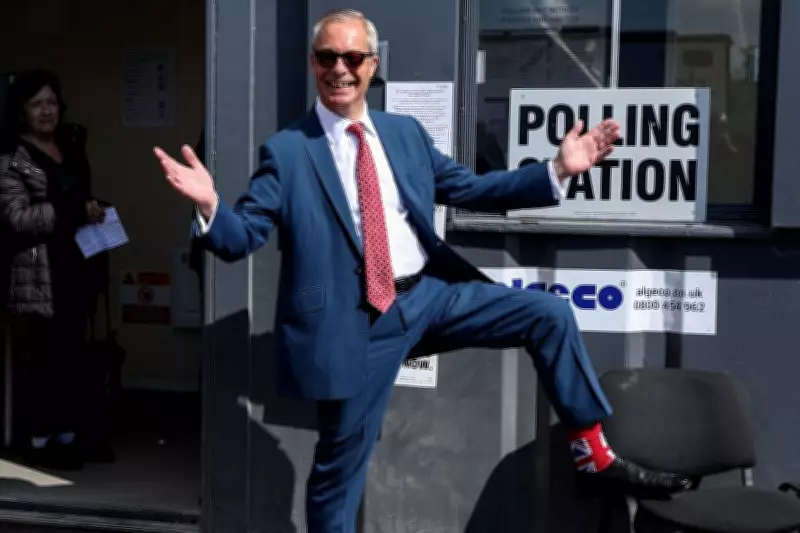
There is something faintly hilarious about watching Westminster suddenly behave as though Reform's success in last week's council elections arrived from nowhere – like an unexpected thunderstorm over Surrey. The political class looks utterly baffled. 'Why are people angry?' ask commentators on six-figure salaries while broadcasting from television studios in North London.
Well, perhaps because ordinary people can no longer afford their gas bill, their rent, a family holiday or sometimes even a decent weekly shop. Perhaps because people feel their country is changing rapidly and nobody in power seems remotely interested in discussing it honestly.
Or perhaps because every time voters raise concerns about illegal boat crossings, strained public services or the simple idea that Britain ought to defend its own borders, they are treated as though they have wandered into a university seminar wearing a Union Jack waistcoat and carrying a burning copy of The Guardian.

A personal perspective
I say this as the son of immigrants. My own family came to Britain from India. Like countless immigrant families, we arrived with admiration for this country – its institutions, fairness, humour and opportunities. Britain opened doors for us. But one of the reasons immigrants respected Britain was because Britain once seemed confident in itself.
Today, that confidence feels badly shaken. You do not have to be 'far-right' to wonder why thousands of people are arriving illegally across the Channel while the government appears incapable of stopping it. Most countries defend borders as a basic function of statehood. Yet in Britain, merely pointing this out can trigger moral panic among politicians and commentators.
Frustration on the ground
Spend time in cities like Wolverhampton or Birmingham and you quickly understand the frustration. Roads are crumbling. High streets feel tired. Councils endlessly discuss 'regeneration' while many town centres seem trapped in managed decline. Taxes remain painfully high, yet the quality of services often feels mediocre at best. People ask a perfectly reasonable question: where exactly is all the money going?
There are also growing communal tensions that polite society prefers not to discuss openly. In some working-class communities, people increasingly suspect that certain groups are somehow receiving a bigger slice of housing, benefits or public support than others. Whether those perceptions are entirely accurate is almost beside the point politically. What matters is that many people feel the system no longer seems fair.
There is widening resentment among working men and women who get up early, pay taxes and struggle through rising bills while believing they are subsidising those who have spent years outside the world of work.
Political vacuum filled by Reform
But instead of confronting these concerns directly, governments often appear more preoccupied with cultural sensitivities, humanitarian obligations and the endlessly exhausting theatre of identity politics. Ordinary people increasingly feel their concerns about borders, housing, crime and the cost of living are treated as secondary to elite moral posturing.
For months, I have argued with my liberal, Labour-loving friends that Reform was going to do remarkably well. They sneered at the suggestion. Apparently only reactionaries, pub bores and angry men in Facebook comment sections took Reform seriously.
Well, the electorate clearly had other ideas. The truth is that millions of voters no longer trust the political establishment. Reform has stepped into that vacuum with the political subtlety of a pint glass smashing across a pub floor. And frankly, many voters rather enjoy it.
Nigel Farage understands something many establishment politicians do not: people would rather hear a blunt argument they disagree with than polished nonsense nobody believes.
Starmer under pressure
Now Sir Keir is planning to 'reset' his leadership. Another podium. Another slogan. Another carefully rehearsed declaration that the government is 'listening'. But voters are increasingly tired of political theatre. Even senior Labour figures appear unconvinced. When Labour grandee David Blunkett sounds underwhelmed by Starmer's performance, you know anxiety inside the party runs deeper than Downing Street would like to admit.

My prediction now is that Starmer will come under enormous internal pressure well before the autumn party conferences. At precisely the moment when the public mood is angry and volatile, Britain's political class keeps offering managerial language and carefully balanced statements that are socially sensitive but inspire nobody.
Many people – like me – feel culturally sneered at, economically squeezed and politically invisible. And once people stop trusting institutions, they stop voting loyally. That is exactly what we are now witnessing.
Professor Roshan Doug is an educationalist and a former Birmingham poet laureate.