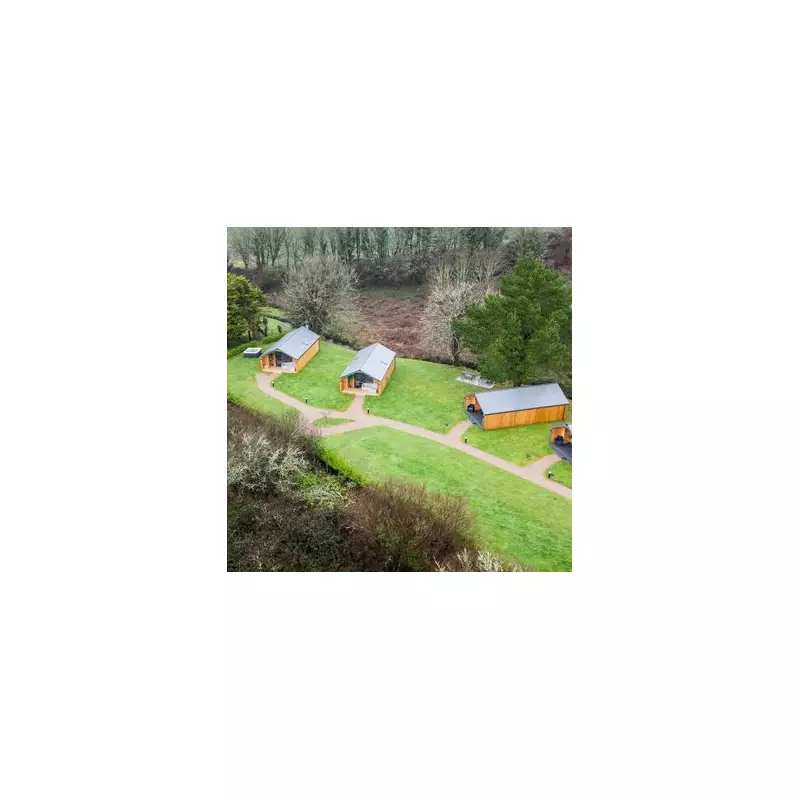
Cornwall Council has formally refused a controversial bid to keep a set of holiday cabins and other structures that were built in a property's garden without the necessary planning consent.
Unauthorised Development Faces Retrospective Refusal
The application was submitted by Ross Cheal for his property at Steamers Meadow in Angarrack, near Hayle. It sought permission to retain four holiday pods, a swimming pool, a gym and garage building, and an extended driveway, all of which were already in place. This type of request is known as a retrospective planning application.
The proposal also included keeping an annexe, which had been converted from a previously approved garage and studio, and requested a change of land use to residential to allow for a new detached garage.
The development, marketed as Riverside Retreats on Airbnb, has been operating and receiving positive reviews despite lacking authorisation. However, it faced strong opposition from Hayle Town Council and several neighbours, who described it as an unapproved "holiday park". The Environment Agency also lodged objections.
Flood Risk Grounds Lead to Council Rejection
On Thursday, January 15, Cornwall Council's planning department rejected the application. The primary reason for refusal was safety concerns related to flood risk.
A formal refusal notice stated that the site, which sits next to Angarrack Stream, is located within Environment Agency Flood Zones 2 and 3, the Hayle Critical Drainage Area, and areas susceptible to groundwater and sea flooding. Council mapping also identified it as being at risk from significant surface water flooding events.
The council concluded that the applicant had failed the 'sequential test', which requires developers to show that a project cannot be located in a lower flood risk area. The submitted Flood Risk Assessment was deemed inadequate, as it did not prove the development would be safe for its lifetime, would not increase flood risk elsewhere, or that a proper evacuation plan was in place.
The report noted that the "significant and unresolved harm arising from flood risk" was fundamental to the decision. It stated that any modest benefits of the scheme were outweighed by this danger.
Local Opposition and Potential Enforcement
Local residents voiced strong objections through the council's planning portal. One neighbour raised concerns about frequent sewage issues in the area since the holiday use began, questioning the adequacy of drainage systems.
The objector argued that the proposal sought to retrospectively approve a second dwelling and a holiday park, representing a significant unauthorised intensification of a residential plot. They warned that approval would set a worrying precedent for the area, impacting neighbours, wildlife, and the village's character.
Interestingly, the planning officer's report indicated that, aside from the flood risk, the holiday lodges themselves were considered an appropriate scale for the location and accessible by various transport modes. Other retrospective elements were also seen as acceptable in principle.
The council's decision now raises the question of whether enforcement action will be taken to remove the unauthorised structures. Cornwall Council has been approached for comment on its next steps regarding the site.