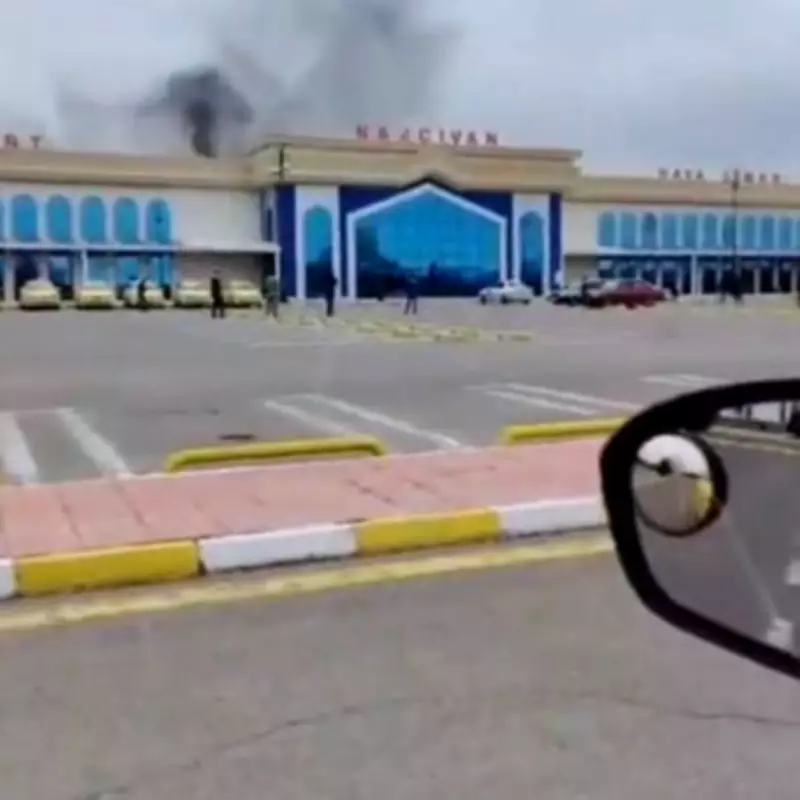
Azerbaijan Accuses Iran of Drone Attacks on Airport and School Area
Two individuals sustained injuries this morning after drones targeted Nakhchivan Airport in Azerbaijan, with a second explosive device detonating near a school in Shekarabad, according to the Azerbaijani Foreign Ministry. The incident has escalated regional tensions, with Azerbaijan explicitly blaming Iran for the assaults and issuing a stern warning of potential retaliation.
Details of the Drone Strikes
The terminal building at Nakhchivan International Airport was hit by a drone, causing thick black smoke to billow from the site. Initial reports indicate that the first drone missed its target, but the second successfully struck the airport. Simultaneously, another drone exploded in the vicinity of a school in Shekarabad, though no casualties were reported from that location. In response, local authorities have closed schools and suspended all flights from the airport as a precautionary measure.
Nakhchivan Airport is strategically located approximately six miles from the Iranian border and is also in close proximity to Turkey, a key ally of Azerbaijan. This geographical positioning has heightened concerns about the ongoing conflict involving Iran, which has seen increased bombing attacks by the US and Israel against Iranian military and security infrastructure.
Azerbaijan's Official Response and Regional Implications
In a strongly worded statement, the Azerbaijani Foreign Ministry condemned the drone strikes, asserting that such actions violate international law and contribute to rising tensions in the region. The ministry has summoned the Iranian ambassador to lodge a formal protest and emphasized that Azerbaijan reserves the right to take necessary retaliatory measures. Iran has not admitted to targeting Azerbaijan, but its drone attacks have spread unpredictably as the war escalates, affecting multiple countries in the region, including Saudi Arabia and Kuwait.
Nakhchivan is an exclave of Azerbaijan, separated from the main territory by a strip of Armenia about 25 miles wide, and constitutes around 6% of the country's land area. This territorial detachment adds complexity to the security situation, as the region is more vulnerable to external threats.
International Reactions and Diplomatic Efforts
The drone strikes have prompted swift international responses. France's Foreign Affairs Minister, Jean-Noel Barrot, spoke with his Iranian counterpart, condemning the attacks on neighboring countries and reiterating France's commitment to stability and de-escalation in the Middle East. Barrot also expressed ongoing concern about French nationals detained in Iran during the call.
Meanwhile, China has announced plans to dispatch its special envoy on Middle Eastern issues, Zhai Jun, to the region in the near future to assist in reducing tensions. Chinese Foreign Ministry spokesperson Mao Ning highlighted that since the onset of the Iran war, China has engaged in intensive mediation efforts, including telephone discussions between Foreign Minister Wang Yi and counterparts from Russia, Iran, Oman, France, Israel, Saudi Arabia, and the United Arab Emirates.
As the situation develops, the international community watches closely, with calls for diplomatic dialogue and adherence to international law growing louder. The drone attacks on Azerbaijan mark a significant escalation in the regional conflict, underscoring the urgent need for peaceful resolution and stability in the Middle East.