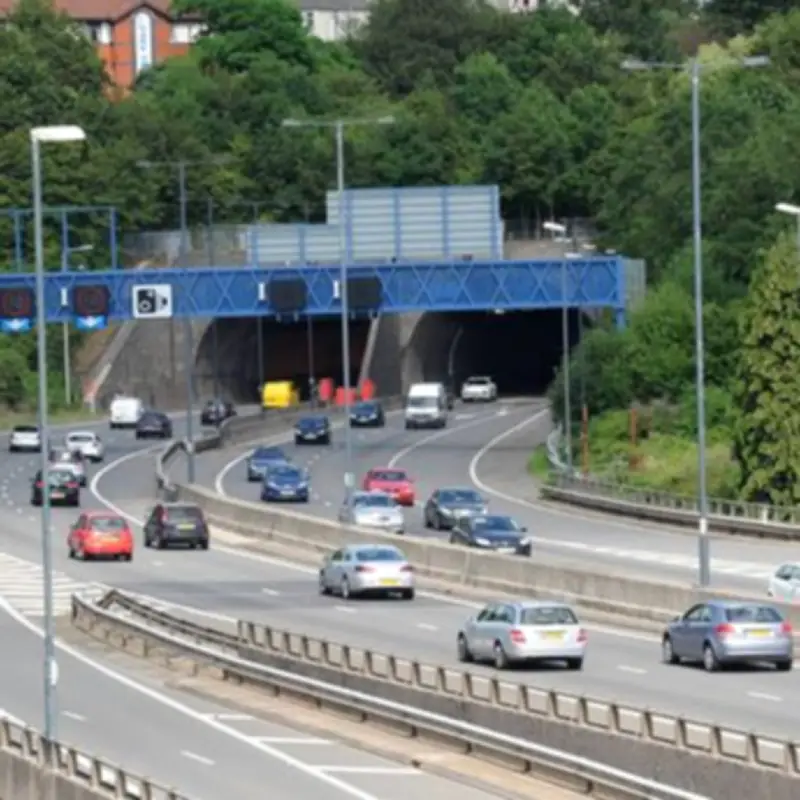
Traffic congestion at the Brynglas Tunnels on the M4 near Newport has once again become a pressing issue. In 2021, the Welsh Government established the Transport Commission on congestion in south-east Wales, chaired by Lord Burns, with a team of highly respected transport professionals. The commission recommended a series of public-transport-led solutions, though some road-based options could be considered.
First Minister's Stance
Rhun ap Iorwerth, the new First Minister, has indicated he will examine road-based means of relieving congestion, including the 'Blue Route'. This columnist authored the Blue Route report, published by the Institute of Welsh Affairs and the Chartered Institute of Logistics and Transport in 2013, as an alternative road solution when it became clear that the Welsh Government's 'Black Route' option—a new six-lane motorway across parts of the Gwent Levels—was unacceptable on cost and environmental grounds.
Cost Comparison
The Black Route is currently estimated at £2.5 billion (£936 million in 2013), compared with the Blue Route at £1 billion (£380 million in 2013). Congestion is mainly during peak working-day periods, largely due to work and school travel. This provides an opportunity for public transport to be the solution, possibly with a Brynglas Tunnel bypass if necessary.
Environmental Support
The Blue Route had the support of environmental groups, including Friends of the Earth Cymru, as it uses the existing A48/A4810 road footprint. It upgrades the A48 Newport Southern Distributor Road from the M4 (J28) to Queen's Meadow and the A4810, running parallel to and south of the Llanwern steelworks site—now a major housing development with a 'Burns Report' railway station. It would rejoin the M4 at J23A Magor Services.
This would be less disruptive than option C in the then government's plan, which built on the footprint of the A48 (at J28) to the M4 (J24)—the already congested Coldra interchange—passing through a large established housing area at Ringland.
Traffic Diversion and Construction
The Blue Route was expected to divert 15% of traffic from the M4, sufficient to reduce congestion during peak periods, by constructing overbridges at intersections to achieve free-flowing traffic. This could be built incrementally, prioritising the most congested junctions, thus spreading the cost over several years.
There is an argument that a new motorway would form a grand entry into Wales. However, it will not solve the congestion problem. Research has shown that added capacity on a route leads to extra traffic and creates environmental damage along that route and adjacent land. This may not only destroy habitats and green spaces but also homes and gardens.
Public Transport Focus
It is not easy to persuade car users onto public transport, but that must be the policy direction for overcrowded roads in south-east Wales. The Burns report delivery unit in Welsh Government has developed plans for stations in the Burns plan, together with adequate park-and-ride facilities and ride-on bus connections. The new tram-trains serving north of Cardiff commuters from later this year will show how effective such high-quality improvements can be.
Rail Infrastructure Responsibility
As owners of the rail infrastructure in Wales (excluding Core Valley Lines north of Cardiff), the UK Department for Transport is responsible for funding track and station enhancements, as well as maintenance through Network Rail. This has so far not been forthcoming for the 'Burns' stations, and only small funding percentages in Valley Lines electrification and Cardiff Central reformation costs. This again shows how reasonable is the 'ask' from Welsh Government for responsibility for rail infrastructure and Barnett consequential funding from HM Treasury.
Bus Lanes and Alternatives
The development of more bus lanes and bus roads will make journey times by bus more attractive than the car. Prior to the introduction of trams in Dublin, the dual-carriageway road between south Dublin and the city centre during peak periods had one lane for buses only. Introduced in the 1980s, its success was evident because the journey time to and from the city centre by bus was less than in the overcrowded car lane.
However, the First Minister, in looking for road solutions, might find one nearer home. The Menai Straits currently has two road crossings between Ynys Môn (his home territory) and the mainland. One of these, designed by Thomas Telford (1826), can take limited traffic, and a third crossing from the A55 is urgently required. Perhaps north Wales' A55 expressway has a better case for road construction than the already highly transport-invested south-east Wales.
Professor Stuart Cole CBE is Emeritus Professor of Transport (Economics and Policy), University of South Wales.